Every summer, cownose rays stream into Chesapeake Bay to mate and give birth to their pups. When autumn comes, they disappear—presumably to migrate south, but no one knew for certain where they spent the winter. Now, after a three-year tagging study published Aug. 23 and led by the Smithsonian Environmental Research Center (SERC), scientists have solved the mystery. Cownose rays all along the Atlantic winter near Cape Canaveral, Florida, and it’s likely they return to the same spots each summer. Click to continue »
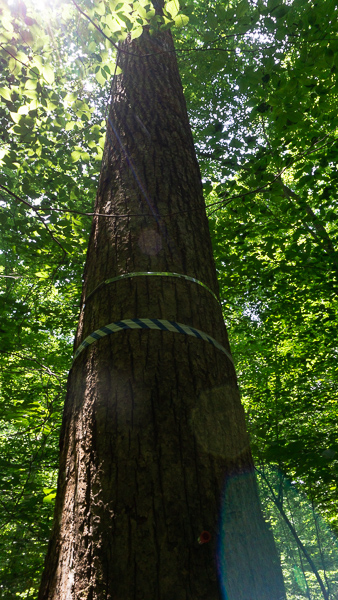
Even healthy trees in the forest, like this tulip poplar, might be producing methane.
Until a decade ago, scientists believed forests were ravenous consumers of methane, a potent greenhouse gas. But we’re discovering that the story is more complicated. It turns out that while forest soils absorb methane, trees might actually release the gas. The problem is, no one is sure how much methane the trees are producing, or why they’re producing it at all.
“We’ve seen anything from 5 percent to 100 percent offset,” says Paul Brewer, a postdoctoral fellow at the Smithsonian Environmental Research Center (SERC). That’s an enormous amount of uncertainty: The forest could be consuming as much methane as we once thought (almost all of it), or barely any at all.
SERC Intern Helps Pin Down Numbers
Maddie Peterson, an intern working for Brewer at the SERC Biogeochemistry Lab, is spending her summer trying to pin these numbers down.
She’s working to solve two questions. First, how much methane is an average tree releasing? And second, why is it doing so at all?
“The big question,” says Peterson, “is whether the trees are acting as straws” – siphoning methane up from deep in the earth – “or incubators” – cradling methane-producing bacteria in their trunks. Answering these questions will help scientists understand how methane moves in and out of the atmosphere, which is critical for predicting the course of climate change. Click to continue »
Posted in Climate Change, Interns | Comments Off on How’s a Tree like a Cradle and a Straw? SERC Intern Studies Forest Methane Emissions
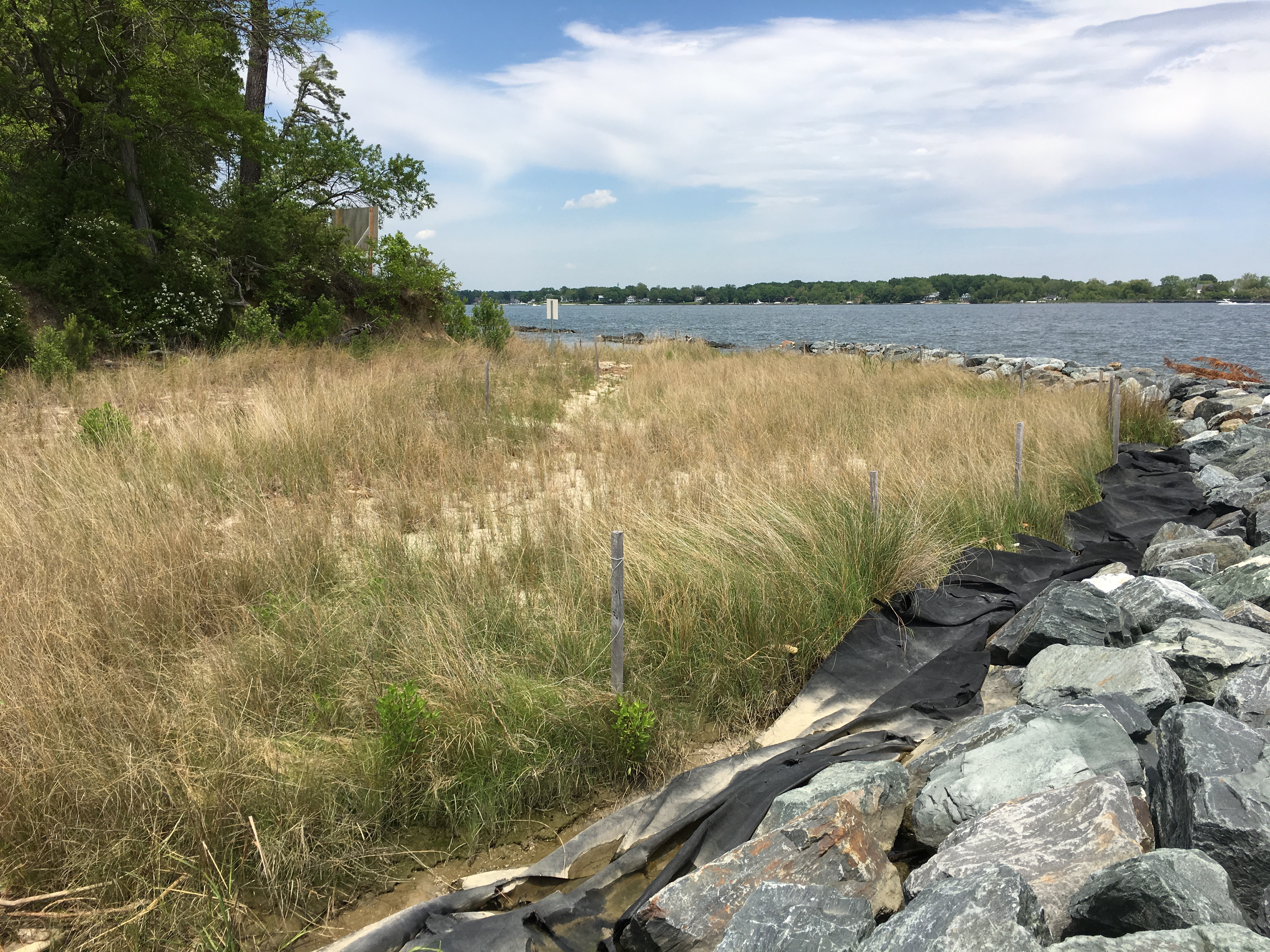
If you were to unravel the Chesapeake Bay shoreline, to smooth out every river mouth and tidal basin, it would stretch from New Jersey to Miami. This twisted shoreline, and the marsh behind it, is part of what makes the Chesapeake so productive: It’s an entire universe for young fish and crabs, a constellation of places to hide when soft and feed when hungry.
A living shoreline at SERC’s Cheston Point. (Credit: SERC)
And it’s disappearing quickly. Anywhere from half a foot to 10 feet of Chesapeake marsh erode every year, depending on which shoreline you’re standing on. Lost marshes mean lost habitat for migratory birds, molting crabs, and young rockfish. Hundreds of islands have disappeared from the Chesapeake Bay in the last century, leaving behind tidal mudflats, sandbars, or open water.
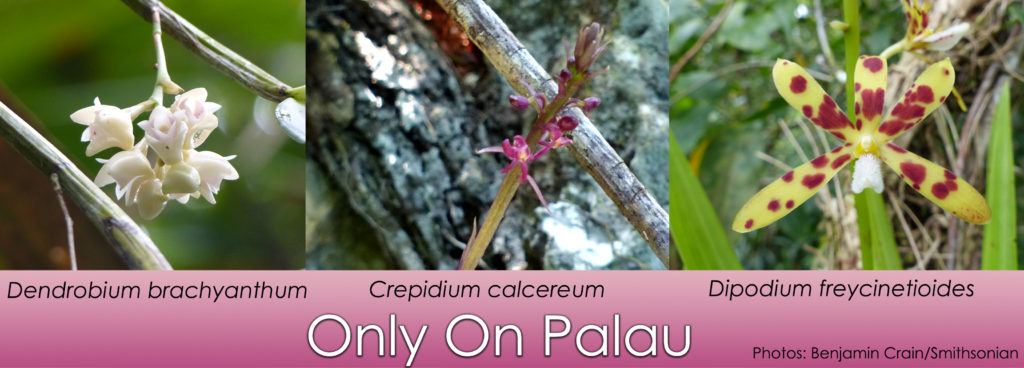
Most visitors to Palau don’t come for its forests. The chain of 300-plus Pacific islands is more famous for its coral reefs, giant rays and hundreds of flamboyantly-colored fish species.
“It’s known as one of the top dive sites on the planet,” said Benjamin Crain, a postdoc at the Smithsonian Environmental Research Center (SERC). Crain is the exception. He’s visited Palau twice in the last year. Naturally fair-skinned, with a dark blond beard and ponytail, Crain has earned plenty of suntans and callouses trekking across the islands’ uneven terrain. He was seeking some of Palau’s forgotten gems on land—its rich diversity of orchids. Click to continue »
Maya Bhalla-Ladd, who is beginning her second summer as an intern at the Smithsonian Environmental Research Center (SERC), didn’t think growing up that she would be a scientist. “In high school, I spent all my time on ballet,” she says. “I danced professionally. I lived on my own in New York.”
But when health problems forced her to turn away from ballet, she found herself drawn to the ocean. “I remember going to the aquarium as a kid and watching the rays,” she says. “The way they move is very naturally beautiful. So when I stopped being able to dance, I wanted to spend the rest of my life preserving that kind of natural beauty for other people to enjoy.”
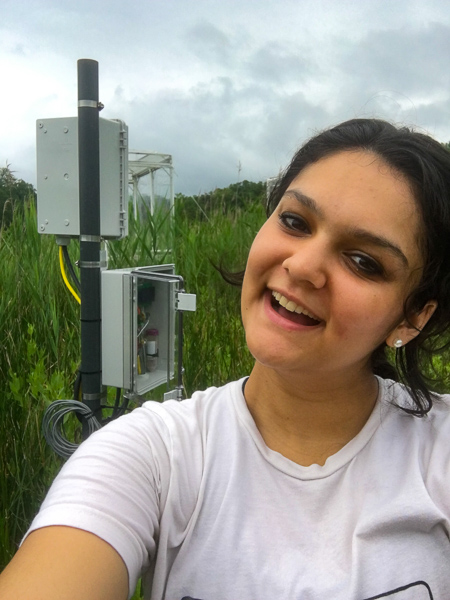
Maya with a hand-crafted temperature sensor! (Maya Bhalla-Ladd/SERC)
Maya spent last summer at SERC’s Global Change Research Wetland (GCREW), investigating how climate change could affect photosynthesis in marsh plants. While there, she became fascinated with a tool used to measure photosynthesis in leaves. The tool seals a single leaf in a chamber and exposes it to light, causing the leaf to begin photosynthesis. It can then measure the precise gas composition of the chamber as the plant produces sugar. In effect, it can watch the plant breathe.
“I think that the instrumentation that enables science is so cool, and that we don’t spend enough time thinking about it,” Maya says. Click to continue »
Posted in Climate Change, Interns | Comments Off on Wiring the Marsh: Intern Helps Build the Wetland of the Future
Think back to your early childhood science classes. Was there
ever a time you had to watch a plant grow? Your first natural sciences teacher may have used plant growth to explain basic concepts of plant biology. The process is a rewarding learning experience for students to observe their hard work pay off as those first few leaves sprout from the soil.
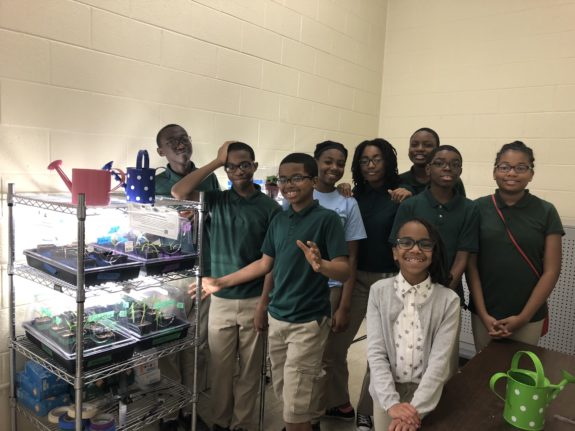
Walker Mill Middle School sixth-grade students and their orchid experiments. (Credit: Hannah-Marie Garcia/SERC)
Now, imagine the work you did was part of a larger scientific project, with real-world applications. That is exactly what four sixth-grade classes are doing this year at Walker Mill Middle School. Located in a Capitol Heights neighborhood of the Prince George’s County school system, Walker Mill is one of seven schools in the Maryland area working with the Smithsonian Environmental Research Center (SERC) on a project called “Orchids in Classrooms.”
Don’t panic. The new robot greeting visitors at the Reed Education Center isn’t about to stage a technological coup over the SERC campus. But it can pose for selfies, tell people about SERC programs and break out a dance move or two.
The robot goes by the name Pepper. Technically, Pepper has no gender, though most visitors—and a few staff—have taken to calling the robot “she” by default. The Smithsonian received a team of Pepper robots in February from SoftBank Robotics, to test out in their museums and other programs. Two Peppers went to the Smithsonian Environmental Research Center (SERC), where staff and students are programming them to interact with the public. Click to continue »
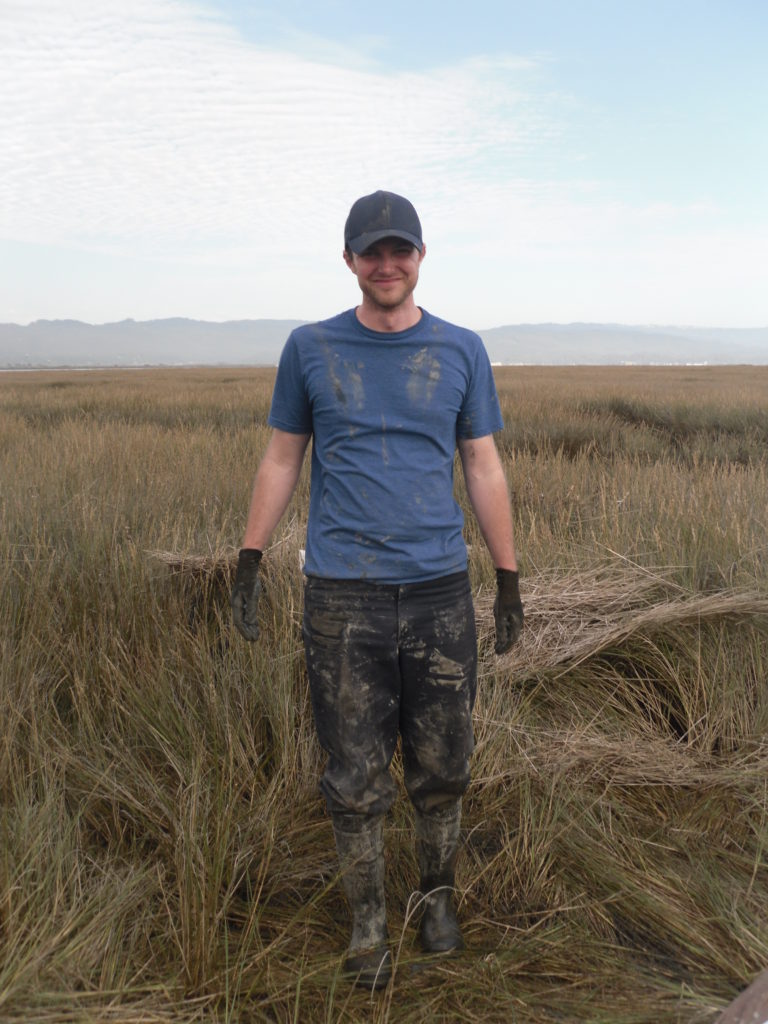
Smithsonian ecologist James Holmquist explores a wetland in Humboldt Bay, California. (Credit: Lauren Brown)
It’s a true story of “grassroots science.” A team of over two dozen researchers set out to estimate how much carbon tidal wetlands across the U.S. can store. But the official datasets didn’t give them much info to work with. So they pooled their resources, creating a new dataset of nearly 2,000 wetland soil cores.
Their final estimate: Nearly 800 million tons of carbon may lie buried in the tidal wetlands of the contiguous U.S. The team published the discovery June 21, in a new study in Scientific Reports led by the Smithsonian Environmental Research Center. The study also leaves another major legacy. The 1,959 soil cores they compiled could help finally unlock some secrets of wetlands, ecosystems that have been overlooked for centuries.
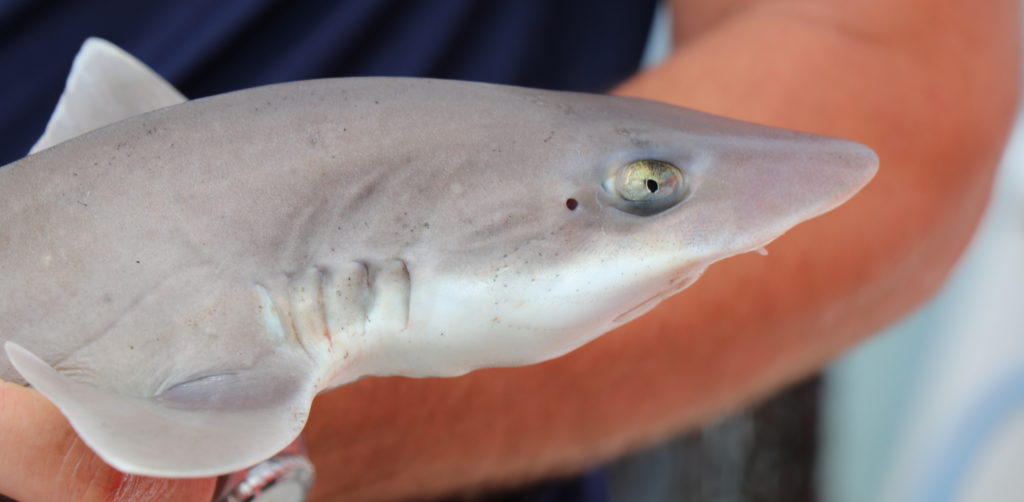
Smooth dogfish shark (Mustelus canis), one of four species Smithsonian scientists are tagging and tracking along the Atlantic. (Mollie McNeel)
Sharks. They’re everyone’s favorite underwater enemy. Between nerve-wracking dramas like Jaws to stories about prehistoric mega-sharks, we have all but made the shark species a completely fictionalized being. But scientists at the Smithsonian Environmental Research Center (SERC) are hoping to change that.
Charles “Chuck” Bangley, a marine ecologist at SERC, travels up and down the East Coast catching and tagging four species of sharks found in the Chesapeake Bay and along the Atlantic: smooth dogfish sharks (Mustelus canis), bull sharks (Carcharhinus leucas), blacktip sharks (Carcharhinus limbatus) and dusky sharks (Carcharhinus obscurus).
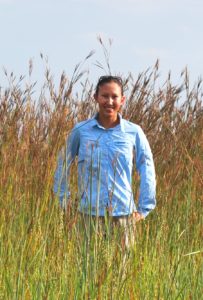
Kim Komatsu stands in a grassland at Konza Prairie Biological Station, in Manhattan, Kansas. (Credit: Cynthia Chang)
by Kim Komatsu,
ecosystem conservation ecologist
One of the unexpected perks of my life as a scientist has been the opportunity to travel for work. As a grassland ecologist, my studies have taken me to South Africa and Tanzania to investigate the roles of fire, grazing, and nutrient availability in determining plant growth and species diversity. In these exotic field sites, I would drive by impalas, zebras, elephants, giraffes, cheetahs, lions, and leopards before arriving at my experimental plots. Then I would spend my day working in the hot sun to survey the plant communities in my plots, all the while guarded by a park ranger with a loaded rifle to protect me from the very animals I marveled at on the way to the field site. (Thankfully those rifles were never fired during my trips.) With grasslands all over the world, I have many more grassland types on my research wish list, including the Mongolian steppes, the Pampas of South America, the Cerrado of Brazil, and the rangelands of Australia and Europe. Click to continue »

 Don’t panic. The new robot greeting visitors at the Reed Education Center isn’t about to stage a technological coup over the SERC campus. But it can pose for selfies, tell people about SERC programs and break out a dance move or two.