by Kiran Das-Goel
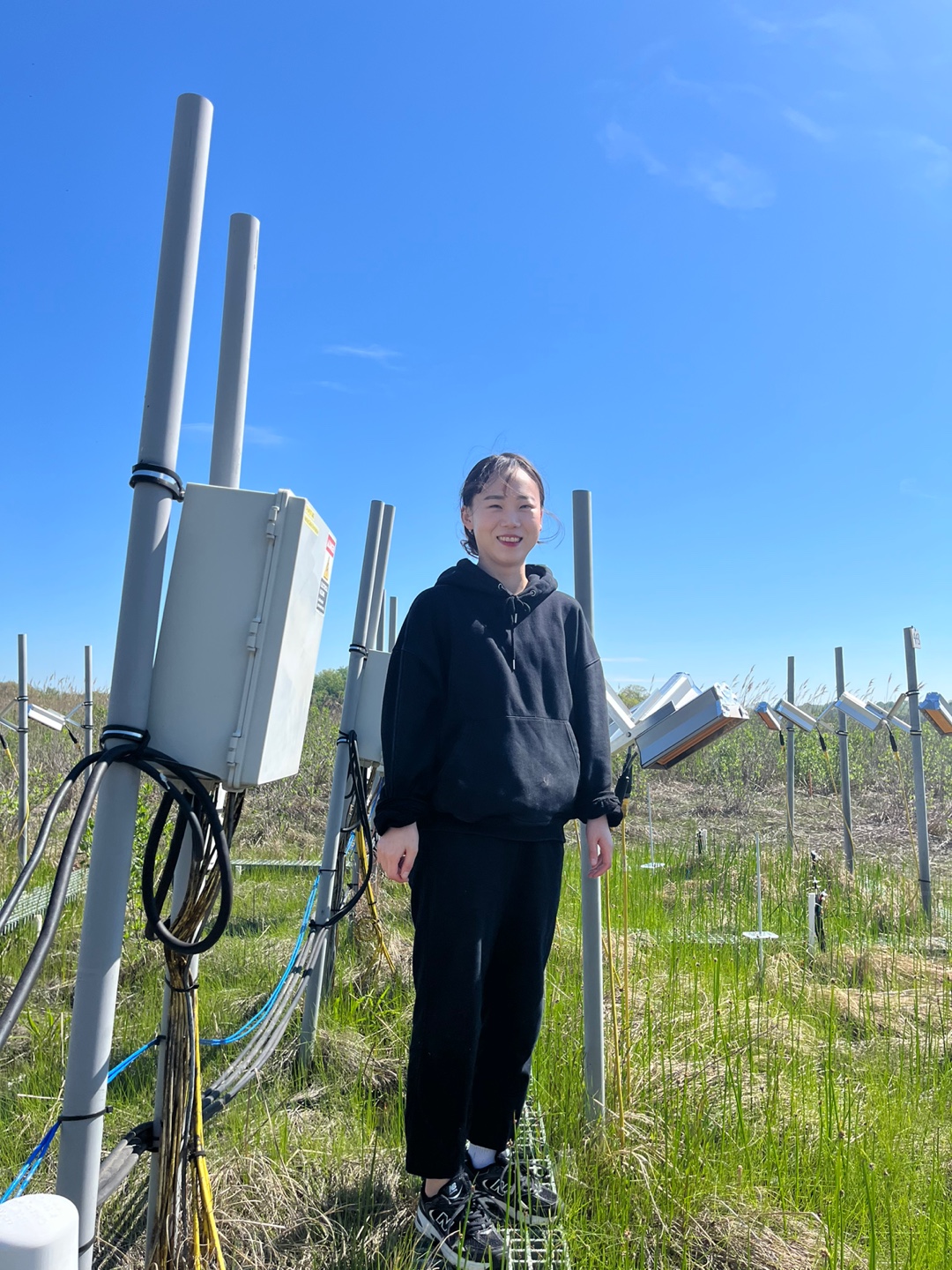
Leaves were changing, the sky was bright and nearly cloudless, and Yerang Yang was looking out into a glimpse of the future. Scientists had controlled the wetlands surrounding her for more than 40 years. In some plots, infrared lamps and underground wires heated the soil. In others, experimental chambers received extra carbon dioxide to simulate a ore carbon-rich atmosphere. Here, on the Global Change Research Wetland, the Smithsonian Environmental Research Center (SERC) was studying climate-driven changes across an entire ecosystem.
She had never seen climate experiments of such scale before.
“It left an impression on me,” said Yang. “I made myself a promise that someday I would build a site like that in Korea.”
Building Blocks
Enter: FReVIEW (or “Forest Response to Variability in Ecosystem Warming,” if you’ve got the time).
FReVIEW, a collaboration between the Korea Institute of Science and Technology (KIST) and SERC, is a large-scale, long-term forest warming experiment taking place in Seoul, capital of the Republic of Korea. Unlike previous climate experiments, it uses “pulse heating,” where plots of forest experience a more accurate version of climate change, complete with temperature spikes.
“In the future, there’s going to be more variability in temperature, which doesn’t give plants and microbes time to adapt,” said Jaehyun Lee, senior researcher at KIST and former postdoctoral fellow at SERC. Lee notes that when temperatures get too hot, plants stop performing photosynthesis. This could mean summer months where forests no longer take up carbon.
“Soils are a bit like a roller coaster where you put a bunch of energy in,” said Roy Rich, principal investigator of SERC’s Technology in Ecology Lab. There can be a lag between a heating event and the effect. Soils can stay warm even after temperatures return to normal. Experiments that don’t consider climate variability may not see these kinds of impacts.
I’m Putting Together a Team
Before FReVIEW, there was the Global Change Research Wetland (GCReW).
GCReW’s collection of experiments represents a boon to global change research, according to Rich. Each experiment tests different ecosystem-scale hypotheses on climate change. The oldest experiment is more than 40 years old, making it the longest-running experiment at SERC and one of the longest in the world.
GCReW is also where Lee and Yang first found their inspiration for FReVIEW.
Back in 2015, GCReW director Patrick Megonigal had tried twice and failed to get a grant to test higher temperatures and higher carbon dioxide in the same experiment. The problem? How to actually build the study. At a conference on warming, Megonigal found a research presenting a climate experiment similar to the one he envisioned.
“You’re in luck, because the guy that built this just moved to D.C., and he’s here,” said the presenter. “The guy” was ecologist turned environmental engineer Roy Rich, who would go on to design several of SERC’s futuristic experiments. He and Megonigal met for the first time in front of the poster and wrote a new grant together later that year.
Soon after, GCReW finally had its global warming experiment, to supplement its existing carbon dioxide experiments. It was complete with infrared heating lamps, underground heating pins and carbon dioxide chambers. Now the mechanics of GCReW are entirely designed and managed by Rich’s lab—part of what so impressed Lee and Yang.
“I told [Rich], I want to set up an experiment like this in Korea, and I want you to help me,” said Lee. “He happily agreed.”
At this point, FReVIEW included Yang, an expert in soil biogeochemistry and microbial ecology; Lee, a biogeochemist and soil ecology researcher; support from Megonigal, co-principal investigator Genevieve Noyce and SERC; and Lee’s team at KIST. With the addition of Rich, they had their engineer.
The team had assembled. It was time to start building the experiment.


Nuts and Bolts
One key difference between the two climate experiments: While the GCReW experiment in the U.S. tests wetland grasses and sedges, the Korea project will test forests.
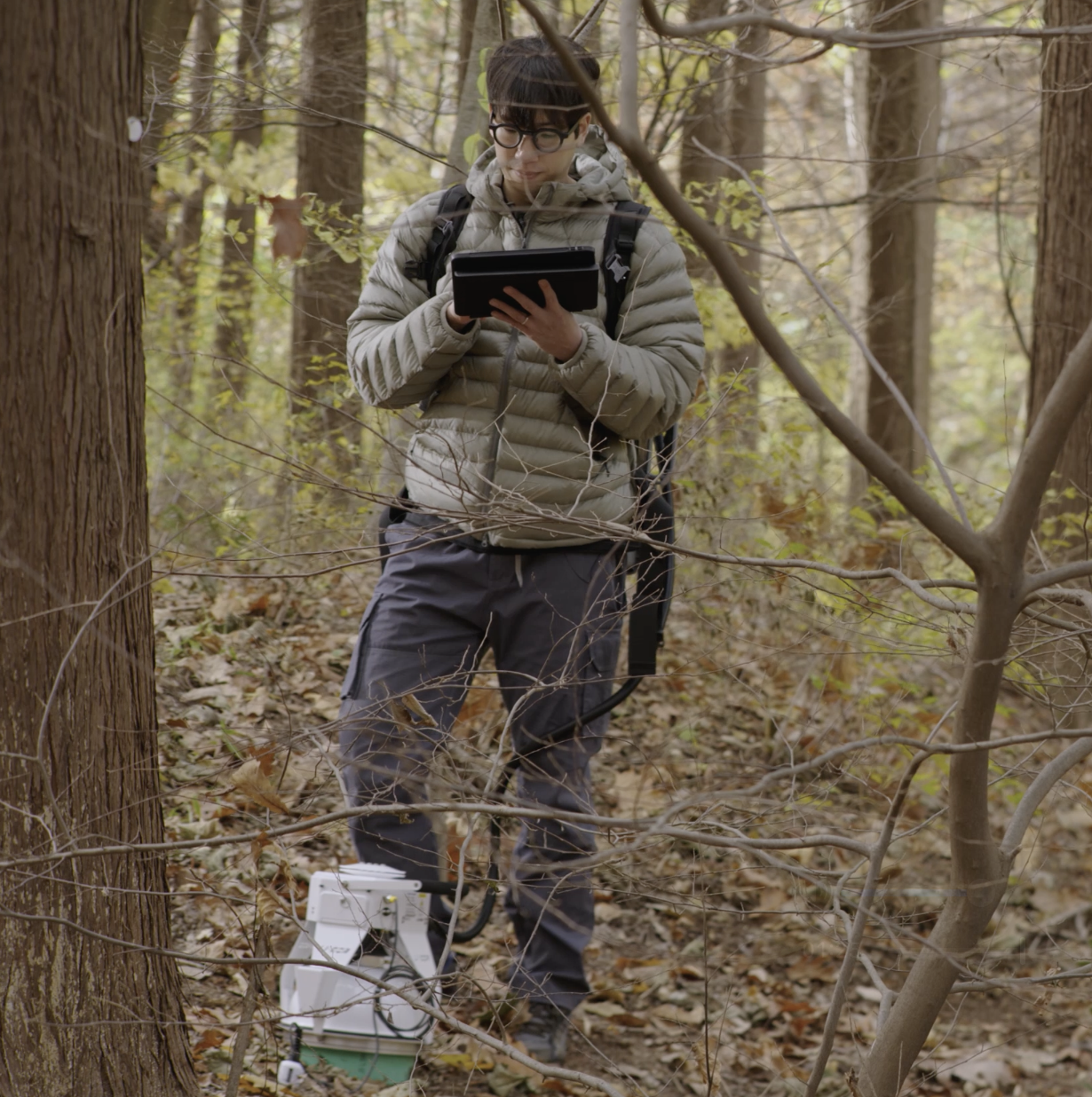
“I don’t even have plants in my house,” joked Lee. Planting seedlings for FReVIEW was Lee’s first exposure to tree management.
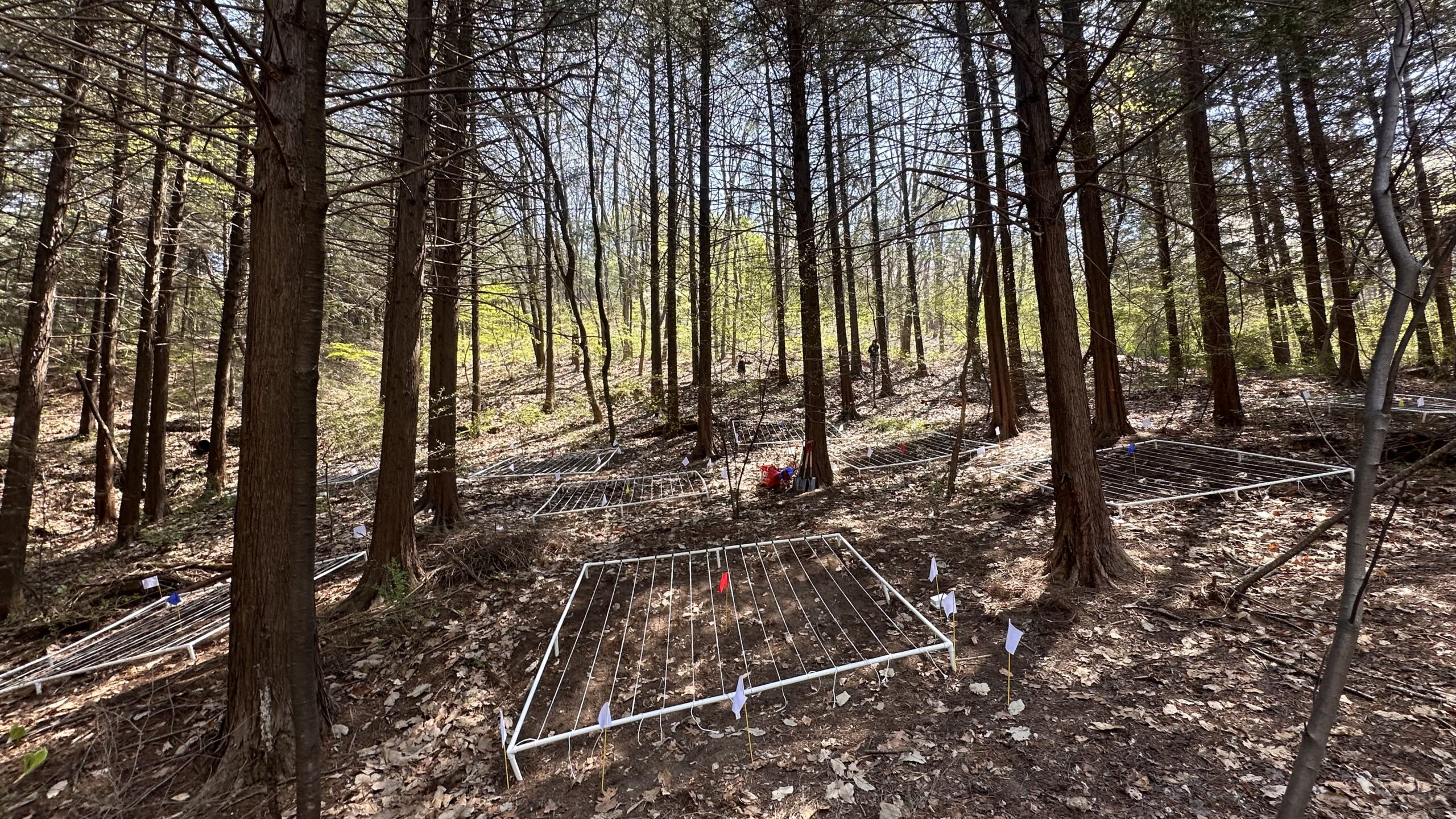
FReVIEW has nine forest plots, each with four different tree species, totaling 40 trees per plot. Three plots act as a control group, where nothing happens. Another three act as a traditional warming experiment—a press warming plot—where the soil is heated steadily. The last set of three is where the magic happens.
“When you were a little kid and you would flip the light switches on and off, that’s what we’re doing over a one-second interval,” said Rich.
Unlike the press warming plot, which will be consistently heated, the experimental one with have cold spells and heatwaves. At the end of a single month, both types of plots will add up to being 3.4°C hotter than the control—a temperature chosen to align with current climate projections. But the experimental plots will experience a mix of temperatures.
Both plot types reflect a warming world. But scientists believe the second version is a more accurate depiction of what can happen to a forest due to climate change. According to Lee, the resulting data can help create better carbon budget projections.
In addition, using four different species per plot lets the researchers consider climate resistance. The species are common commercial trees in Korea, but some might be more vulnerable to temperatures spikes than others.
“I hope this project helps close gaps, so we can make more accurate predictions and support policy that reflects what’s really happening,” said Yang.
Going Global
FReVIEW isn’t the only climate experiment inspired by GCReW.
Grace Cott, a postdoctoral researcher from Ireland, came to SERC to learn about the technology behind their climate experiments. Peter Müller, another postdoctoral researcher and friend of Lee’s, is working with Rich on his own experiment in Germany. Last year, Noyce and Rich started another experiment in the Brazil.
“SERC is kind of the center of this network,” said Lee. Ideally, former fellows that go on to design experiments in their home countries will be part of a shared database. The more data gathered from different regions, the more decisionmakers can plan for the specific ecological impacts of climate change.
“There’s a lot of information coming in,” said Rich.
GCReW was the start. FReVIEW is the next step. But that doesn’t make it the end of the story. GCReW continues to host researchers from around the world that may find themselves similarly inspired.
“It’s important to be an advocate for good science, and for people,” said Megonigal. “To be kind, to be warm, and to help promote them and their interests.”
Megonigal doesn’t consider his lab a key part of the current FReVIEW project. His role happened when Lee was still a postdoctoral researcher at SERC, talking through his ideas for a long-term climate manipulation experiment based on pulse warming. As with Yang, Cott, Müller and the many other researchers that have come through GCReW, Megonigal offered feedback.
“That’s a great idea,” he would tell them. The rest is history.

More Stories from the Global Change Research Wetland:
Hotter Temps Trigger Wetlands To Emit More Methane as Microbes Struggle To Keep Up
What’s the Perfect Temperature to Bake Your Soil?
Cranking Up the Heat in the ‘Wetland of the Future’

