New study helps restorations pin down how much nitrogen their local mangroves can bury
by Kiran Das-Goel
Mangroves tell stories. Some tell of defending shorelines from rising waters and extreme weather, or sheltering young marine life at its most vulnerable stages. Others whisper of vast amounts of carbon stored in their soils, known as blue carbon.
But one story has flown under the radar. While mangroves are famous carbon-storing powerhouses, their ability to store nitrogen—an element with more local impacts—has rarely received the limelight.
A recent study shows mangroves play an important role in burying nitrogen.
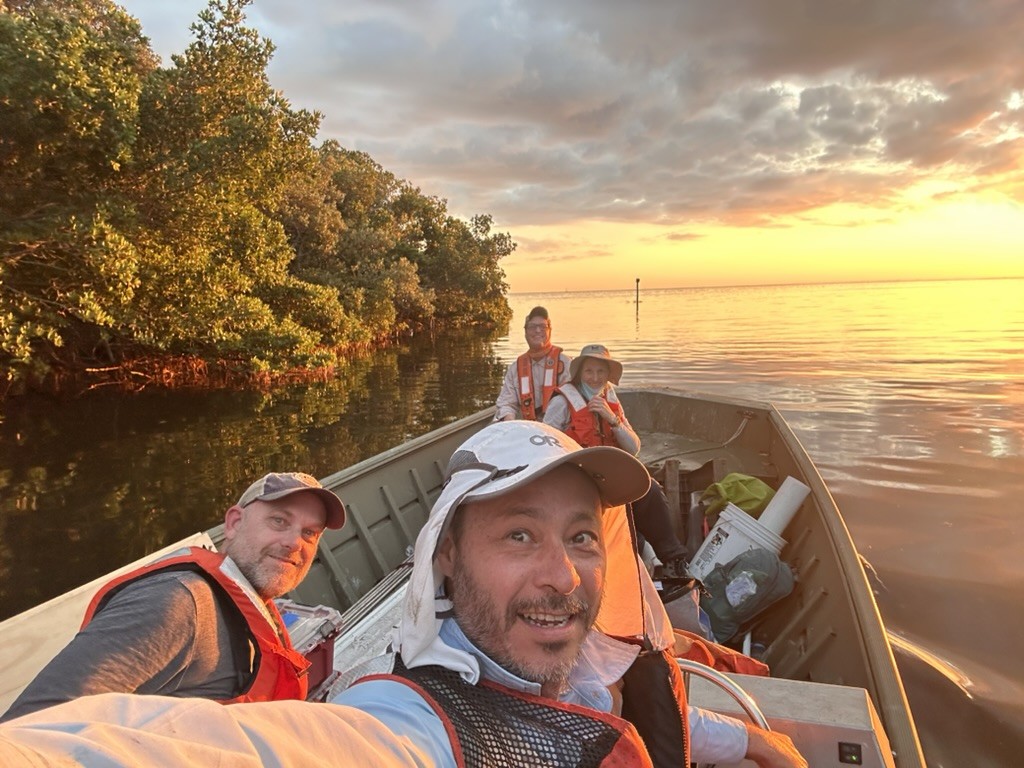
Andre Rovai and colleagues on field work in Florida studying mangroves (Credit: Andre Rovai) Click to continue »
From bourbon barrels to sea battles, white oaks are among the most significant trees in American history – and they need our help.
by Wes Melker
SERC’s 274-year-old white oak tree. (Credit: John Parker / SERC)
One could say that the white oak is “as American as apple pie.” The problem is that apples aren’t exclusive to the United States, and pies were first baked by ancient Egyptians. To make the expression accurate, you’d need a food so patriotic that it could not be produced anywhere else in the world. As luck would have it, bourbon fits the bill, and we have the white oak to thank for it.
In 1963, Congress legally designated bourbon as a distinctive product of the United States. They laid out a unique set of production standards to ensure this would never change. The most important of these rules is that the spirit must be stored in fresh white oak barrels, which are charred before use. The burnt wood provides the spirit’s unique flavor and qualifies it as true bourbon. Without white oak, it’s just whiskey.
The United States wouldn’t be the same without white oaks either. Americans have put their trust (and sometimes their lives) in the hands of this tree for 250 years and counting. It’s a mainstay in our nation’s history in ways that you might not expect. In fact, one of the Smithsonian’s research organizations, the Smithsonian Environmental Research Center in Maryland, may have never come into existence without it. Simply put, the white oak’s laurels are long overdue.
They come in a hundred different forms, as creatures from all over the world take up residence in the marine ecosystems of the United States. Some are brought by ships, others by storms. For millions of years, temperature served as a natural barrier for species. But the current warming world encourages the spread of marine invaders.
Scientists like those at the Smithsonian Environmental Research Center’s (SERC) Marine Invasions Research Lab are working hard to defend the coasts, by detecting and preventing new introductions. Here are eight of the most-wanted species on their radar today.
Since it would take up too much space to include every high-profile marine invader, let us know in the comments if you have a favorite (or least favorite) aquatic invasive species!
Marine Invasions Lab biologist Linda McCann studies fouling communities in California. (Credit: Gail Ashton / SERC)Click to continue »
Imani Black is the founder and CEO of Minorities in Aquaculture, a nonprofit dedicated to helping people in underrepresented communities establish themselves in the seafood industry. Her passion for aquaculture is rooted in coastal Maryland, where her family has worked on the water for over 200 years. Her June 16 webinar at the Smithsonian Environmental Research Center, “Seafood 101,” aims to clear up misconceptions about the aquaculture industry and teach consumers to make informed seafood purchases. In anticipation of her talk, we sat down with Black for a Q&A on her nonprofit, sustainability and the future of the seafood industry. Edited for brevity and clarity.
How did growing up on the coast of Maryland fuel your interest in aquaculture?
Growing up in a coastal community, I think it really just gets ingrained into your DNA. Some of us get bit by the bug and want to stick with it, and I’m a product of that.
Coral reef at Laughing Bird Caye, Belize (Credit: Leah Harper)
In the warming oceans of the Caribbean Sea, restorationists plant 10,000 fast-growing corals by cementing them to the limestone seafloor. The goal is simple: Rebuild the reef quickly and efficiently. The coral takes off, and a year after the project, the planters report that it’s a success. Yet several years later, the new reef is gone.
Scenarios like the one above are not uncommon for conservationists working to save corals. Almost one third of all coral restorations fail eventually, either by failing to attract reef-dwelling species or collapsing entirely due to high mortality rates.
Harper recently co-authored a new paper on coral restorations. The article, published in PLOS One, suggests a new approach: Treat restorations like science experiments.
Allie Blanchette conducts research on river herring (Credit: Henry Legett)
Allie Blanchette joined the Smithsonian Environmental Research Center (SERC) in November 2025, after completing her Ph.D. in biology with a focus on coral reef ecology at Florida State University. Now, as a postdoc in SERC’s Fisheries Conservation Lab, she is heading a project to study recreational fisheries in the Chesapeake, like bluefish and sheepshead. In this Q&A, Blanchette shares stories about what sparked her interest in marine ecology and how that led to her research in shallow marine ecosystems throughout the world. Edited for brevity and clarity.
What first sparked your interest in marine ecology?
I was always interested in environmental science, and I think marine biology is one of those things that everyone loves. I tried out an internship in college with the South African Shark Conservancy, and it was a done deal after that…The shark internship started it, and ever since then I’ve been hooked.
Hannah Morrissette in the mangroves of Belize (Credit: Steve Crooks / Silvestrum Climate Associates)
Blue carbon is the carbon captured by coastal and marine ecosystems, like mangroves, marshes and seagrass beds. These overachieving ecosystems also provide vital habitat for animals, protect the coast from storms, support livelihoods and improve water quality. When left undisturbed, blue carbon can remain sequestered for thousands of years. Based on this ability to remove carbon from the atmosphere, conserving and restoring coastal wetlands has become a popular “nature-based solution” where protecting these ecosystems can help mitigate the effects of climate change.
In a recent paper published by Nature Ecology and Evolution, 30 scientists from around the world considered what’s next for blue carbon, especially the vital role of local communities and traditional knowledge. The team included three scientists from the Smithsonian Environmental Research Center (SERC): Hannah Morrissette, Pat Megonigal and Andre Rovai.
Morrissette found her love for mangroves in the Dominican Republic while working with local communities. Recently, she became the new principal investigator of SERC’s Marine Conservation Lab. In this Q&A, we sat down with Morrissette to learn more about blue carbon and the role local and traditional ecological knowledge plays in her research. Edited for brevity and clarity.
Posted in Climate Change, Interviews, Mangroves, Publications | Comments Off on Hannah Morrissette: Traditional Ecological Knowledge, Blue Carbon and the Quest to Make a More Resilient World
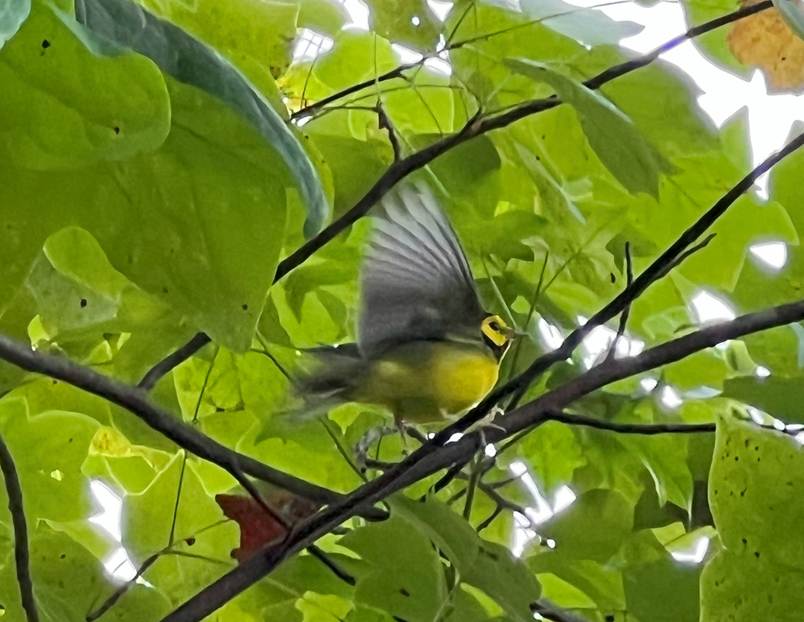
A hooded warbler lands on a branch in BiodiversiTREE (Credit: Eriberto Osorio)
Alongside Chesapeake Bay, a young forest is growing.
BiodiversiTREE isn’t like other reforestation attempts. Instead of planting a single species, the project includes 16 different species and roughly 17,000 trees. Many of these multi-layered canopies increase shade and enhance cooling effects—great news for birds, which may use cooler plots as a refuge from warmer temperatures, according to a new study.
“You experience this yourself,” said Justin Nowakowski, senior scientist at the Smithsonian Environmental Research Center (SERC). “On a hot day, you’d rather spend more of your time under the shade of a tree than baking in the sun. The same goes for many species.”
Smithsonian Study Finds Juvenile Crabs Rely on Shrinking Shallow-Water Habitats To Escape Cannibalism by Adults
by Kristen Goodhue
An adult male blue crab attempts to cannibalize a smaller blue crab on a tether. (Credit: SERC Fisheries Conservation Lab)
The Chesapeake Bay’s most popular crustacean has a dark streak. Cannibalism is the No. 1 killer of juvenile blue crabs in mid-salinity waters where they are known to congregate, according to a new study from the Smithsonian Environmental Research Center (SERC), published March 16 in Proceedings of the National Academy of Sciences. But shallow waters can offer a vital refuge.
Blue crabs lead a life on the run. After spending roughly two months as larvae in the ocean, they are swept back into the lower bay to morph into juvenile crabs. There, the juveniles rely on seagrass to provide partial refuge from predatory fish like striped bass. But after growing to about 1 inch, many migrate up the bay to mid-salinities, where fish and seagrasses are scarcer. There they face another enemy: larger blue crabs.
“Blue crabs are notoriously cannibalistic,” said Tuck Hines, marine biologist and director emeritus of SERC. But although cannibalism is common throughout aquatic ecosystems, he added, long-term studies attempting to quantify it are rare. And the data could make a difference for managers trying to keep the blue crab fishery sustainable.
Sickle-leaved cymodocea seagrass (Thalassodendron ciliatum) in Zanzibar, Tanzania. (Credit: Ben Jones / Ocean Image Bank)
They’ve been called the “lungs of the sea.” And while certain marine microbes could also compete for that title, there’s no question that seagrasses are crucial for life on coastal lands and at sea. They provide oxygen, food, habitat and shoreline protection. But seagrasses are routinely overshadowed by flashier coral reefs or more charismatic marine animals.
“They’re just below the radar,” said Emmett Duffy, a marine scientist with the Smithsonian Environmental Research Center. “A lot of people don’t know what they are, don’t know that they’re important. They think it’s just something that gets tangled in your boat motor.”