New study helps restorations pin down how much nitrogen their local mangroves can bury
by Kiran Das-Goel
Mangroves tell stories. Some tell of defending shorelines from rising waters and extreme weather, or sheltering young marine life at its most vulnerable stages. Others whisper of vast amounts of carbon stored in their soils, known as blue carbon.
But one story has flown under the radar. While mangroves are famous carbon-storing powerhouses, their ability to store nitrogen—an element with more local impacts—has rarely received the limelight.
A recent study shows mangroves play an important role in burying nitrogen.
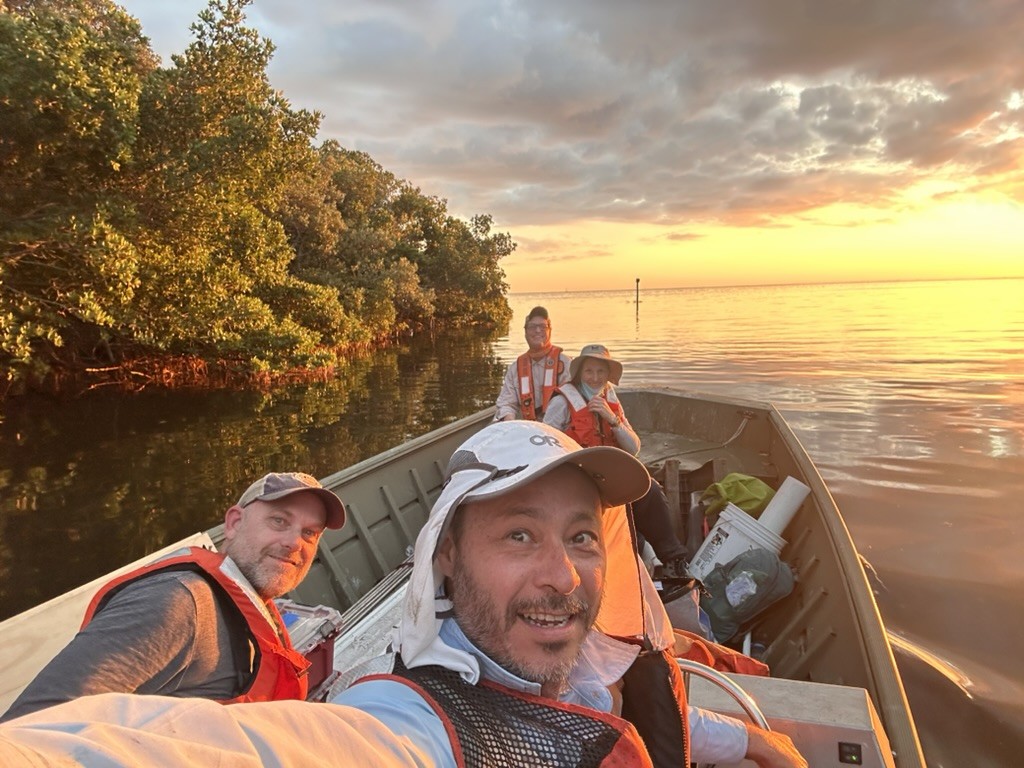
Andre Rovai and colleagues on field work in Florida studying mangroves (Credit: Andre Rovai) Click to continue »
Bluestriped grunts and gray snapper, two important subsistence fish in the Mesoamerican region, school in a marine sanctuary in Belize. (Credit: Claudio Contreras-Koob)
Around the world, an estimated 52.8 million people engage in subsistence fishing—the practice of fishing to feed one’s family and community, where most of the food stays local. As ocean temperatures rise, so do concerns about how this will impact the fish populations these communities depend on.
Subsistence fisheries are difficult to track, due to lower reporting of catch numbers compared to industrial fishing. Subsistence fish are also usually smaller species that aren’t as economically valuable. But they are vital to the food security of these communities.
“We want to know if the communities that depend on these fish as food sources will still have that resource under different, end-of-century climate scenarios,” said Cortese.
Olympia oysters in British Columbia (Credit: Erin Herder)
For many species, rising global temperatures will strain their ability to survive. However, a hotter climate might not be the end for one threatened species of oyster, according to a recent study.
The Olympia oyster is the only species of oyster native to the West Coast of North America. It was a staple in Native American diets in precolonial America, and became a major economic resource during industrialization. But its numbers took a hit in the early 20th century, thanks to pollution and overfishing.
New Study Offers First Look at Diet and Ecology of River Otters in Chesapeake Bay
by Kristen Goodhue
North American river otters have terrible hygiene when it comes to their food. They eat, play and defecate in the same place. But their unhealthy habits make them ideal for detecting future health threats in the environment, according to scientists. In a new study published Aug. 13, Smithsonian scientists analyzed the otters’ diets and “latrine” habitats in the Chesapeake Bay for the first time. They discovered river otters often eat food riddled with parasites—and that may not be a bad thing for the larger ecosystem.
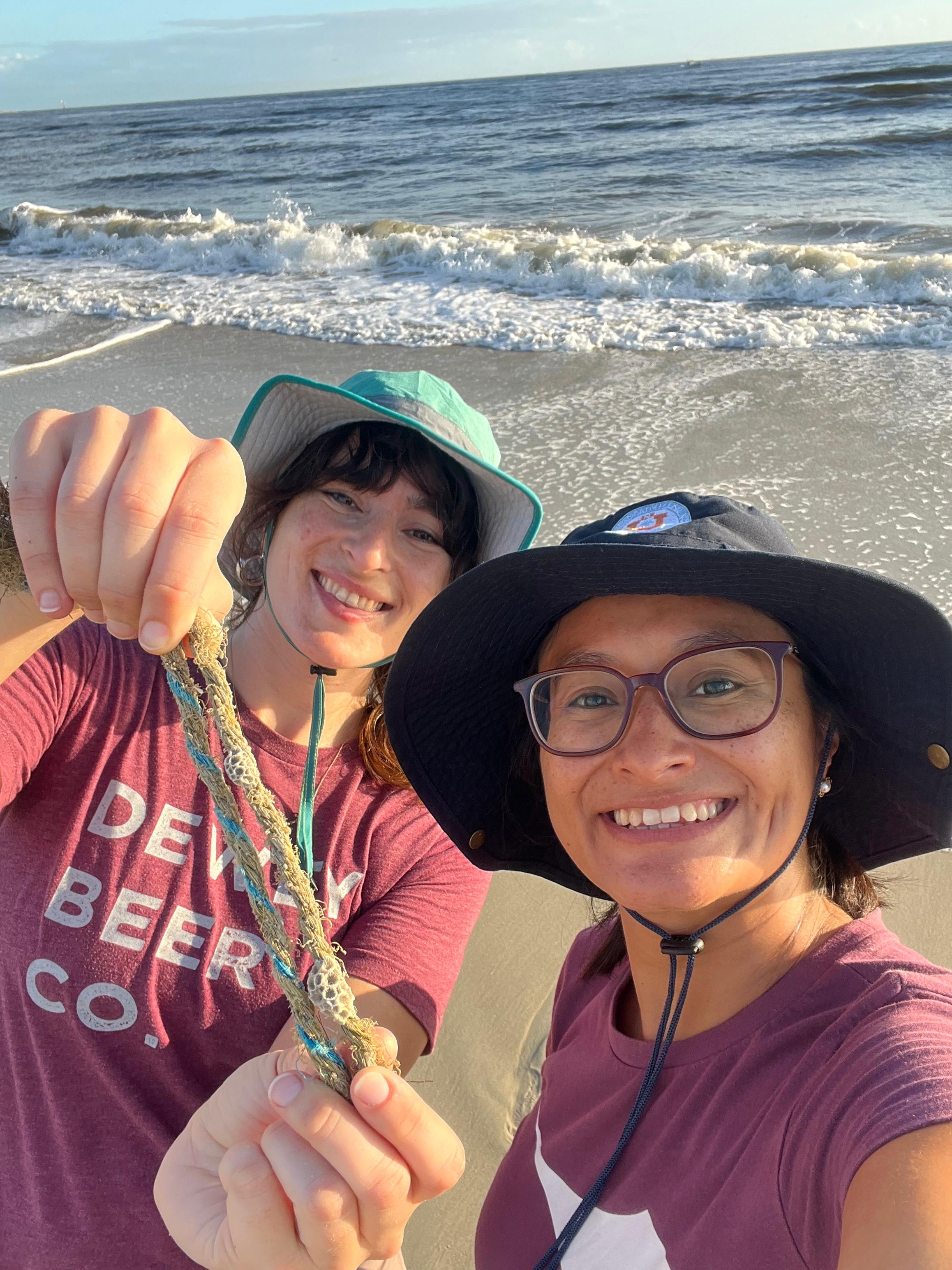
Diamela De Veer (left) and Ocean Travelers II intern Ninoshka Lopez collect a piece of litter with corals on it. (Credit: Ninoshka Lopez)
Many marine organisms, like barnacles, bryozoans and algae, spend their lives on other living creatures floating in the sea. But today, some of them are finding new homes to colonize: plastic pollution. Ocean Travelers is a participatory science project, where volunteers and scientists track marine organisms living on litter that washes ashore. Run by the Smithsonian Environmental Research Center (SERC), the project hopes to determine whether invasive species are spreading via litter in the ocean.
Marine biologists Martin Thiel, Jim Carlton and Greg Ruiz started the first Ocean Travelers at SERC in 2022. They wanted to understand what organisms were living on plastic in the ocean, and how far they were spreading. It was born of a collaboration between different programs around the world, including the Smithsonian-led MarineGEO that monitors the world’s coastal ecosystems and Científicos de la Basura, based out of Chile. Ocean Travelers I was a huge success, recruiting volunteers, local teachers and their students to collect samples on the beach with professional scientists.
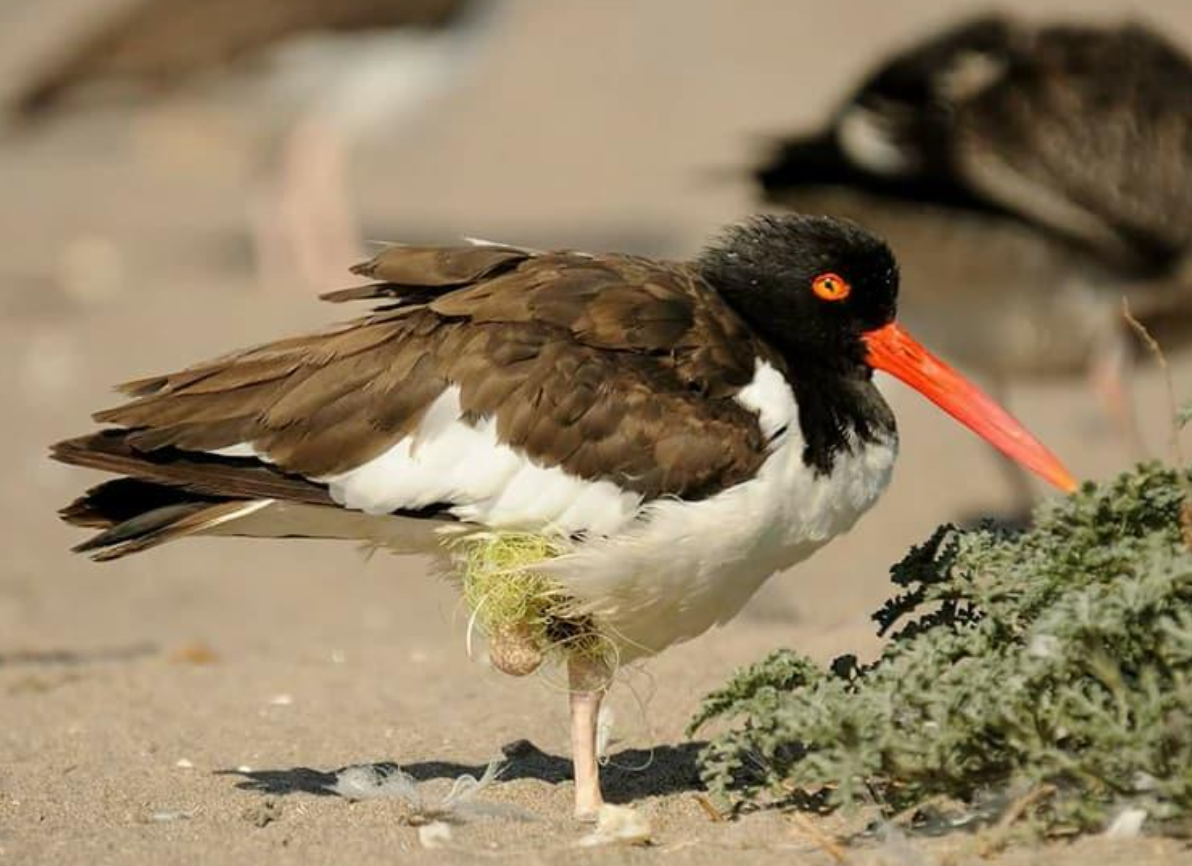
An American oystercatcher stands on the beach of the Elqui River in Chile. There is plastic netting tangled around one of its legs and it has lost the bottom part of the leg. (Credit: Pedro Valencia)
Plastic pollution in our ocean is growing daily. Scientists estimate 12 million U.S. tons of plastic enter the ocean every year, and it makes up 80% of all marine debris.
How can we hope to keep track of this vast amount of plastic, or detect any useful patterns to help get it under control? One way is to collect plastic samples using animals. Marine animals ingest plastic that has broken off from plastic trash and ends up in the ocean. Scientists can then measure how much of this plastic has accumulated in the bodies of these animals. Scientists have used this method for decades.
“Sampling microplastics can be challenging and expensive,” said Martin Thiel, a marine biologist at the Smithsonian Environmental Research Center (SERC). Thiel co-authored an article in Environmental Science Advances reviewing how scientists around the world use animals to study ocean plastic. Using animals, he said, allows scientists to more efficiently collect data. “It can tell us not only how many plastics are in the environment, but how the organisms are affected by this type of pollution.”
Here are some of the most popular animals scientists use for plastic pollution research.
by Patrick Megonigal, Associate Director of Research, Smithsonian Environmental Research Center. Originally published in The Conversation
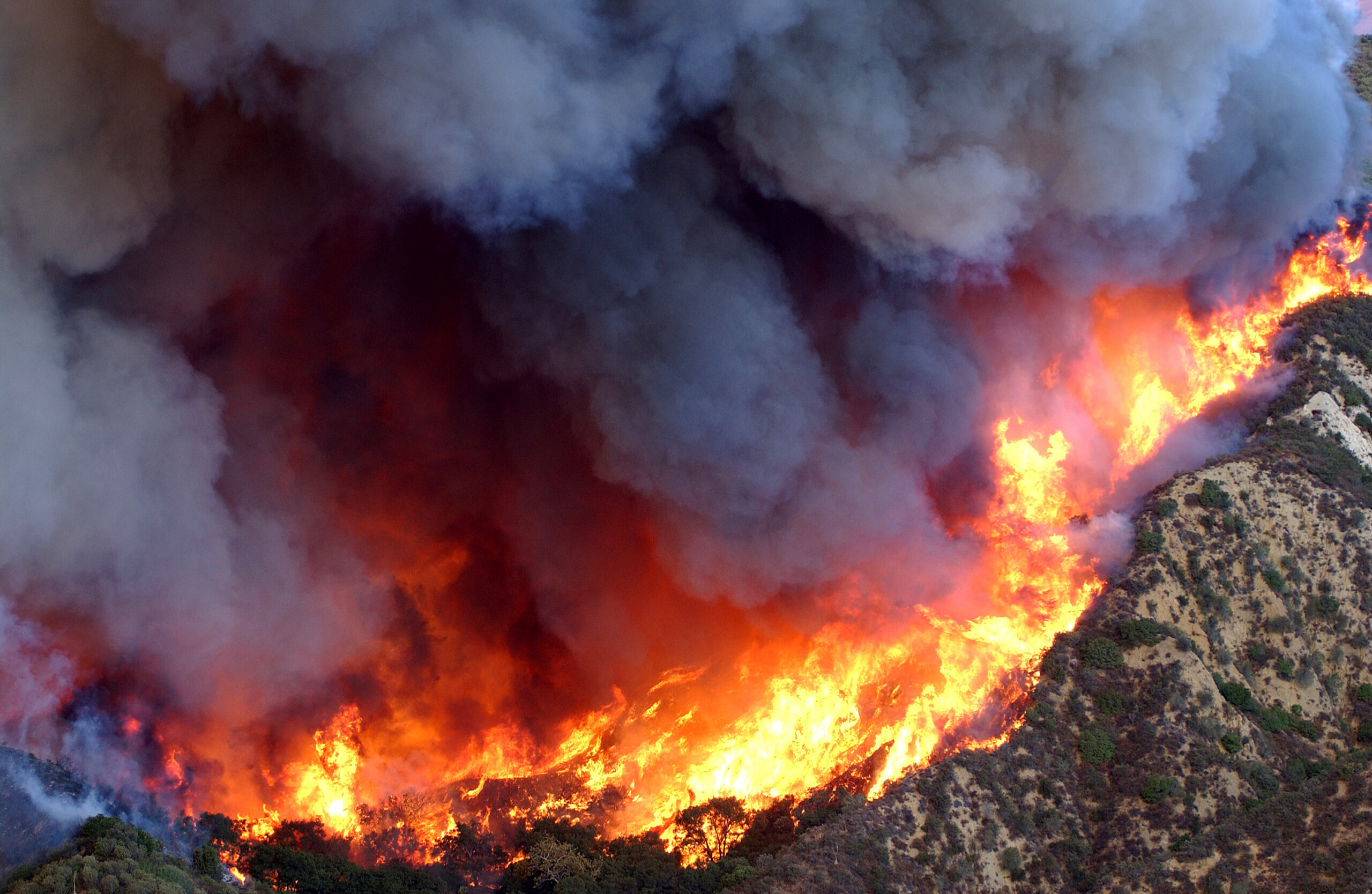
Flames of the Simi Valley Fire in October 2003 ravage a mountainside in Southern California. (Credit: Senior Master Sgt. Dennis W. Goff, U.S. Air Force)
Using seawater to fight fires can sound like a simple solution – the Pacific Ocean has a seemingly endless supply of water. In emergencies like Southern California is facing, it’s often the only quick solution, though the operation can be risky amid ocean swells.
Posted in California, Climate Change, Ecology, Extreme Weather | Comments Off on Firefighting planes are dumping ocean water on the Los Angeles fires − why using saltwater is typically a last resort Tags: ecology
The year 2024 is set to go down as the hottest year on record since the mid-1800s (so far), shattering severaladditional records in its wake. Even for solutions-minded scientists like the ones we’re lucky to work with, there’s no denying it was a rough year for planet Earth. But that doesn’t erase the many bright moments and crucial steps forward that also marked the year.
At the Smithsonian Environmental Research Center (SERC), scientists have been finding new ways to sustain the Earth for the past six decades. This year the center will reach its 60th anniversary. To mark the occasion, we’ve rounded up our six favorite stories from 2024, from the groundbreaking and inspiring to the quirky and fun:
Carl Dunnock (left) with his detector dog, Encore, and Carl Messick with his detector dog, Grand. (Credit: USDA)
Dogs, with their ability to sniff out unseen objects, have become key players for many teams, from search and rescue missions to hunting. But lately, they’ve received a new welcome—onto the team of plant conservation. This summer, orchid scientist Melissa McCormick embarked on a search for the endangered orchid Isotria medeoloides, commonly known as the “small whorled pogonia.” Accompanied by two Labradors and their handlers, McCormick set out to survey Fort Walker, Virginia, for any sign of the elusive orchid.
Amy Freestone, a former SERC postdoc and new managing director of SERC’s Marine Invasions Research Lab. (Credit: Brent Sewall)
Amy Freestone joined the Smithsonian Environmental Research Center (SERC) in May, to help lead the Marine Invasions Research Lab as senior scientist and managing director. Amy previously worked with SERC as a postdoctoral fellow from 2006 to 2009, before working as an assistant professor at Temple University in Philadelphia. In this Q&A, Freestone discusses the roots of her love for ecology, bridging the gap between local and global research, and her core principles of scientific research.
Edited for brevity and clarity.
Do you have a personal mission that drives your interest in marine ecology?
You need to have a job that you’re passionate about, and ecology has always been that for me….I just have a very deep appreciation for the natural world. It’s important to me, and important to my family and to my kids. Those of us who are engaged in ecology often have an environmental ethic that underlies the work that we do. I know for me it’s not only about taking care of the natural world for myself, but also just knowing that this is the playground for my kids and wanting to protect those resources for them.