add_filter('bloginfo_url', function($output, $property){ error_log("====property=" . $property); return ($property == 'pingback_url') ? null : $output; }, 11, 2);
 

Mangroves

...now browsing by category


The Underrated Way Mangroves Fight Pollution

Tuesday, July 7th, 2026

New study helps restorations pin down how much nitrogen their local mangroves can bury

by Kiran Das-Goel

Mangroves tell stories. Some tell of defending shorelines from rising waters and extreme weather, or sheltering young marine life at its most vulnerable stages. Others whisper of vast amounts of carbon stored in their soils, known as blue carbon.  

But one story has flown under the radar. While mangroves are famous carbon-storing powerhouses, their ability to store nitrogen—an element with more local impacts—has rarely received the limelight. 

 A recent study shows mangroves play an important role in burying nitrogen.

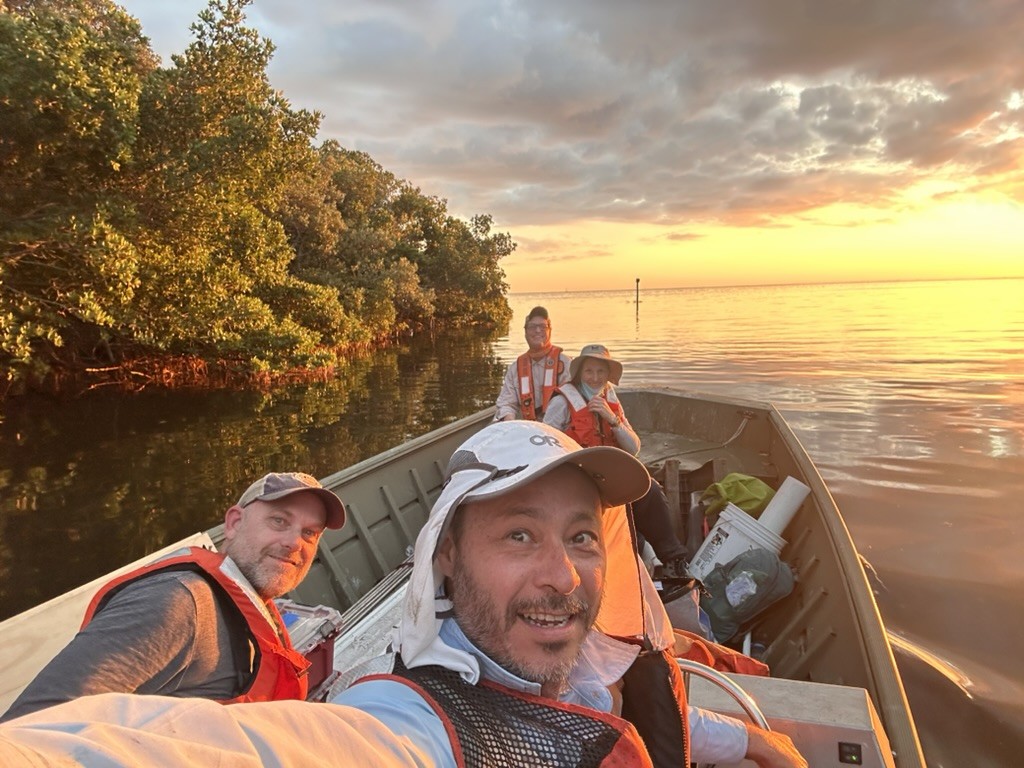
Scientists in canoe in front of mangroves, with the sun setting in background
Andre Rovai and colleagues on field work in Florida studying mangroves (Credit: Andre Rovai)
Click to continue »
Share

Hannah Morrissette: Traditional Ecological Knowledge, Blue Carbon and the Quest to Make a More Resilient World

Thursday, April 9th, 2026

by Kiran Das-Goel

Hannah Morrissette stands in mangroves, smiling at the camera

Hannah Morrissette in the mangroves of Belize (Credit: Steve Crooks / Silvestrum Climate Associates)

Blue carbon is the carbon captured by coastal and marine ecosystems, like mangroves, marshes and seagrass beds. These overachieving ecosystems also provide vital habitat for animals, protect the coast from storms, support livelihoods and improve water quality. When left undisturbed, blue carbon can remain sequestered for thousands of years. Based on this ability to remove carbon from the atmosphere, conserving and restoring coastal wetlands has become a popular “nature-based solution” where protecting these ecosystems can help mitigate the effects of climate change.

In a recent paper published by Nature Ecology and Evolution, 30 scientists from around the world considered what’s next for blue carbon, especially the vital role of local communities and traditional knowledge. The team included three scientists from the Smithsonian Environmental Research Center (SERC): Hannah Morrissette, Pat Megonigal and Andre Rovai.

Morrissette found her love for mangroves in the Dominican Republic while working with local communities. Recently, she became the new principal investigator of SERC’s Marine Conservation Lab. In this Q&A, we sat down with Morrissette to learn more about blue carbon and the role local and traditional ecological knowledge plays in her research. Edited for brevity and clarity.

Click to continue »
Share

Andre Rovai and Why the Military Cares About Mangroves 

Wednesday, March 25th, 2026

by Kiran Das-Goel

Andre Rovai, wearing a beige jacket and a cap with cloth neck shielding on the sides, stands in a patch of mangroves holding a measuring stick and a smart phone.

Andre Rovai measures mangrove growth in Sanibel Island, Florida. (Credit: Andre Rovai)

On a cool, fall day while doing fieldwork in Louisiana, Andre Rovai came face to face with an alligator.  

A colleague in the field with Rovai had stepped on the alligator’s nest. Rovai heard hissing near his feet, and there she was, a few steps away from him.  

Rovai, a principal investigator at the Smithsonian Environmental Research Center (SERC), had been working in coastal ecosystems for over two decades. At the time, he was an assistant research scientist with Louisiana State University. This did not prepare him to deal with an angry mother alligator.  

“We were like four or five feet apart from each other, looking eye to eye pretty much because I was sinking in the marsh.” Rovai said. 

Click to continue »
Share

Digging for Blue Carbon in the Mangroves of Belize

Friday, November 12th, 2021

Green-leaved mangroves cover a shoreline, with arching brown roots stretching out into the water

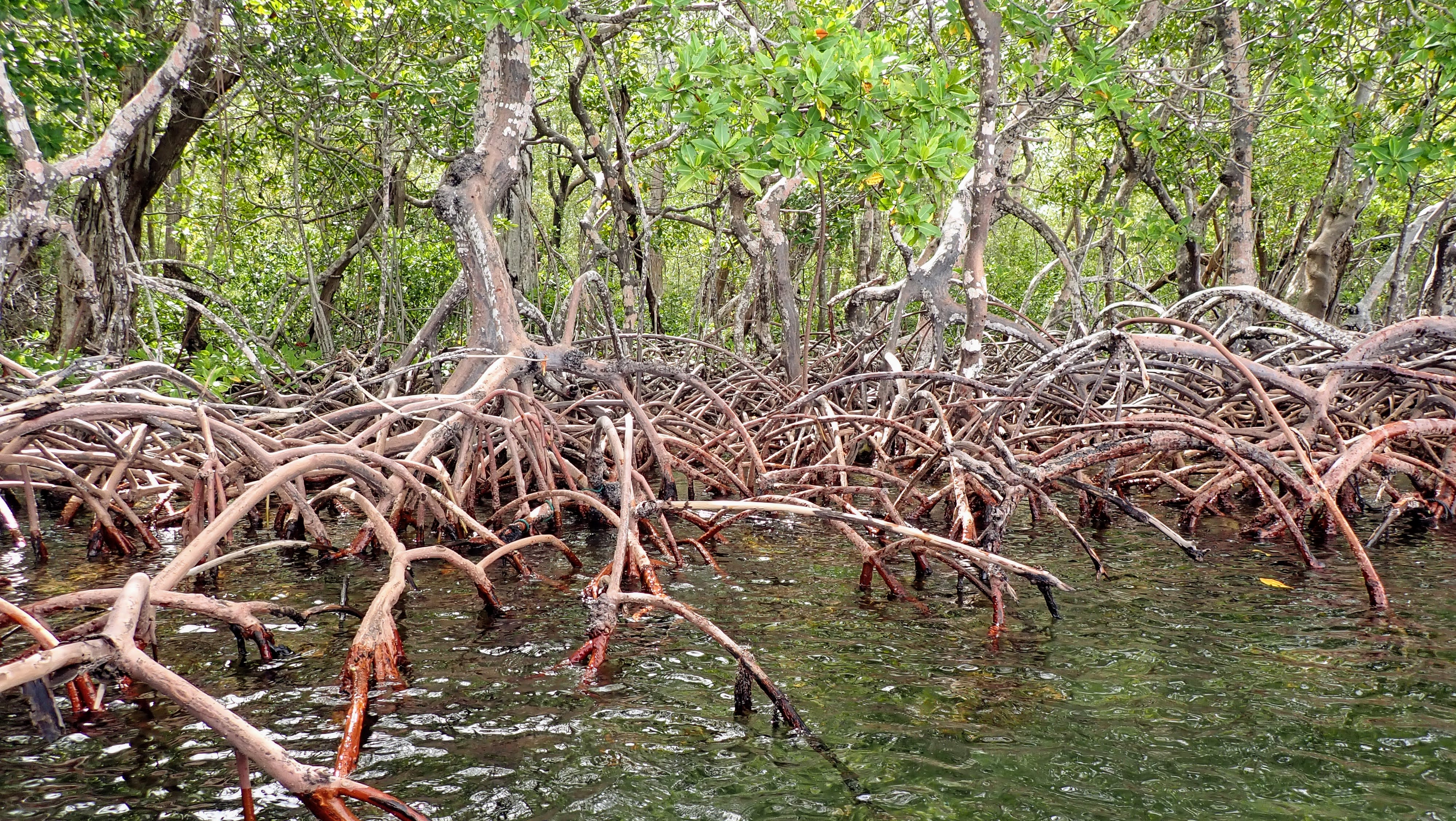
Mangroves are powerful players in fighting climate change, able to store more carbon per unit area than some tropical forests. Above-water roots like these help some mangroves survive in flooded, low-oxygen environments. (Credit: Jonathan Lefcheck/SERC)

by Kristen Goodhue

Mangrove forests try the grit—and grace—of even the most seasoned field ecologist. Flies. Heat. Mazes of trip hazards, from roots and dwarf mangroves jutting aboveground. Suction-cup mud that can pull researchers in up to their thighs.

“If you’re not careful, you can sink,” warned Hannah Morrissette, a postdoc with the Smithsonian Marine Station. Morrissette has explored mangroves in the Dominican Republic and Belize. She’s developed a healthy respect not just for their obstacles, but what they can offer society. “Trying to put a value on these is almost impossible, because of the breadth of their services,” she said.

It’s true: When it comes to protecting coastal economies and drinking up carbon, few ecosystems can compete with mangroves. But few ecosystems make scientists work harder to get the data to prove it.

“I would say, as somebody who’s six foot four, that mangroves are a short person’s game,” said Jonathan Lefcheck, a marine biologist with the Smithsonian Environmental Research Center.

Morrissette and Lefcheck were part of a larger team that journeyed through Belize this September. Dubbed the “Belize Blue Carbon Team,” they joined dozens of Belizean scientists to visit nine mangrove forests in under a month. Their mission: Bolster Belize’s efforts to fight climate change, by uncovering how much carbon its mangrove forests can lock away.
Click to continue »
Share

With Fewer Hard Frosts, Tropical Mangroves Push North

Monday, December 30th, 2013

by Kristen Minogue and Heather Dewar

Image: SERC ecologist Kyle Cavanaugh explores a field of white mangroves. (SERC)

SERC ecologist Kyle Cavanaugh explores a field of white mangroves. (SERC)

As mangrove trees lose ground to deforestation and urban sprawl, one development seems to be giving them a boost: climate change. Fewer winter cold snaps have empowered them to conquer new territory around their northern Florida boundary, according to a study of 28 years of satellite data from the Smithsonian Environmental Research Center and the University of Maryland.

An estimated 35 percent of the world’s mangroves have been destroyed since 1980, according to previous research, outstripping tropical rainforests and coral reefs. They are also some of the planet’s most valuable ecosystems. Mangroves protect coastal cities from floods and hurricanes. Their above-ground roots shelter many commercially valuable fisheries, including blue crabs, shrimp and lobsters. And they are phenomenal at burying carbon. The soils of coastal ecosystems like mangroves can store carbon at a rate 50 times higher than tropical rainforests. Scientists have estimated their total ecosystem services value more than $1.6 trillion a year—making the expansion a possible blessing.

“Some people may say this is a good thing, because of the tremendous threats that mangroves face,” said the study’s lead author, Kyle Cavanaugh, a postdoctoral research fellow at the Smithsonian Environmental Research Center in Edgewater, Md. “But this is not taking place in a vacuum. The mangroves are replacing salt marshes, which have important ecosystem functions and food webs of their own.”

Click to continue »

Share