add_filter('bloginfo_url', function($output, $property){ error_log("====property=" . $property); return ($property == 'pingback_url') ? null : $output; }, 11, 2);
 

Interviews

...now browsing by category


Hannah Morrissette: Traditional Ecological Knowledge, Blue Carbon and the Quest to Make a More Resilient World

Thursday, April 9th, 2026

by Kiran Das-Goel

Hannah Morrissette stands in mangroves, smiling at the camera

Hannah Morrissette in the mangroves of Belize (Credit: Steve Crooks / Silvestrum Climate Associates)

Blue carbon is the carbon captured by coastal and marine ecosystems, like mangroves, marshes and seagrass beds. These overachieving ecosystems also provide vital habitat for animals, protect the coast from storms, support livelihoods and improve water quality. When left undisturbed, blue carbon can remain sequestered for thousands of years. Based on this ability to remove carbon from the atmosphere, conserving and restoring coastal wetlands has become a popular “nature-based solution” where protecting these ecosystems can help mitigate the effects of climate change.

In a recent paper published by Nature Ecology and Evolution, 30 scientists from around the world considered what’s next for blue carbon, especially the vital role of local communities and traditional knowledge. The team included three scientists from the Smithsonian Environmental Research Center (SERC): Hannah Morrissette, Pat Megonigal and Andre Rovai.

Morrissette found her love for mangroves in the Dominican Republic while working with local communities. Recently, she became the new principal investigator of SERC’s Marine Conservation Lab. In this Q&A, we sat down with Morrissette to learn more about blue carbon and the role local and traditional ecological knowledge plays in her research. Edited for brevity and clarity.

Click to continue »
Share

Andre Rovai and Why the Military Cares About Mangroves 

Wednesday, March 25th, 2026

by Kiran Das-Goel

Andre Rovai, wearing a beige jacket and a cap with cloth neck shielding on the sides, stands in a patch of mangroves holding a measuring stick and a smart phone.

Andre Rovai measures mangrove growth in Sanibel Island, Florida. (Credit: Andre Rovai)

On a cool, fall day while doing fieldwork in Louisiana, Andre Rovai came face to face with an alligator.  

A colleague in the field with Rovai had stepped on the alligator’s nest. Rovai heard hissing near his feet, and there she was, a few steps away from him.  

Rovai, a principal investigator at the Smithsonian Environmental Research Center (SERC), had been working in coastal ecosystems for over two decades. At the time, he was an assistant research scientist with Louisiana State University. This did not prepare him to deal with an angry mother alligator.  

“We were like four or five feet apart from each other, looking eye to eye pretty much because I was sinking in the marsh.” Rovai said. 

Click to continue »
Share

Oceanographer Monty Graham Takes Helm at Smithsonian Environmental Research Center

Tuesday, September 2nd, 2025

by Kristen Goodhue

Monty Graham, wearing a white shirt and beige slacks, stands in front of the Mathias Lab's silver entry sign with a green wetland behind him.
Monty Graham beside SERC’s Charles McC. Mathias Lab, during his first week as director. (Credit: Kristen Goodhue)

Monty Graham has spent most of his life guided by two passions: the ocean and time. As a child in Danville, Kentucky—over 400 miles from the nearest coast—he remembers going out with his mother to search for crinoids and other marine fossils, from Kentucky’s deep past as a former ocean. He devoted his career to studying jellyfish, one of the oldest groups of animals on Earth. 

But for Graham, the future holds just as strong a pull as the past. He studied jellyfish blooms in part because they’re harbingers of larger changes in the ocean. And in 2010, when the Deepwater Horizon oil spill wreaked havoc on communities on land and at sea, he led multi-organizational efforts to understand its larger ripples on marine life.

All those experiences shaped his mind for the role he took on this June: the new director of the Smithsonian Environmental Research Center (SERC).

Click to continue »
Share

Amy Freestone: The Unexpected World of Underwater Invasions

Friday, September 20th, 2024

by Taylor Wev

Amy Freestone, a Caucasian woman with short brown hair, sits on a rock wearing a hiking backpack and a pink cap. She is smiling at the camera.
Amy Freestone, a former SERC postdoc and new managing director of SERC’s Marine Invasions Research Lab. (Credit: Brent Sewall)

Amy Freestone joined the Smithsonian Environmental Research Center (SERC) in May, to help lead the Marine Invasions Research Lab as senior scientist and managing director. Amy previously worked with SERC as a postdoctoral fellow from 2006 to 2009, before working as an assistant professor at Temple University in Philadelphia. In this Q&A, Freestone discusses the roots of her love for ecology, bridging the gap between local and global research, and her core principles of scientific research.

Edited for brevity and clarity.

Do you have a personal mission that drives your interest in marine ecology?

You need to have a job that you’re passionate about, and ecology has always been that for me….I just have a very deep appreciation for the natural world. It’s important to me, and important to my family and to my kids. Those of us who are engaged in ecology often have an environmental ethic that underlies the work that we do. I know for me it’s not only about taking care of the natural world for myself, but also just knowing that this is the playground for my kids and wanting to protect those resources for them.

Click to continue »
Share

Q&A: For Too Long, Big-Picture Ecologists Have Left Disease Out Of Their Models. It’s Time To Fix That.

Thursday, May 20th, 2021
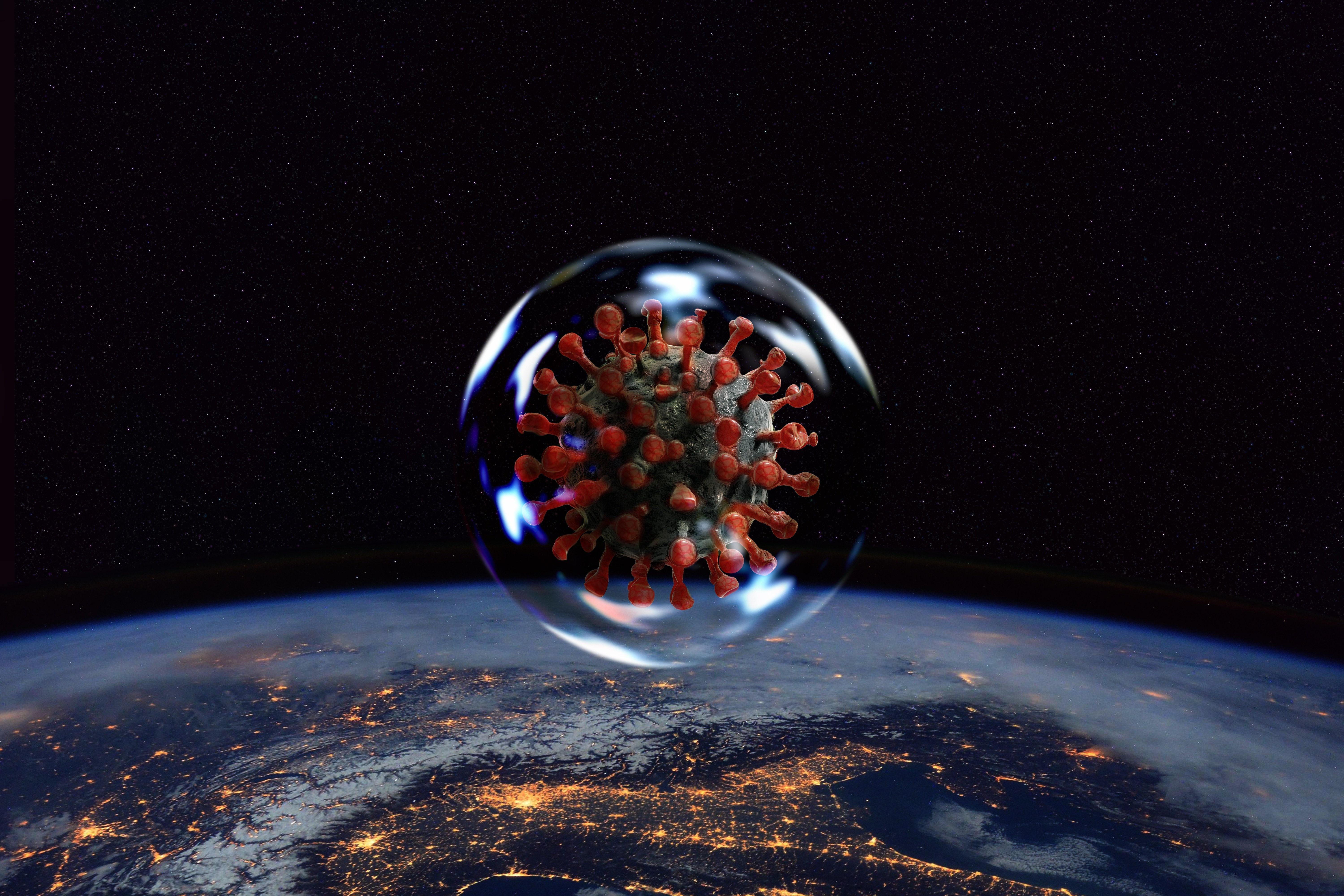
Illustration of a virus with red spikes hovering over planet Earth
Image: Gerd Altmann via Pixabay
by Kristen Goodhue

Diseases don’t spread in a vacuum. But as ecologists try to create a more interconnected picture of planet Earth, parasites, viruses and other disease-spreading pathogens have been sidelined. In a new article published May 17 in Nature Ecology and Evolution, a team of scientists makes the case that today, we have the tech and the global connectivity to change that. In this Q&A, we talked with lead author Dr. James Hassell, a wildlife veterinarian, disease ecologist and Keller Family Skorton Scholar with the Smithsonian Conservation Biology Institute’s Global Health Program, and co-author Dr. Katrina Lohan, a parasite and disease ecologist at the Smithsonian Environmental Research Center. Edited for brevity and clarity. Click to continue »

Share

Fred Tutman: Fighting for Justice and Inclusion on the Patuxent River

Friday, April 24th, 2020

by Kristen Minogue

After nearly three decades in television, Fred Tutman left filmmaking to found the Patuxent Riverkeeper in 2004. For 16 years, the Patuxent Riverkeeper organization has empowered citizens to advocate for their right to a healthy environment. Today he’s also lending his leadership skills as a Director’s Circle volunteer with the Smithsonian Environmental Research Centeer, and spoke on environmental justice this April at the Smithsonian’s Earth Optimism digital summit. Learn more about some of the Patuxent Riverkeepers’ greatest environmental wins, and how the green movement can evolve to meet the needs of a diverse future.  Edited for brevity and clarity.

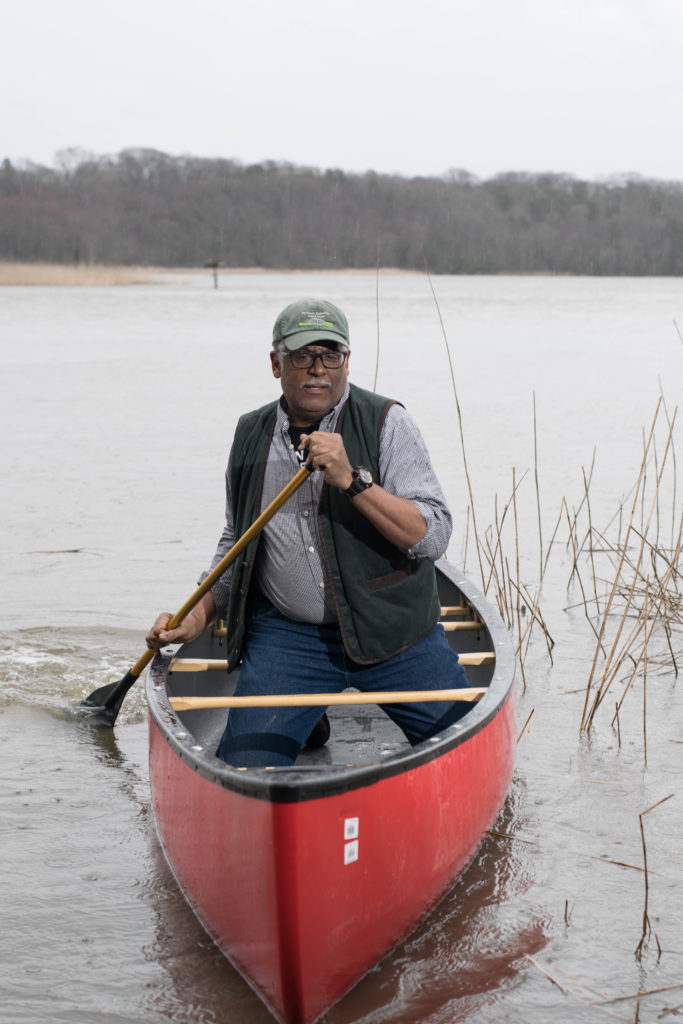
Fred Tutman paddling a red kayak on a river

Fred Tutman (Credit: Audobon Naturalist Society)

What motivated you to be involved in conservation?
I thought that my future was going to be in radio, television, media communications. As an activist, because I’d always been an activist, I thought that was the best portal for me to change my corner of the world. And, you know, I did that for 27 years…But I was bored and didn’t feel like I was making a difference in all of these awful problems in the world we were making films about…

So I decided to go to law school, because I knew nobody who knew me thought I could do that, just because I hadn’t done that sort of thing before….It was a different world, a different life for me. It was really hard to reboot. I literally had to change my friends. Not because people were hostile to the work. They didn’t understand how it fit into my past endeavors. And so people were baffled by it. A midlife crisis, I think someone accused me of that. Click to continue »

Share

Christine Arena: Determined Optimism and Letting Science Speak

Tuesday, April 14th, 2020

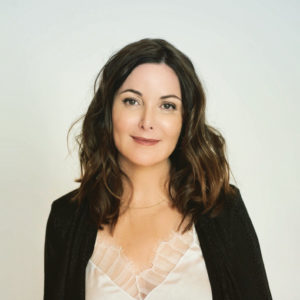
head and shoulders picture of young woman with brown hair, in a black jacket and white blouse

Filmmaker and science communicator Christine Arena (Photo courtesy of Christine Arena)

A communicator with a passion for environmental and social issues, Christina Arena left her mark on the environmental film world with the 2018 series Let Science Speak. The short documentary videos go beyond the “war on science” headlines to humanize scientists and let them tell their own stories. Today, she’s donating her time and talent to help produce videos for the Smithsonian Environmental Research Center (SERC). Her newest short film will premiere this April at the Smithsonian’s digital Earth Optimism Summit April 22-24. In this Q&A, she talks about what gives her purpose and optimism. Click to continue »

Share

Sarah Donelan: How Parents Prep Offspring for Tough Lives Before Birth

Friday, November 22nd, 2019

by Kristen Minogue

Sarah Donelan in red hoodie on sandy beach

Sarah Donelan in Wellfleet, Massachusetts.
(Credit: Patricia Donelan)

Every parent wants to give their children the best shot at life. But sometimes, this means more than protecting newborns after birth. Some species can prepare offspring for tough conditions before they enter the world. It’s called transgenerational plasticity. Sarah Donelan, a Smithsonian Environmental Research Center postdoc, has spent years piecing together how it works. This November she published a new article highlighting how humans could be changing this age-old parental strategy. Discover more in the Q&A here.

This interview has been edited and condensed for clarity. Click to continue »

Share

Q&A: Jon Lefcheck, MarineGEO Pioneer

Monday, November 26th, 2018

by Kristen Minogue

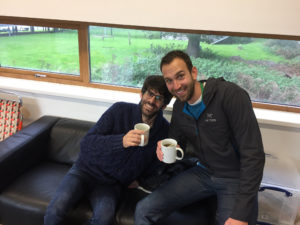
Two men sitting on couch with mugs.
Jon Lefcheck (right) at Swansea University in Wales with colleague John Griffin. Lefcheck taught a course on mathematical modeling in Wales in 2017. (Photo courtesy of Jon Lefcheck)

Jon Lefcheck has spent most of his life on the East Coast. But as the new coordinating scientist for the Marine Global Earth Observatories (MarineGEO), he’s about to get a crash course in doing marine biology on the other side of the country and the other side of the globe. In this Q&A, learn about some of the weird discoveries and creatures he’s encountered so far, and why the coasts make society tick. Edited for brevity and clarity.

You were the first person in your family to go to college. What motivated you to push yourself in that way?

I always liked school—oddly enough, yeah, I know. I liked science. I pushed my parents to send me to private high school so that I could get more into my studies, and they were hugely supportive the entire way. I think that was their dream, that they would have a kid that would grow up to go on to college. My father said he wanted me to be a doctor when I was born. He meant medical doctor, so I’m not sure how he feels. But, you know, Ph.D.

Click to continue »
Share

Q&A: Sherman’s Lagoon Cartoonist Jim Toomey on Ocean Conservation with Comics

Tuesday, September 12th, 2017

by Kristen Minogue

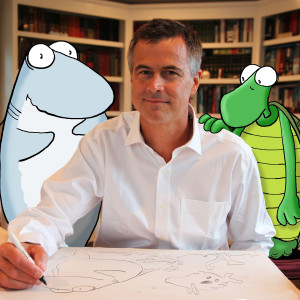
Artist with cartoon shark and cartoon sea turtle looking over his shoulder

Cartoonist Jim Toomey with two of his characters, Sherman the shark and Fillmore the sea turtle. (Image courtesy of Jim Toomey)

Since 1997, a great white shark named Sherman has put a wacky spin on life underwater in the comic strip Sherman’s Lagoon. Jim Toomey, the comic’s creator and conservationist, uses Sherman and his (usually more intelligent) friends to reveal real issues facing the ocean. In this Q&A, Toomey describes adding humor to environmentalism, and what happens when Sherman’s Lagoon meets Chesapeake Bay. Edited for brevity and clarity.

Want to dive deeper? Watch Jim Toomey’s TED Talk online. You can also meet Toomey at the Smithsonian Environmental Research Center October 17 at 7pm, for his free evening lecture, “Drawing Inspiration from the Sea.” Details here.

What first sparked your interest in the sea?

I was a little boy, maybe six, seven, eight years old….Some of the TV shows I used to watch, the Jacques Cousteau specials and things were somewhat unique. And it just fascinated me. It really captured my imagination to see this team of scientists explore this completely alien world. Click to continue »

Share