add_filter('bloginfo_url', function($output, $property){ error_log("====property=" . $property); return ($property == 'pingback_url') ? null : $output; }, 11, 2);
 

Climate Change

...now browsing by category


Hannah Morrissette: Traditional Ecological Knowledge, Blue Carbon and the Quest to Make a More Resilient World

Thursday, April 9th, 2026

by Kiran Das-Goel

Hannah Morrissette stands in mangroves, smiling at the camera

Hannah Morrissette in the mangroves of Belize (Credit: Steve Crooks / Silvestrum Climate Associates)

Blue carbon is the carbon captured by coastal and marine ecosystems, like mangroves, marshes and seagrass beds. These overachieving ecosystems also provide vital habitat for animals, protect the coast from storms, support livelihoods and improve water quality. When left undisturbed, blue carbon can remain sequestered for thousands of years. Based on this ability to remove carbon from the atmosphere, conserving and restoring coastal wetlands has become a popular “nature-based solution” where protecting these ecosystems can help mitigate the effects of climate change.

In a recent paper published by Nature Ecology and Evolution, 30 scientists from around the world considered what’s next for blue carbon, especially the vital role of local communities and traditional knowledge. The team included three scientists from the Smithsonian Environmental Research Center (SERC): Hannah Morrissette, Pat Megonigal and Andre Rovai.

Morrissette found her love for mangroves in the Dominican Republic while working with local communities. Recently, she became the new principal investigator of SERC’s Marine Conservation Lab. In this Q&A, we sat down with Morrissette to learn more about blue carbon and the role local and traditional ecological knowledge plays in her research. Edited for brevity and clarity.

Click to continue »
Share

Andre Rovai and Why the Military Cares About Mangroves 

Wednesday, March 25th, 2026

by Kiran Das-Goel

Andre Rovai, wearing a beige jacket and a cap with cloth neck shielding on the sides, stands in a patch of mangroves holding a measuring stick and a smart phone.

Andre Rovai measures mangrove growth in Sanibel Island, Florida. (Credit: Andre Rovai)

On a cool, fall day while doing fieldwork in Louisiana, Andre Rovai came face to face with an alligator.  

A colleague in the field with Rovai had stepped on the alligator’s nest. Rovai heard hissing near his feet, and there she was, a few steps away from him.  

Rovai, a principal investigator at the Smithsonian Environmental Research Center (SERC), had been working in coastal ecosystems for over two decades. At the time, he was an assistant research scientist with Louisiana State University. This did not prepare him to deal with an angry mother alligator.  

“We were like four or five feet apart from each other, looking eye to eye pretty much because I was sinking in the marsh.” Rovai said. 

Click to continue »
Share

Mary Cortese and the Fate of Subsistence Fishing in a Warmer World

Monday, September 29th, 2025

by Erin Minor

A school of silver fish and another school of yellow fish swim in a coral reef surrounded by blue water.
Bluestriped grunts and gray snapper, two important subsistence fish in the Mesoamerican region, school in a marine sanctuary in Belize. (Credit: Claudio Contreras-Koob)

Around the world, an estimated 52.8 million people engage in subsistence fishing—the practice of fishing to feed one’s family and community, where most of the food stays local. As ocean temperatures rise, so do concerns about how this will impact the fish populations these communities depend on.

Subsistence fisheries are difficult to track, due to lower reporting of catch numbers compared to industrial fishing. Subsistence fish are also usually smaller species that aren’t as economically valuable. But they are vital to the food security of these communities.

Mary Cortese is a postdoctoral fellow at the Smithsonian Environmental Research Center (SERC). As part of her work with SERC’s Spatial Ecology and Conservation Lab and Marine Conservation Lab, she’s creating models to help understand how fish species in the Mesoamerican region will respond to rising sea temperatures through the end of the century.

“We want to know if the communities that depend on these fish as food sources will still have that resource under different, end-of-century climate scenarios,” said Cortese.

Click to continue »
Share

Olympia Oysters Can Take Some Extra Heat

Wednesday, September 10th, 2025

by Alejandro Moses de la Vega

Closeup of a golden-brown Olympia oyster shell resting on a rocky beach, taken at ground  level.
Olympia oysters in British Columbia (Credit: Erin Herder)

For many species, rising global temperatures will strain their ability to survive. However, a hotter climate might not be the end for one threatened species of oyster, according to a recent study.

The Olympia oyster is the only species of oyster native to the West Coast of North America. It was a staple in Native American diets in precolonial America, and became a major economic resource during industrialization. But its numbers took a hit in the early 20th century, thanks to pollution and overfishing.

“Few people have ever seen or eaten one,” said Kerstin Wasson, lead author of the paper and research coordinator of the Elkhorn Slough National Estuarine Research Reserve.

Click to continue »
Share

Firefighting planes are dumping ocean water on the Los Angeles fires − why using saltwater is typically a last resort

Monday, January 13th, 2025

by Patrick Megonigal, Associate Director of Research, Smithsonian Environmental Research Center. Originally published in The Conversation

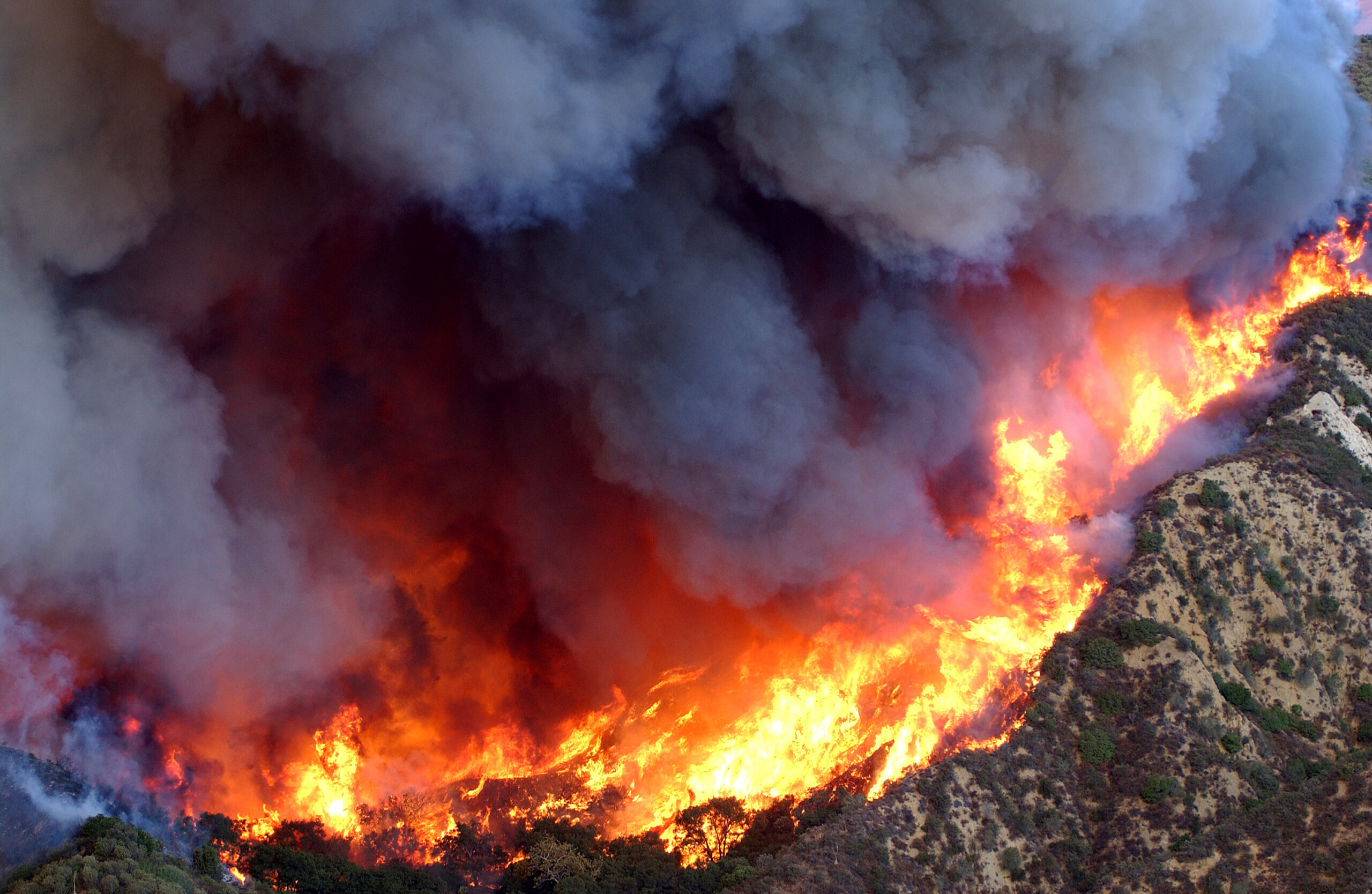
Gray smoke billows from fires on a mountainside, as seen from above.
Flames of the Simi Valley Fire in October 2003 ravage a mountainside in Southern California. (Credit: Senior Master Sgt. Dennis W. Goff, U.S. Air Force)

Firefighters battling the deadly wildfires that raced through the Los Angeles area in January 2025 have been hampered by a limited supply of freshwater. So, when the winds are calm enough, skilled pilots flying planes aptly named Super Scoopers are skimming off 1,500 gallons of seawater at a time and dumping it with high precision on the fires.

Using seawater to fight fires can sound like a simple solution – the Pacific Ocean has a seemingly endless supply of water. In emergencies like Southern California is facing, it’s often the only quick solution, though the operation can be risky amid ocean swells.

But seawater also has downsides.

Click to continue »
Share

Six Stories From 2024 To Warm Your Heart (Not the Planet)

Friday, January 10th, 2025

by Kristen Goodhue

The year 2024 is set to go down as the hottest year on record since the mid-1800s (so far), shattering several additional records in its wake. Even for solutions-minded scientists like the ones we’re lucky to work with, there’s no denying it was a rough year for planet Earth. But that doesn’t erase the many bright moments and crucial steps forward that also marked the year.

At the Smithsonian Environmental Research Center (SERC), scientists have been finding new ways to sustain the Earth for the past six decades. This year the center will reach its 60th anniversary. To mark the occasion, we’ve rounded up our six favorite stories from 2024, from the groundbreaking and inspiring to the quirky and fun:

Click to continue »
Share

Biodiversity Makes Reefs Tick—But It Needs Big Players

Wednesday, February 2nd, 2022

by Kristen Goodhue

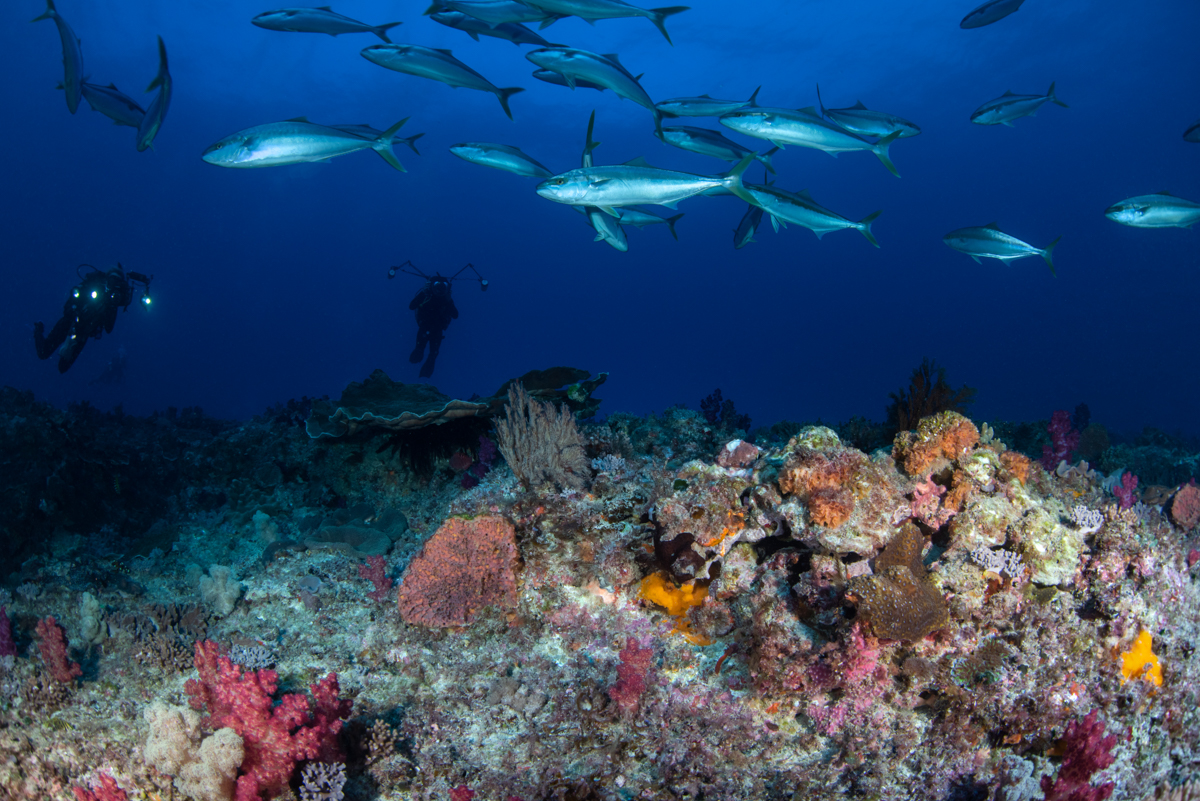
Underwater photo of silver fish swimming over a reef, with orange, pink, brown and white coral.
A school of yellowtail kingfish (Seriola lalandi) at Lord Howe Island in Australia. The presence of large fish like yellowtails can help keep ecosystems healthy and productive, a new study found. (Credit: Rick Stuart Smith, Reef Life Survey)

Three thousand reefs. (Technically 3,040 reefs, for those who like precision.) That’s how many underwater sites scientists and volunteers poured over in the latest effort to uncover how much biodiversity matters for reef health.

The answer: Quite a lot.

Scientists have known for years that diverse fish communities help ocean ecosystems flourish, even when facing rising temperatures and climate change. But the latest study, published in Nature Communications, reveals it’s about more than the numbers. Which species call a reef home can matter just as much as how many there are. And that holds especially true when it comes to large predator fish.

Click to continue »
Share

Digging for Blue Carbon in the Mangroves of Belize

Friday, November 12th, 2021

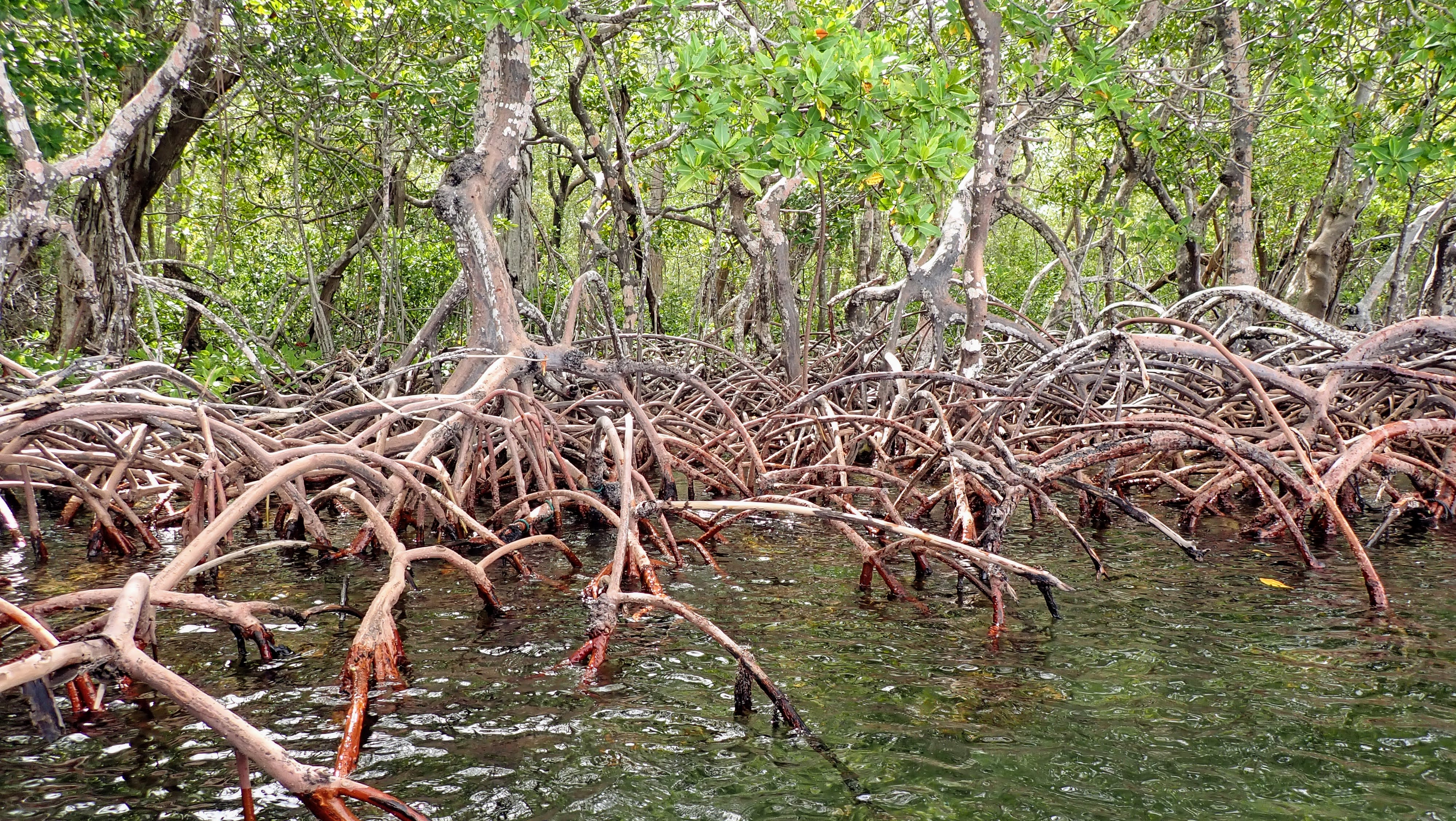
Green-leaved mangroves cover a shoreline, with arching brown roots stretching out into the water

Mangroves are powerful players in fighting climate change, able to store more carbon per unit area than some tropical forests. Above-water roots like these help some mangroves survive in flooded, low-oxygen environments. (Credit: Jonathan Lefcheck/SERC)

by Kristen Goodhue

Mangrove forests try the grit—and grace—of even the most seasoned field ecologist. Flies. Heat. Mazes of trip hazards, from roots and dwarf mangroves jutting aboveground. Suction-cup mud that can pull researchers in up to their thighs.

“If you’re not careful, you can sink,” warned Hannah Morrissette, a postdoc with the Smithsonian Marine Station. Morrissette has explored mangroves in the Dominican Republic and Belize. She’s developed a healthy respect not just for their obstacles, but what they can offer society. “Trying to put a value on these is almost impossible, because of the breadth of their services,” she said.

It’s true: When it comes to protecting coastal economies and drinking up carbon, few ecosystems can compete with mangroves. But few ecosystems make scientists work harder to get the data to prove it.

“I would say, as somebody who’s six foot four, that mangroves are a short person’s game,” said Jonathan Lefcheck, a marine biologist with the Smithsonian Environmental Research Center.

Morrissette and Lefcheck were part of a larger team that journeyed through Belize this September. Dubbed the “Belize Blue Carbon Team,” they joined dozens of Belizean scientists to visit nine mangrove forests in under a month. Their mission: Bolster Belize’s efforts to fight climate change, by uncovering how much carbon its mangrove forests can lock away.
Click to continue »

Share

The Tides Are Turning: Rising Seas Threaten Coastal Wetlands

Friday, July 2nd, 2021

by Deva Holliman

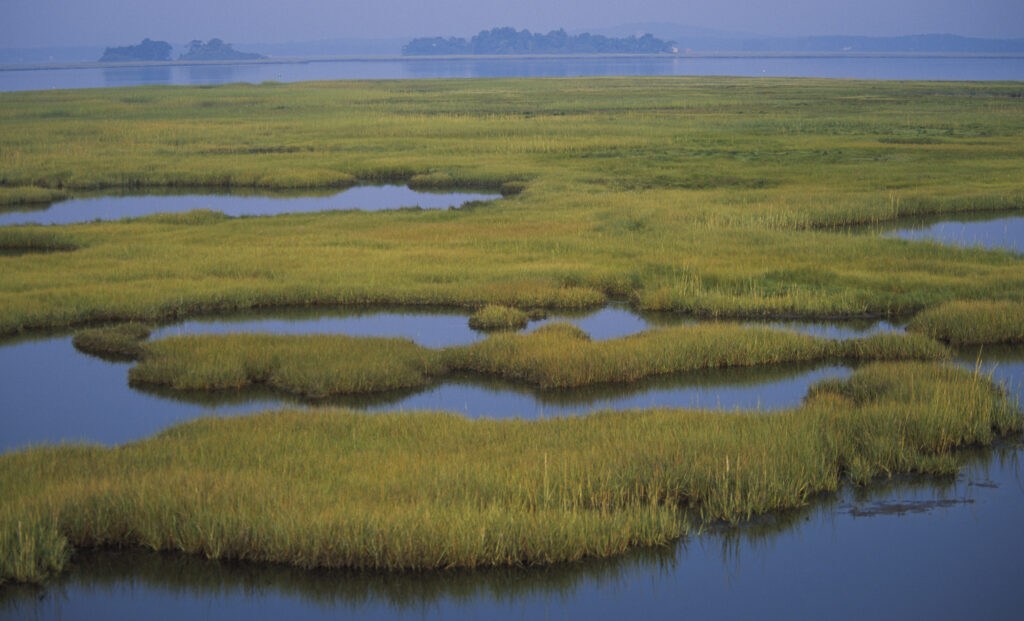
Green wetland with blue patches of water

Coastal wetland in Parker River National Wildlife Refuge, Massachusetts. (Credit: U.S. Fish and Wildlife Service)

Between 43% and 48% of coastal wetlands along the continental U.S. may be unable to survive rising seas, according to a recent study from the Smithsonian Environmental Research Center (SERC).  

The study, published in the June issue of Earth’s Future, highlighted the capacity of coastal wetlands across the continental United States to resist sea level rise. While wetland plants are adapted to the stress of salty tides, sea level rise threatens to entirely submerge some sections of marsh—eventually causing these plants to die.  

The survival of wetlands is essential to the continued prosperity of coastal communities. Wetlands protect shorelines from damage by severe storms. They provide vital habitats for fish and shellfish that humans rely on for food, and support numerous endangered and endemic species. To many locals, wetlands also tie into their cultures and identities, and provide tourism revenue. 

“Our collective economic and cultural wealth is diminished if we don’t have tidal wetlands,” said SERC scientist James Holmquist, who spearheaded the study.  Click to continue »

Share

EQSphere invention measures greenhouse gases in cloudy, freezing waters

Friday, May 14th, 2021

by Marisa Sloan, Northwestern University

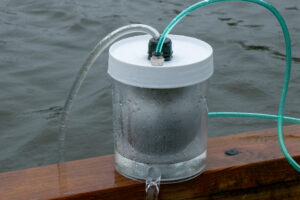
The EQSphere, a silver ball inside transparent container, with gray and blue tubes coming out of top

The silver EQSphere measures dissolved carbon dioxide and methane, potent greenhouse gases, in the Rhode River on a rainy afternoon. (Photo: Marisa Sloan/Northwestern University)

Don’t be fooled—the EQSphere™ isn’t a silver softball or a tree ornament gone rogue. It’s a spherical equilibrator invented to continuously yank carbon dioxide, methane and other gases from three feet underwater into the air to be measured in real time.

Whitman Miller, a research scientist with the Smithsonian Environmental Research Center, came up with the design with his head technician Amanda Reynolds while they were studying the effects of elevated carbon dioxide in marine ecosystems. He considers it an invention born of necessity, thanks to turbid and debris-ridden coastal waters, where it’s dangerous to deploy expensive instruments for very long.

Click to continue »

Share