add_filter('bloginfo_url', function($output, $property){ error_log("====property=" . $property); return ($property == 'pingback_url') ? null : $output; }, 11, 2);
 

Publications

...now browsing by category


High Carbon Dioxide Can Create “Shrinking Stems” in Marshes

Wednesday, September 25th, 2019

Marshes Grow Shorter, Denser Stems Under High Carbon Dioxide, Which Can Help Them Resist Sea Level Rise

by Kristen Minogue
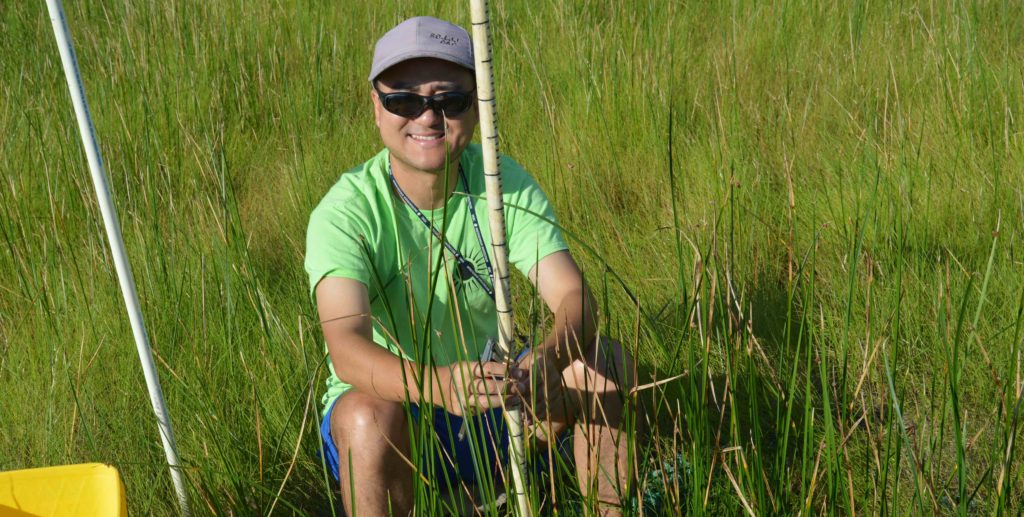
Man in sunglasses and green T-shirt sitting in a marsh holding a measuring stick

Ecologist Meng Lu measures green blades of sedge in SERC’s Global Change Research Wetland in Maryland. Lu led a discovery that under higher carbon dioxide, sedges like these grow shorter and thinner stems. (Credit: Maria Sharova/SERC)

For most plants, carbon dioxide acts like a steroid: The more they can take in, the bigger they get. But in a new study published Sept. 25, scientists with the Smithsonian discovered something strange happening in marshes. Under higher levels of carbon dioxide, instead of producing bigger stems, marsh plants produced more stems that were noticeably smaller.

“I don’t think anybody expected this,” said Meng Lu, lead author of the new study in the journal Nature Climate Change. For years, scientists had known that carbon dioxide was bulking up the total biomass of marsh plants, so it seemed natural to think individual plants were getting bigger too. “Everyone thought, okay, [plants] increased, biomass increased, so the height, width, all should increase. But that’s not the case in a marsh,” he said.

Click to continue »

Share

Global Change is Triggering an Identity Switch in Grasslands

Monday, August 19th, 2019
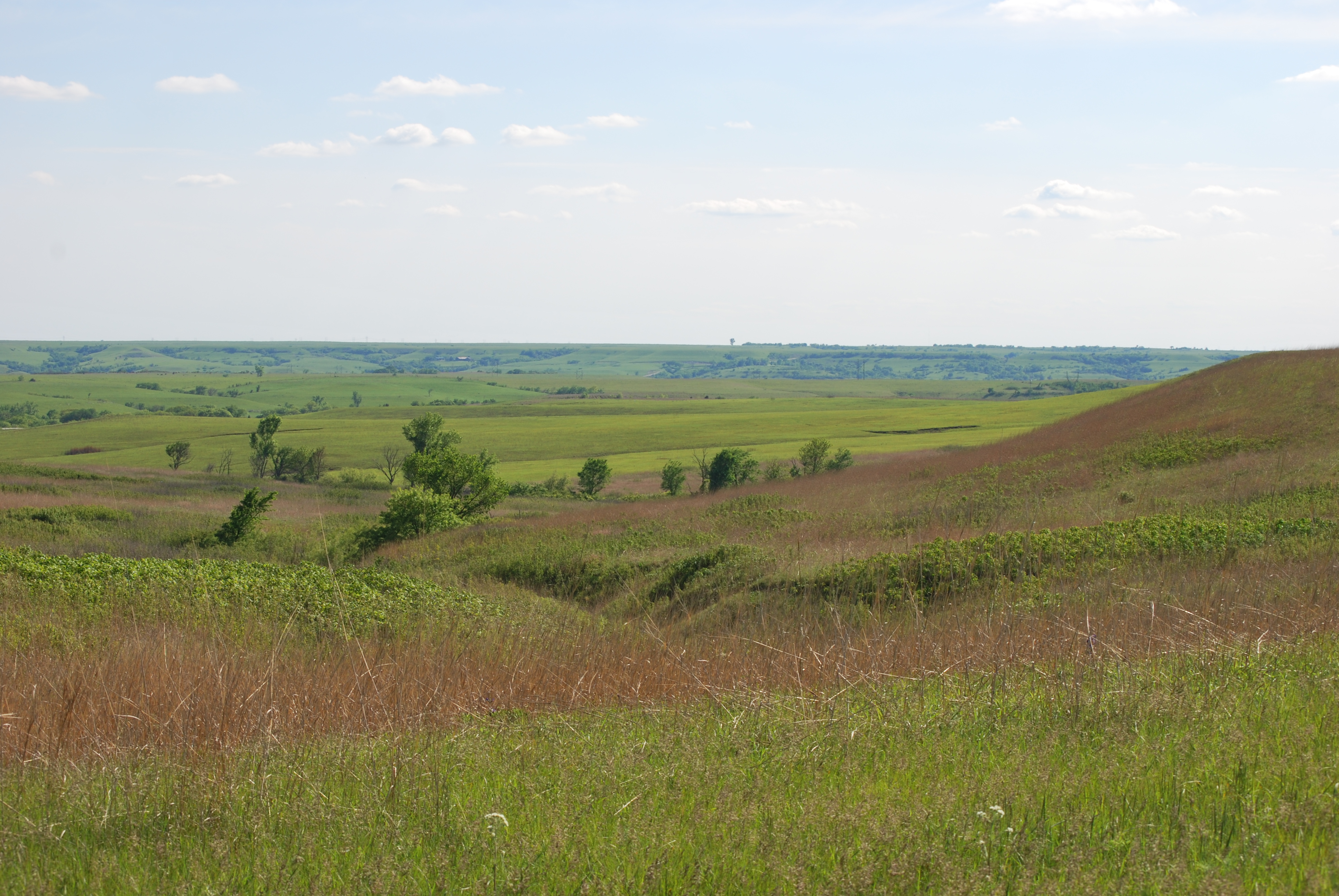
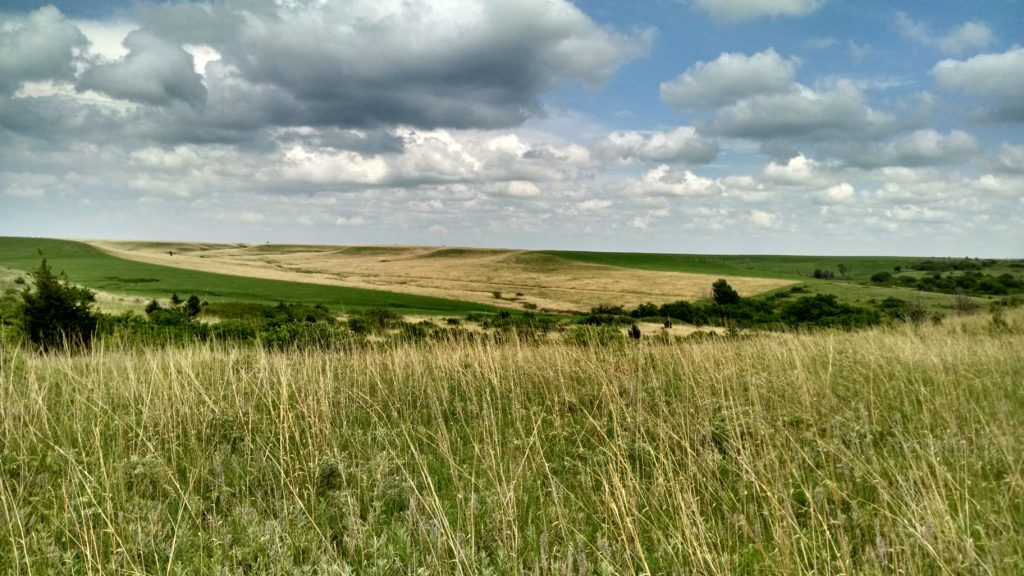
Landscape view of grasslands under blue, cloudy sky

Konza Prairie Biological Station in northeast Kansas. (Credit: Kim Komatsu/SERC)

Scientists Discover Species Turnover in Study of More Than 100 Grassland Experiments

by Kristen Minogue

Since the first Homo sapiens emerged in Africa roughly 300,000 years ago, grasslands have sustained humanity and thousands of other species. But today, those grasslands are shifting beneath our feet. Global change—which includes climate change, pollution and other widespread environmental alterations—is transforming the plant species growing in them, and not always in the ways scientists expected, a new study published Monday revealed.

Grasslands make up more than 40 percent of the world’s ice-free land. In addition to providing food for human-raised cattle and sheep, grasslands are home to animals found nowhere else in the wild, such as the bison of North America’s prairies or the zebras and giraffes of the African savannas. Grasslands also can hold up to 30 percent of the world’s carbon, making them critical allies in the fight against climate change. However, changes in the plants that comprise grasslands could put those benefits at risk.

“Is it good rangeland for cattle, or is it good at storing carbon?” said lead author Kim Komatsu, a grassland ecologist at the Smithsonian Environmental Research Center. “It really matters what the identities of the individual species are….You might have a really invaded weedy system that would not be as beneficial for these services that humans depend on.” Click to continue »

Share

The Scientists’ Time Machine—Otherwise Known as Ginkgos

Monday, July 22nd, 2019

by Quinn Burkhart

When the word fossil comes to mind, the first thing many people think of are dinosaurs. Of course, dinosaurs are long extinct. Yet, as crazy as it sounds, we can find ourselves walking under the shade of a special fossil that grew in the age of the dinosaurs too. We call this “fossil” a ginkgo tree–an ancient plant giving us a glimpse into the future. Click to continue »

Share

The Invisible Flood: When We Can’t Tell We’re Drowning

Tuesday, June 18th, 2019

by Quinn Burkhart

Most people need to visit the ocean to get their sea water fix. But beneath their feet, those waters may already be closer than they think. “Saltwater intrusion,” which occurs when the sea level rises and pushes large amounts of saltwater onto the coast, is one of the most prominent—and least talked about—effects of climate change. Its influence on the Chesapeake Bay, one of the lowest regions in the United States, is gaining traction.

Click to continue »

Share

Galápagos Islands Have 10 Times More Alien Marine Species Than Once Thought

Thursday, March 28th, 2019
View of dock on San Cristobal Island

A cargo dock on San Cristóbal Island in the Galápagos. Manmade structures like docks can help non-native marine species thrive by providing a hard surface to grow on. (Inti Keith/Charles Darwin Foundation)

More than 50 non-native marine species have found their way to the Galápagos Islands, over 10 times more than scientists previously thought, reports a new study in Aquatic Invasions published Thursday, March 28.

The study, a joint effort of the Smithsonian Environmental Research Center, Williams College, and the Charles Darwin Foundation, documents 53 species of introduced marine animals in this UNESCO World Heritage Site, one of the largest marine protected areas on Earth. Before this study came out, scientists knew about only five. Click to continue »

Share

These Creatures Crossed the Pacific on Plastic Tsunami Debris. Now, a New Struggle for Survival.

Tuesday, January 29th, 2019

by Kristen Minogue

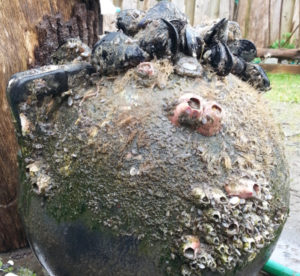
Black mussels, pink barnacles and other sea creatures on buoy
Mediterranean mussels, acorn barnacles and anemones crossed the Pacific on this buoy found in Long Beach, Washington, in February 2017. (Photo: Nancy Treneman)

On March 11, 2011, a 125-foot tsunami struck Japan’s Tōhoku coast, triggered by a massive earthquake just hours earlier. The cost in human life and property damage was devastating. When it receded, it set in motion another chain of events—one scientists are still watching unfold eight years later. It’s a story of millions of pieces of plastic that journeyed across the ocean, and the plants and animals that rafted with them.

Click to continue »
Share

8 Ways Nature Can Help Us Conquer
Climate Change

Thursday, November 15th, 2018

by Kristen Minogue

The United States may be officially pulling out of the Paris Climate Agreement, but scientists are still brainstorming ways the country could meet its original goals. Mother Nature can lend a far more powerful hand than we thought, if given the chance.

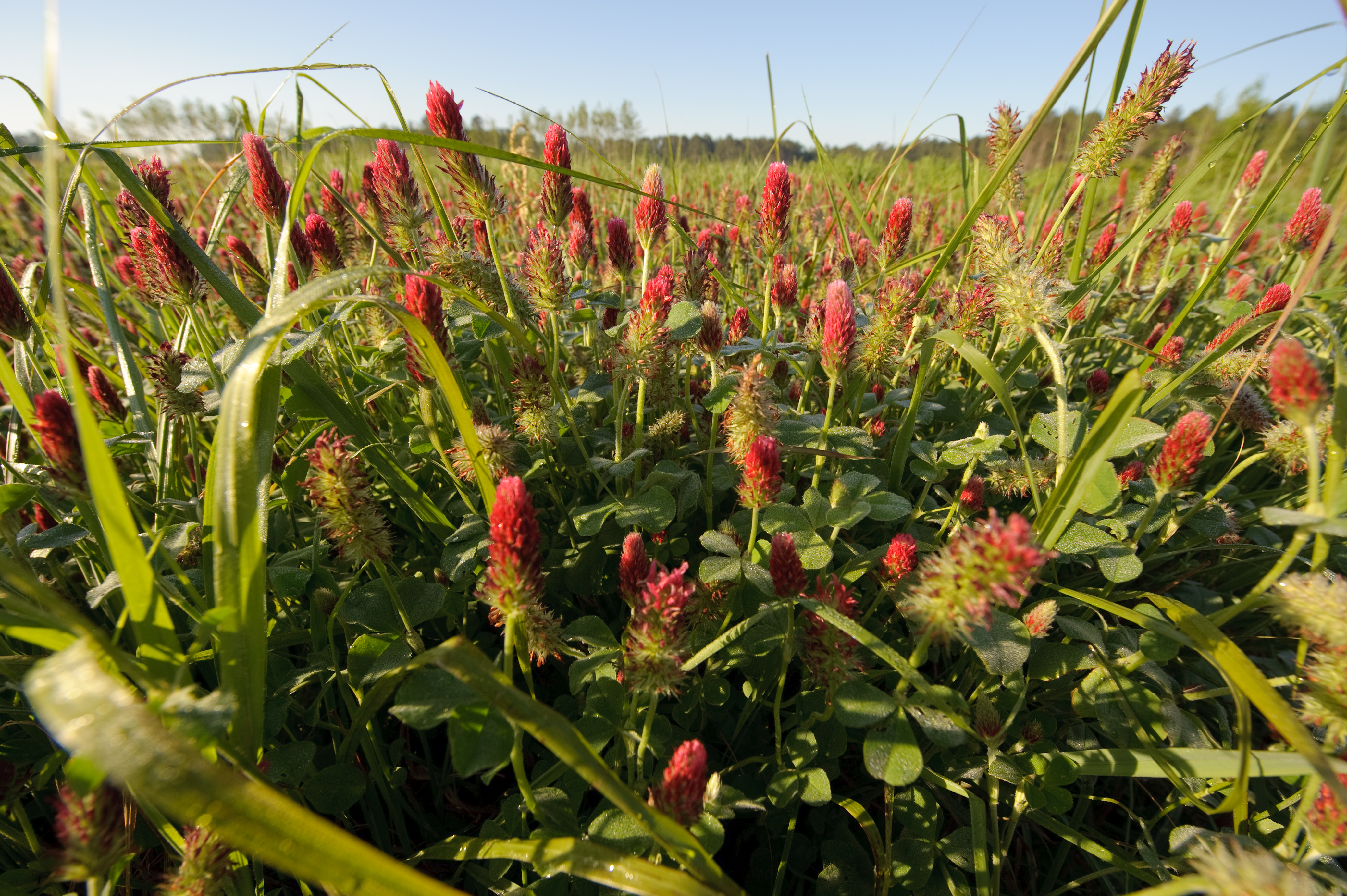
Led by The Nature Conservancy, a team of scientists from the Smithsonian Environmental Research Center and other organizations looked at 21 “natural climate solutions,” like restoring forests and wetlands or planting cover crops. According to the report published Wednesday in Science Advances, these tactics could knock an estimated 1.2 trillion kilograms off the U.S.’s yearly carbon emissions—just enough to hit the country’s 2025 targets for the Paris agreement. And they come with a range of side benefits, including increased yields for farmers and decreased risks of catastrophic wildfires.

But to work, they would also require a serious rethinking of how our society values carbon. Today, saving 1,000 kg of carbon is worth about $10. To provide enough incentive to make these solutions widespread, the authors estimated those credits would need to go for at least $100 per 1,000 kg.

We’ve highlighted eight of these solutions below, but you can read about all 21 in the full report.

Click to continue »

Share

eDNA emerges as powerful tool for tracking threatened river herring in Chesapeake Bay

Thursday, November 1st, 2018

Article contributed by the University of Maryland Center for Environmental Science

Using environmental DNA (eDNA) to track the presence of fish in waterways is emerging as a powerful tool to detect and understand the abundance of species in aquatic environments. However, relatively few studies have compared the performance of this emerging technology to traditional catch or survey approaches in the field.

Researchers from the University of Maryland Center for Environmental Science and Smithsonian Environmental Research Center field tested using eDNA—tracking the presence of fish by identifying DNA that has been left behind in the water—to detect river herring in tributaries of Maryland’s Chesapeake Bay. They found that tracking and quantifying herring DNA from the environment corresponded well to more traditional field methods and has great potential to assist future monitoring efforts of river herring abundance and habitat use.

“Sampling a single river, you need a net, crew, permits, it can be expensive,” said study author Louis Plough of the University of Maryland Center for Environmental Science. “The eDNA approach is an alternative where you just take water and you get an idea of the abundance of fish.” Click to continue »

Share

Teaching Moment: Research Takes a Right Turn

Friday, October 5th, 2018

by Philip Kiefer

In the messy world of science, real progress often happens when experiments don’t go as planned. It’s in these moments that scientists learn that the world doesn’t work like they expected. This year, two teaching fellows at the Smithsonian Environmental Research Center (SERC) had a taste of that during a summer project on oyster predation. Although the data they collected didn’t answer their questions about oysters, it did tell an unexpected story about the coastline. They’re bringing that knowledge back to their classrooms, to show students that science isn’t just about collecting facts, but about how to creatively interrogate the natural world.

This summer, SERC’s West Coast lab hosted two fellows from California’s STEM Teacher and Researcher (STAR) program. The fellowship supports STEM teachers who want to actively pursue science research during the summer in order to bring that experience back to their classrooms.

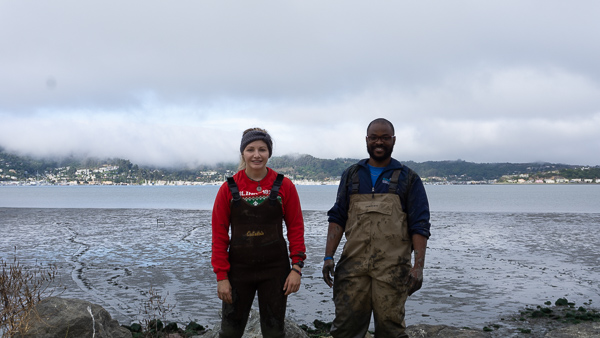
Two people standing in front of a mudflat

Evie Borchard and Jason Thomas, teacher-researchers at SERC, stand in front of prime oyster habitat in the San Francisco Bay. (Philip Kiefer/SERC)

“We want to give teachers the opportunity to do research that they can share with their students,” said Erin Blackwood, an education and outreach coordinator at San Francisco State University who organizes the STAR program locally. “At the same time, the program gives our scientists a new perspective on science education–they have to think about how they would teach their research to a high-school student.”

Click to continue »

Share

Invasive Plants Can Boost Blue Carbon Storage

Monday, October 1st, 2018

by Kristen Minogue

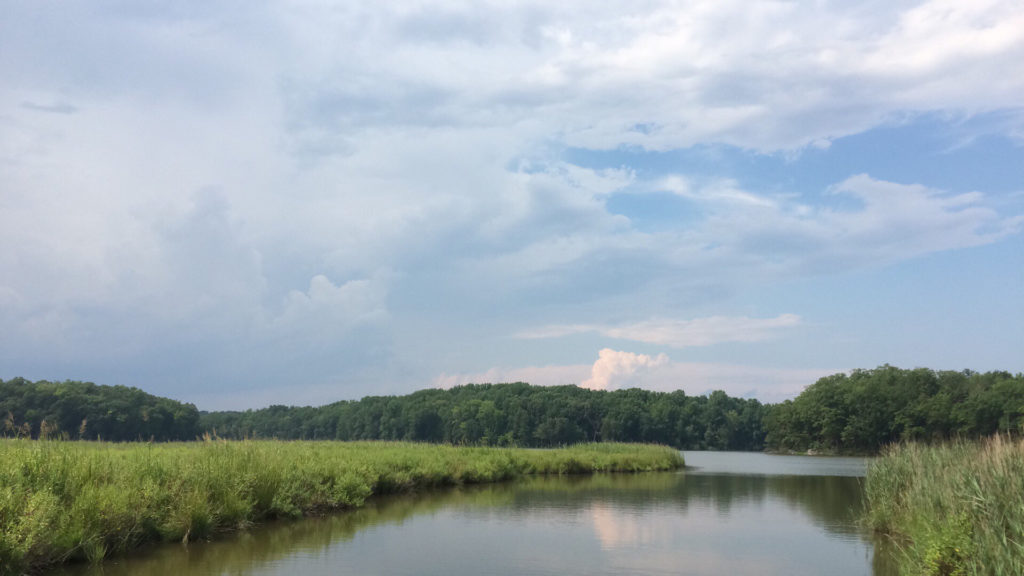
Green marsh banks alongside river on a cloudy day

Some invasive plants like Phragmites australis, the light-brown stalks on this Maryland marsh, could more than double the ability of marshes and other coastal ecosystems to store blue carbon. (Credit: Gary Peresta/SERC)

When invasive species enter the picture, things are rarely black and white. A new paper has revealed that some plant invaders could help fight climate change by making it easier for ecosystems to store “blue carbon”—the carbon stored in coastal environments like salt marshes, mangroves and seagrasses. But other invaders, most notably animals, can do the exact opposite.

Click to continue »

Share