add_filter('bloginfo_url', function($output, $property){ error_log("====property=" . $property); return ($property == 'pingback_url') ? null : $output; }, 11, 2);
 

Archives

...now browsing by author


Small Lagoon Fights Off Occupation

Tuesday, December 6th, 2011

by Monaca Noble

On a thin strip of land between Bolinas Lagoon and the Pacific Ocean lies the neighborhood of Seadrift, a community battling an invasion of crabs that have taken over their lagoon.

European green crab (BrentMWilson)

Seadrift is a small subdivision at the northern tip of Stinson Beach, Calif., sandwiched between Bolinas Lagoon and the Pacific Ocean on a narrow sand spit. It surrounds a small enclosure called the Seadrift Lagoon, an artificial lagoon created for the subdivision. It’s a popular site for visitors, and the lagoon provides recreational enjoyment for the entire community. But for the last two decades one unwelcome visitor has proven to be very bad company.
Click to continue »

Share

Six Endangered Species of the Chesapeake

Wednesday, November 23rd, 2011

by Kristen Minogue

Bat infected with deadly white-nose syndrome.
(U.S. Fish and Wildlife Service)

The last Western Black Rhino appeared in Cameroon in 2000. Now they’re gone, according to the International Union for Conservation of Nature, which declared the rare subspecies officially extinct Nov. 10. As thousands more species go extinct across the world every year, the Chesapeake Bay watershed is fighting to save its own endangered flora and fauna. Maryland counts 362 plants and animals on its endangered list – and that’s not including the ones that have already been wiped out from the state. Whales, bats, turtles and orchids: here are six of Chesapeake’s most wanted.
Click to continue »

Share

Why We Like Science

Friday, November 4th, 2011

Above: One perk of student research at SERC. Photo courtesy of the Phytoplankton Lab


It’s impossible to work here without some compulsion to understand the natural world – whether it’s colonial tunicates that bear a creepy resemblance to the Borg or endangered orchids that need microscopic fungi to survive. So when Smithsonian Magazine launched a “Why I Like Science” series on their blog Surprising Science, we took full advantage of the opportunity to share our enthusiasm. Here’s how four staff responded when asked why science is cool.

Click to continue »

Share

Hurricanes, Snakeheads and Dead Zones: What 2011 Weather Meant for the Chesapeake

Wednesday, October 5th, 2011

by Kristen Minogue

Credit: NOAA Photo Library

Let’s face it, the East Coast has had an incredibly bizarre year. In 2011 so far, we’ve seen the coldest January on record, the hottest month on record (July), a hurricane, a tropical storm and an earthquake (we’re not even going to touch the last one – we’ll leave that to our colleagues at Natural History). And to top it off, August and September drenched us with uncharacteristically high rainfall. While SERC tends to focus on the long-term picture rather than brief snapshots, this year has prompted more than a few raised eyebrows among our scientists. What does it mean for the environment? What does it mean for Chesapeake Bay? And can any of it be linked to climate change?

Click to continue »

Share

How the West Was Won (Back)

Tuesday, October 4th, 2011

by Monaca Noble

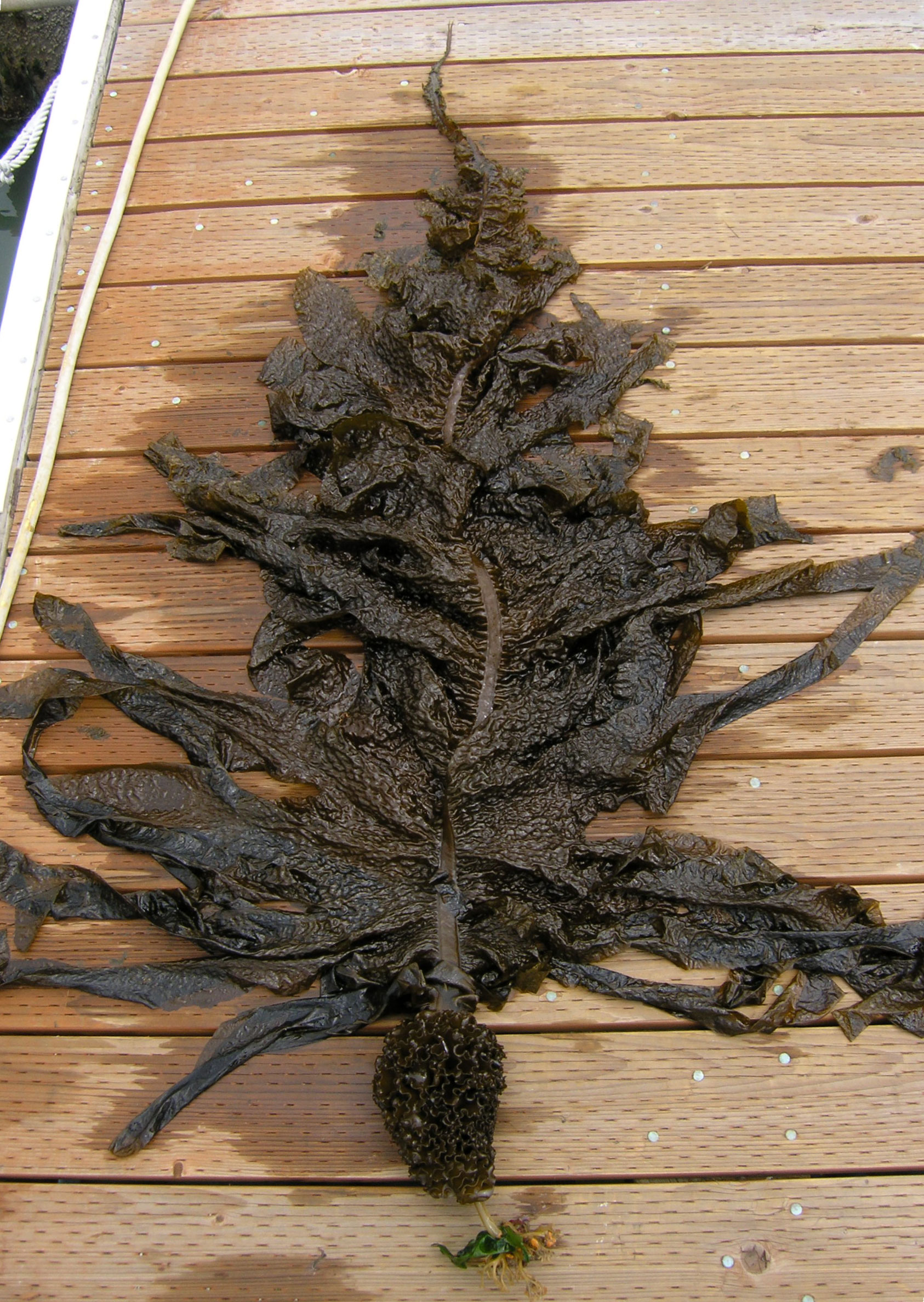
Over the last two years, more than 150 volunteers have been working to remove an invasive Asian kelp from marinas in San Francisco Bay.

Undaria_mature

Undaria pinnatifida, grown to maturity. (Credit: SERC)

Undaria pinnatifida, also known as Asian Kelp, Wakame or just Undaria, is a fast-growing kelp that fouls ship hulls, nets, fishing gear, moorings, ropes and other marine structures. As a fouling species, Undaria causes economic and ecological damage and competes for light and space with native organisms, altering their ecosystems. The kelp is native to the northwest Pacific – Korea, China, Hong Kong, and Japan – where it is cultivated for food. But starting in the 1980s, it appeared in France, New Zealand, Australia, Argentina, and California.
Click to continue »

Share

The Satellite That Could Save the Coasts

Friday, September 16th, 2011

by Kristen Minogue

On a hot afternoon in July, a team of researchers sailing down Chesapeake Bay stumbled across a cluster of striped bass floating in the water. About a dozen of the iridescent black and silver fish bobbed at the surface near the ship’s bow. All of them were dead.

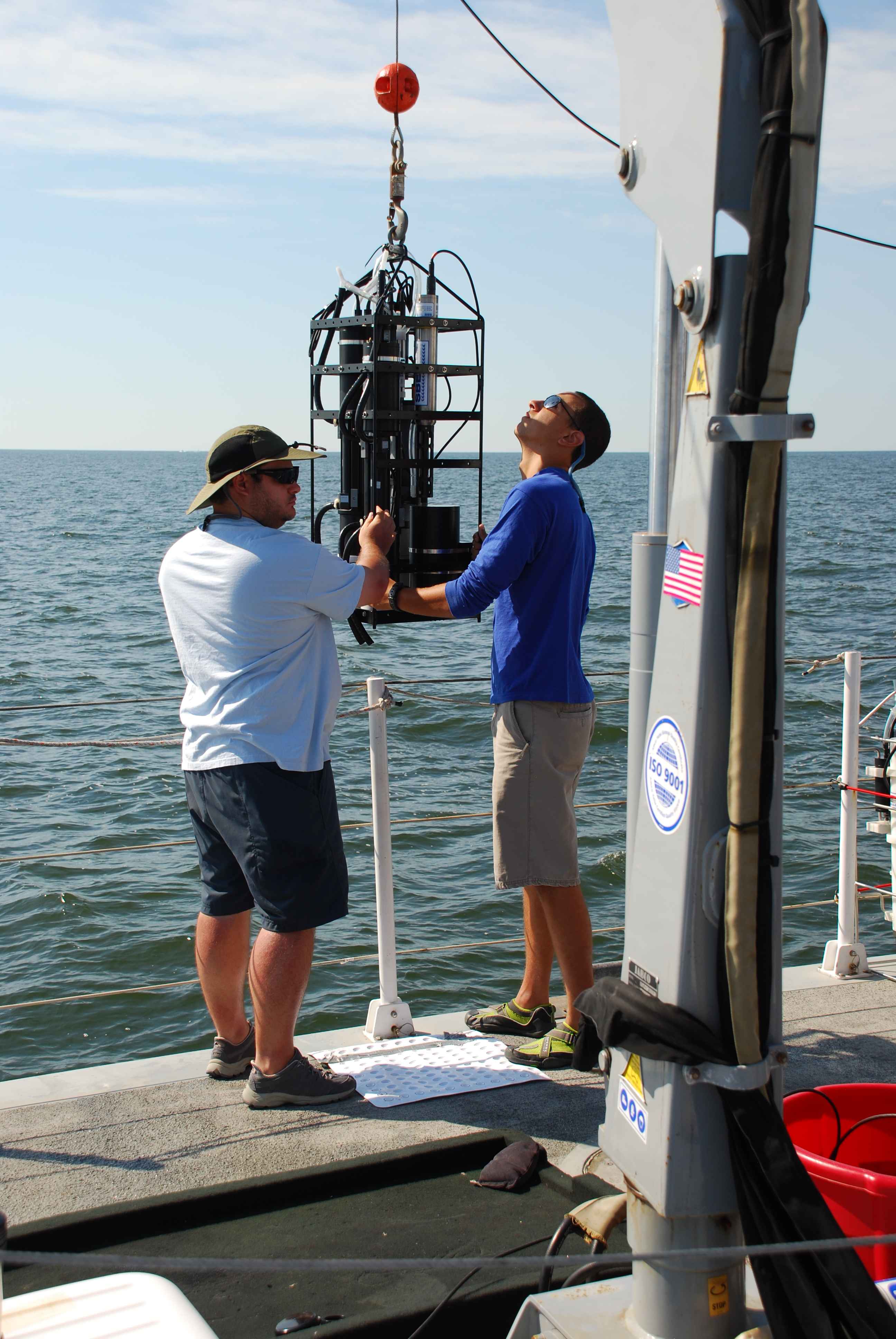
Scientists prepare to measure how light interacts with particles in the Bay. Credit: Carlos DelCastillo

The fish kill came out of a low-oxygen zone near Annapolis, just one symptom of the Bay’s declining health. Overflows of nutrients from farms and cities have fueled massive growths of algae that cut off light and oxygen to the Bay’s lower levels.

“There was a very quiet moment between everybody on the boat,” recalled Vienna Saccomanno, one of the Smithsonian research interns aboard when it was discovered. “You kind of knew what everyone was thinking, feeling empowered to continue with this research and hopefully contribute to prevention of this in our water system.”

The scientists on board weren’t there simply to document the Bay’s many ailments, however. They had joined the 10-day cruise to pave the way for a much larger goal: a geostationary satellite that could provide constant, detailed coverage of coastal health.
Click to continue »

Share

Marshes, Microbes and the Other Blue Carbon

Tuesday, September 6th, 2011

by Kristen Minogue

Tidal marshes have long been lauded as carbon sinks for their ability to pull CO2 from the atmosphere and bury it in the soil, what scientists have taken to calling “blue carbon.” But wetlands are also notorious methane emitters. Now ecologists suspect that only a select few wetland types can reliably act as sinks, and that number may shrink as sea levels rise.

tidal wetland

The Kirkpatrick Marsh on SERC's campus in Edgewater, MD. Tidal wetlands both store and release greenhouse gases. Which will prevail as the planet warms is a question ecologists are still trying to answer. (Credit: Gary Peresta/SERC)

Scientists estimate wetlands are responsible for anywhere from 15 to 45 percent of all methane emissions – a wide range that makes predicting their role in climate change difficult. However, that role could prove critical in the years to come. Methane (CH4) is a far more potent greenhouse gas than carbon dioxide. Over the course of a century, a single gram of methane is roughly 25 times more powerful than a gram of CO2.
Click to continue »

Share

Intern Logs: A Soldier and a Scientist

Friday, August 19th, 2011

This summer the SERC interns had a unique addition to their ranks – Iraq veteran Kiel Edson, a former Marine finishing his last year of undergrad at California State University, Sacramento. In this edited Q&A, the 28-year-old shares thoughts on Iraq, SERC and the transition from soldier to researcher.

Edson1

After five years working as a Russian linguist for the Marines, 28-year-old Kiel Edson started college and discovered his passion for conservation biology. (Credit: Michael Tobias.)

What kind of work did you do for the Marines in Iraq?

E: I was part of a group of what’s called Signal Support Team. We basically go out onto missions off the base, closer to the main cities, and we collect intelligence on what’s happening within the city. And then anything relevant that we find, we basically just write-up in situation reports or intelligence reports and send them off to the commanders who are making decisions as to how to handle the situations in that city. We just tell them, hey, they know that you’re going to ambush, or they know about the convoy going through on Thursday, so that they can change the way that they operate to avoid taking casualties, or they know going in there’s going to be a firefight, so everybody’s prepared for it. It’s not a surprise.
Click to continue »

Share

Hunt for a Missing Nutrient

Wednesday, August 17th, 2011

by Kristen Minogue

Leviton

Intern Ginny Leviton (left) and Vienna Saccomanno sample groundwater from a drainage ditch, trying to pin down the exact spot where the nitrogen goes missing. (Credit: Tom Jordan)

The Choptank watershed has SERC researchers baffled. On the eastern shore of Chesapeake Bay, roughly a 75-minute drive from SERC, the groundwater flowing into the Choptank River passes through a cornfield – a likely source of nitrogen, a nutrient that can wreak havoc on the Bay’s ecosystem if it runs too high. But something is happening to the nitrogen here before it reaches the Bay. Nutrient ecologist Tom Jordan and his research team have spent the better part of a year trying to figure out what.
Click to continue »

Share

Intern Logs: Witness to an Invasion

Tuesday, July 19th, 2011

snakehead students

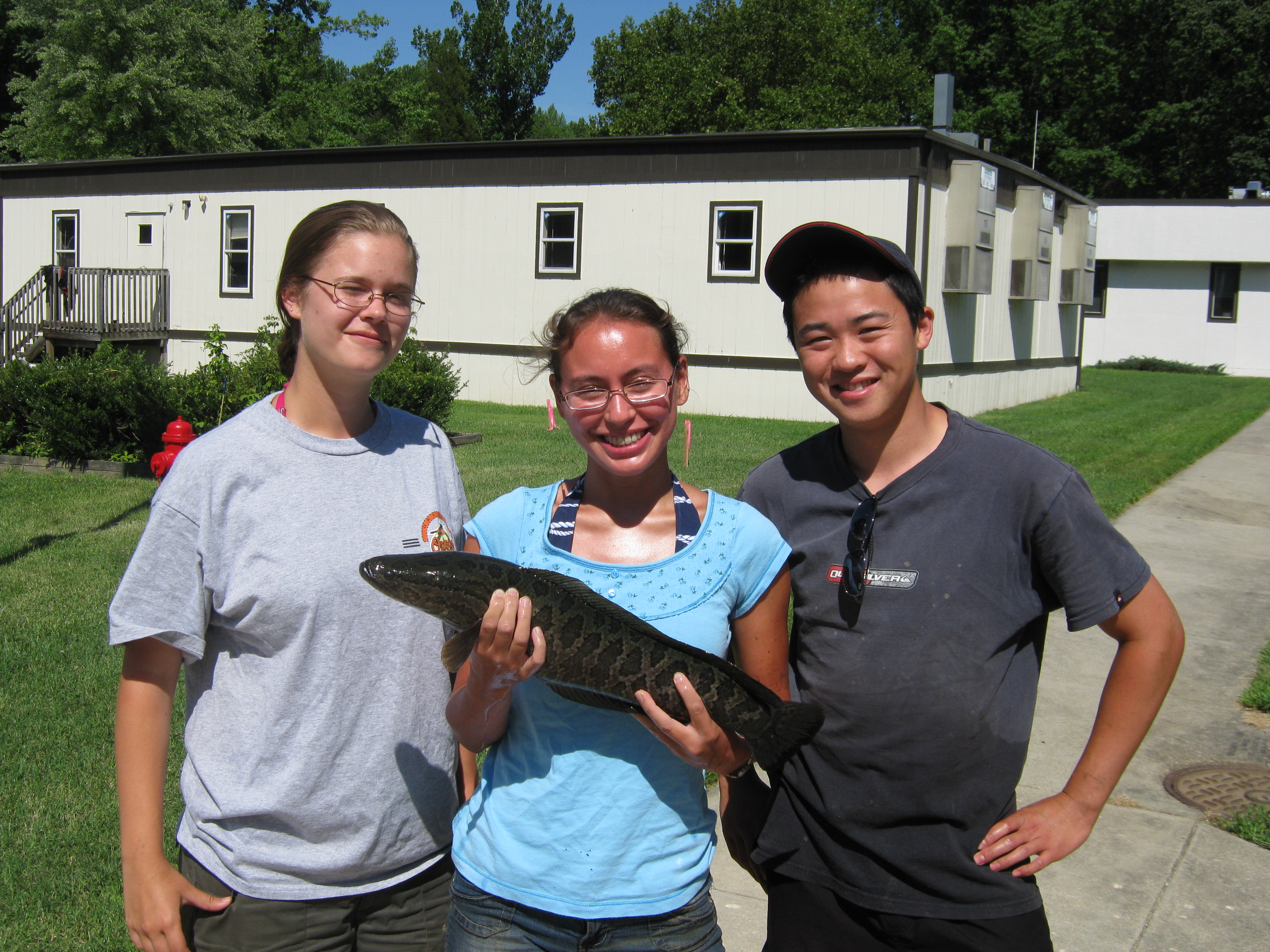
Students on the SERC sampling team, with the 23-inch female snakehead fish they helped ensnare: Diana Sisson (intern), Alison Everett (visiting student), and Philip Choy (intern).

First-hand accounts of the snakehead capture from two interns on the seining survey.

It was around 3 p.m., and it was time to pull the last seine net of the day. We had been out on the water since 10 a.m., and we had already caught a few rarer species, including a stingray and a few juvenile Common Carp. Research biologists Eric Bah and Stacey Havard volunteered to pull what may be the seine of their career.
Click to continue »

Share