add_filter('bloginfo_url', function($output, $property){ error_log("====property=" . $property); return ($property == 'pingback_url') ? null : $output; }, 11, 2);
 

Climate Change

...now browsing by category


How the “Blue Methane” Team Used COVID Restrictions To Get More Data Than Ever

Thursday, April 15th, 2021

by Kristen Minogue

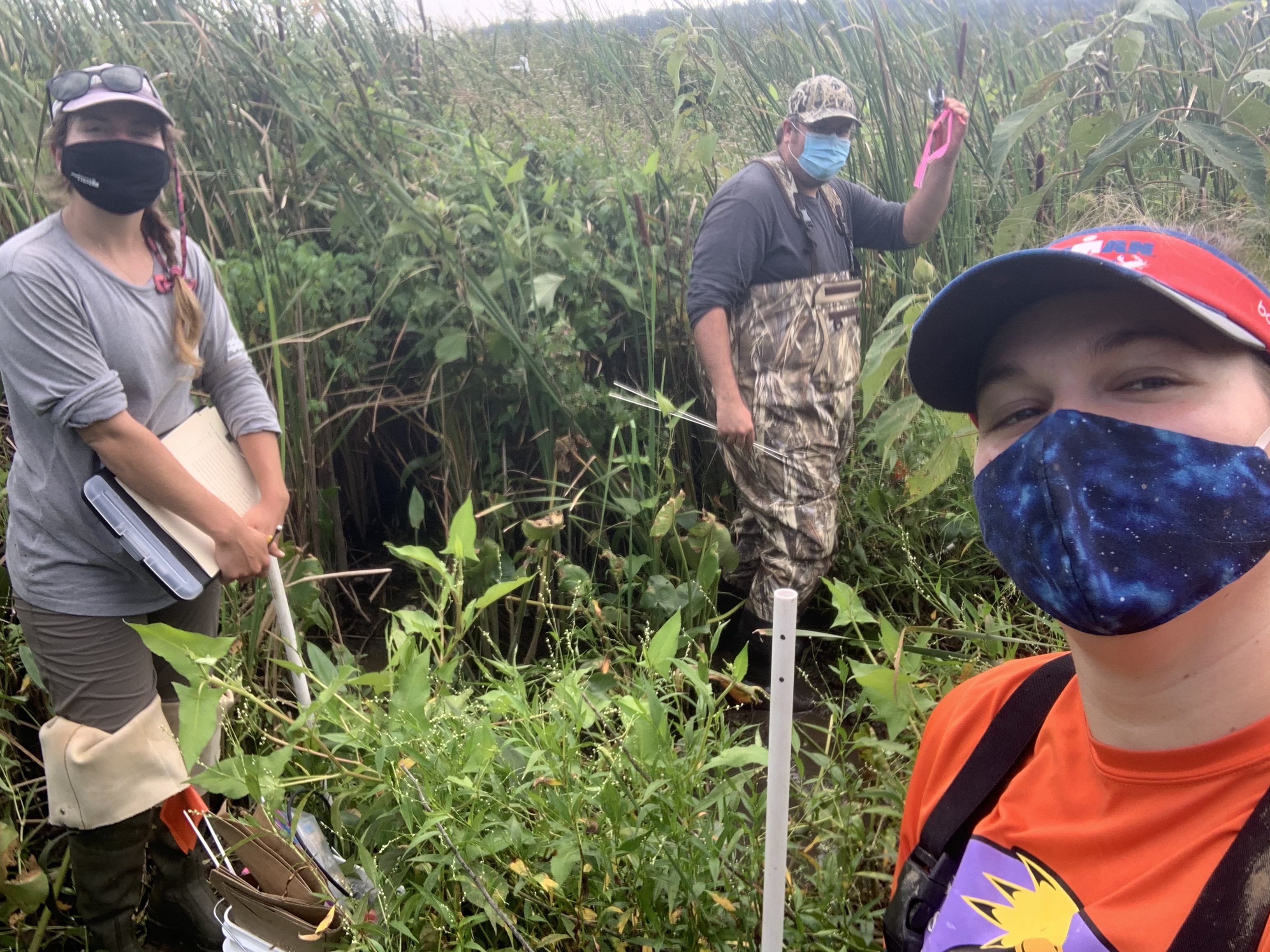
Three scientists in masks taking measurements in a wetland

Erika Koontz (right) pauses for a selfie with Shelby Cross (left) and Kyle Derby (center) while doing methane sampling in Maryland’s Jug Bay, one of the few sites she could visit in-person during the pandemic. (Credit: Erika Koontz)

This article is part of a series of posts highlighting research the Smithsonian Environmental Research Center is continuing to do amid the COVID-19 pandemic, and adaptations its staff have been making in a more socially distant world.

Like many scientists, Erika Koontz was hired for a specific project. She had just begun a job as a technician with the Smithsonian Environmental Research Center’s Biogeochemistry Lab. Her new supervisor, James Holmquist, had an ambitious goal in mind: Uncover how wetlands across the U.S. store—or emit—the powerful greenhouse gas methane. They called it the Blue Methane project.

“It’s a dataset that’s really never been attempted before, to be housed under one single project,” Koontz said. During field season, Koontz would visit wetlands on the East, West and Gulf Coasts, sampling methane in their porewater and measuring the flux of methane into and out of their soils.

Koontz started her job in March 2020. Enough said on that subject.

The next six months were some of the busiest of her life.

Click to continue »

Share

TEMPEST Experiment Mimics Future Storms Inside Forests

Monday, December 7th, 2020

by Aliya Uteuova

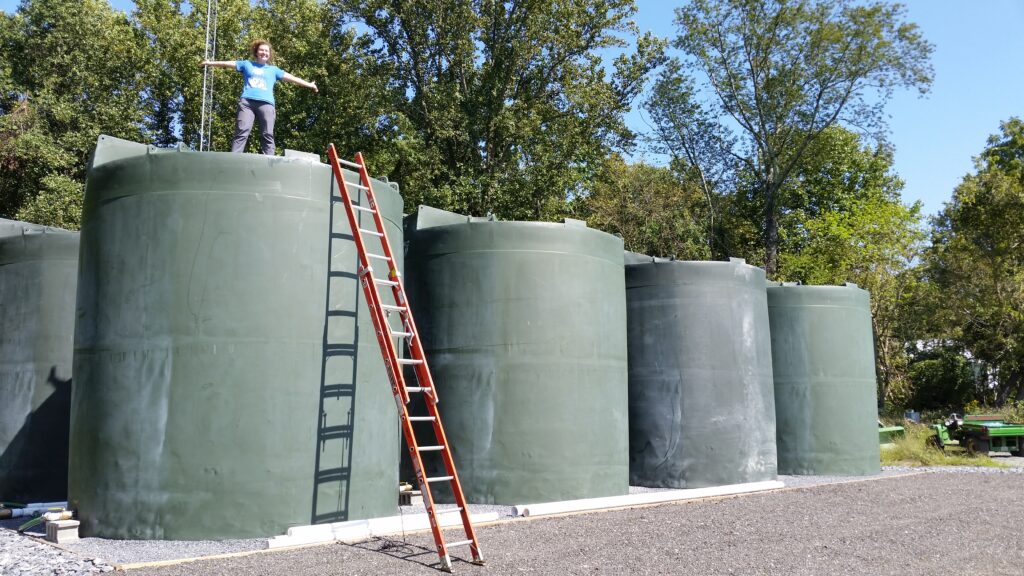
Woman standing with outstretched arms on one of four giant grey tanks, with an orange ladder propped up beneath her.

Postdoc Anya Hopple stands atop freshwater tanks for the new TEMPEST experiment. Each tank can hold 10,000 gallons of water, which will saturate forest soils to simulate heavy rainfall events. (Credit: Rick Smith)

Heavy rainfall and storm surges rank among the most common natural-weather events in the United States. They can occur in every state. They’re also one of the most widely felt impacts of climate change, making it impossible to ignore the economic and physical harm they leave in their wakes.

In a forest at the Smithsonian Environmental Research Center (SERC), scientists are working to uncover how sudden deluges could impact forests in decades to come. Called TEMPEST, the new experiment will mimic intense freshwater rainstorms and saltwater storm surges by inundating parts of the forest.

Click to continue »

Share

Sharks Tags Reveal Endangered Species Returning To Natural Refuge

Wednesday, November 18th, 2020

by Kristen Minogue

In the coastal waters of the mid-Atlantic, an endangered shark is making a comeback. Led by former Smithsonian postdoc Chuck Bangley, scientists at the Smithsonian Environmental Research Center (SERC) tagged and tracked nearly two dozen dusky sharks over the course of a year as part of the Smithsonian’s Movement of Life Initiative. They discovered a protected zone put in place 15 years ago is paying off—but it may need some tweaking with climate change.

Dusky sharks are what Bangley calls “the archetypal big, gray shark.” Born three feet long, as babies they’re already big enough to prey on some other shark species. But they’re slow growing. It can take 16 to 29 years for them to mature. If their populations take a hit, recovery can take decades.

The sharks’ numbers plummeted in the 1980s and 1990s, when well-intentioned managers offered sharks as an “alternative fishery” while other stocks, like cod, were collapsing. The overfishing that followed wiped out anywhere from 65 to 90 percent of the Chesapeake’s duskies, said Bangley, now a postdoc at Dalhousie University in Nova Scotia. Managers banned all intentional dusky shark fishing in 2000. Five years later, they created the Mid-Atlantic Shark Closed Area encompassing most of the North Carolina coast. The zone prohibits bottom longline fishing, which can accidentally ensnare dusky sharks, for seven months of the year.

But is the partial refuge working?

Click to continue »

Share

Global “BiteMap” Reveals How Marine Food Webs May Change With Climate

Monday, October 26th, 2020

by Kristen Minogue

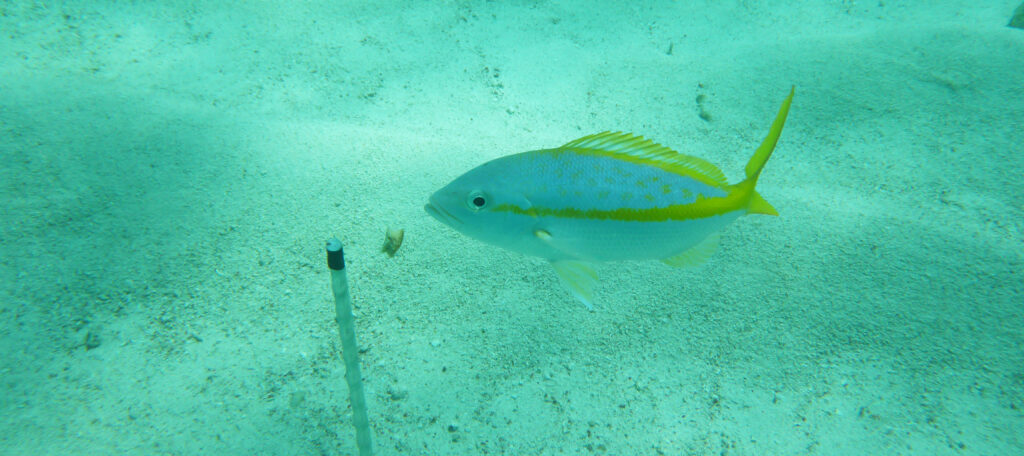
Blue and yellow fish approaching stick in sandy, turquoise water

A yellowtail fish approaches a “squid pop” in the coastal waters off Mexico. By planting squid pops (stakes with dried squid bait) in coastal waters around the world, ecologists were able to sketch a global “BiteMap” of fish feeding. (Credit: Brigitta van Tussenbroek/Universidad Nacional Autónoma de México)

Where are small marine animals most vulnerable to getting eaten? The answer has big consequences for coastal ecosystems, where most of the world’s fishing takes place, since predators can radically change underwater communities. In a new study published in Proceedings of the National Academy of Sciences Oct. 26, an international team of scientists sketched the first global “BiteMap” showing where the ocean’s mid-sized predators are most active. By fishing with dried squid baits called “squid pops,” they discovered rising temperatures can shape entire communities of predators and have potential impacts lower down the food web.

“We know that communities around the world are changing with climate warming,” said Emmett Duffy, co-author on the paper and director of the Smithsonian’s Marine Global Earth Observatory program. But while warmer temperatures generally increase animal activities like eating, researchers are only just starting to grasp what those changes mean for marine ecosystems as a whole. “We might expect a soccer team, for example, to perform better in warm weather than in really cold conditions. But what if in the warmer conditions, the team switches out for different players? That can completely change the game.”

Click to continue »

Share

When Forests Grow Back Naturally, Climate Change Takes A Hit.

Friday, September 25th, 2020

by Aliya Uteuova

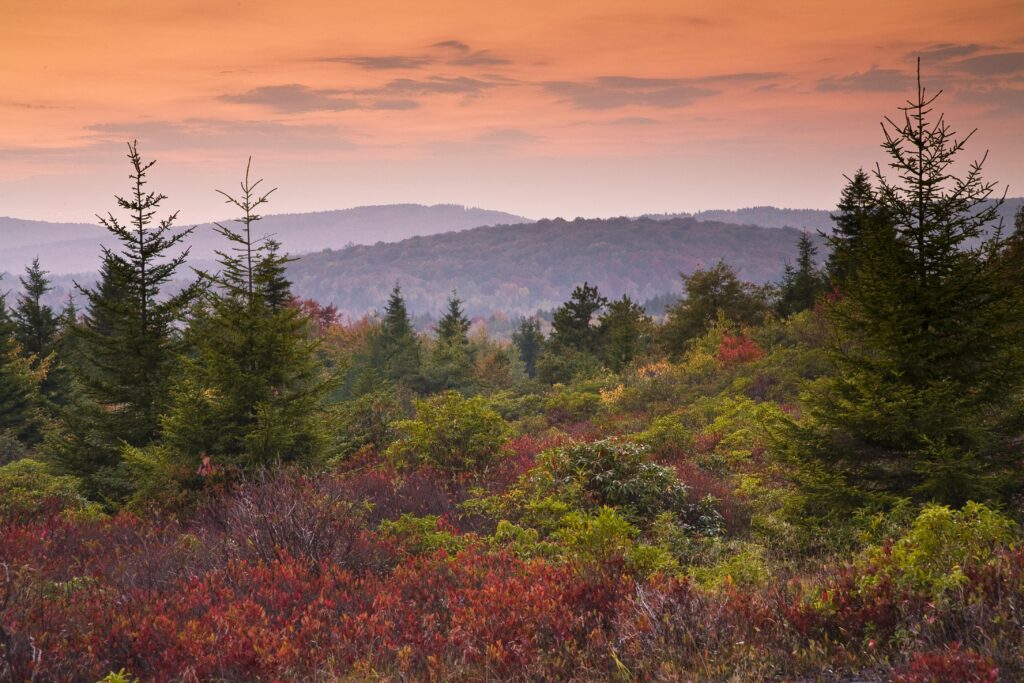
Mountain forests with red, purple, yellow and green foliage.

Fall color in the Dolly Sods Wilderness, part of Monongahela National Forest in West Virginia. “Natural forest regrowth,” a climate-mitigation strategy where forests regrow without human interference, could store 1.6 billion metric tons of carbon annually. (Credit: Kent Mason)

Trees have a powerful ability to absorb carbon dioxide, and a lot of it. According to the Environmental Protection Agency, American forests offset about 12% of the carbon emissions the U.S. creates each year from fossil fuels. While it’s great to plant trees, it can be costly. It’s also important to plant the right species in the right places to avoid disrupting other ecosystems. A major new study published Sept. 23 highlights the potential of an alternate strategy—natural forest regrowth—which can soak up excess carbon and help mitigate climate change.

Click to continue »

Share

Carbon Sensors in the Time of Coronavirus

Friday, August 21st, 2020

by Isabella Eclipse

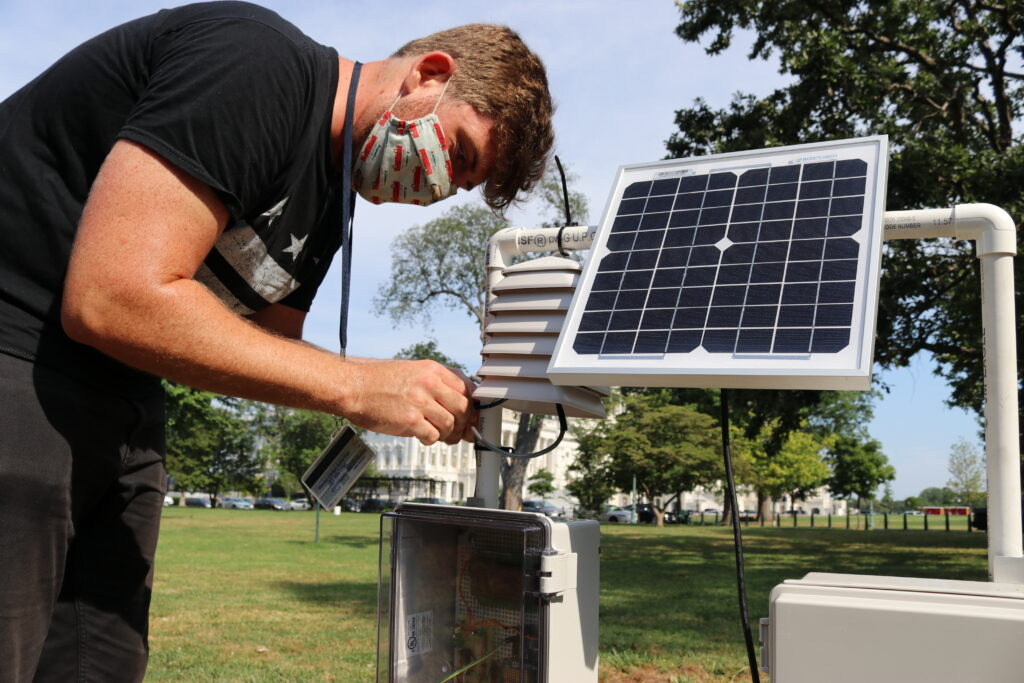
Young man in mask on a green lawn next to solar panel

Marc Rosenfield sets up a carbon cycling sensor outside the U.S. Capitol Building. (Credit: Megan Wilkerson)

This is the second in a series of posts highlighting research the Smithsonian Environmental Research Center is continuing to do amid the COVID-19 pandemic, and adaptations its staff have been making in a more socially distant world.

When the pandemic hit, many scientists’ field sites closed down, bringing countless research projects to a screeching halt. Marc Rosenfield, a graduate student at George Washington University, found himself in this exact situation when the Virginia Coast Reserve shut its doors. An ecosystem ecologist, Rosenfield was studying the exchange of carbon between the land and the atmosphere. He’d planned to deploy carbon sensors to understand how carbon exchange differs when moving from marshes to surrounding forests.

Instead of giving up, Rosenfield switched gears and transformed his research into a citizen science project. He, along with his dedicated undergraduate assistant Leona Neftaliem, reached out to colleagues in Washington, D.C., to see if anyone would allow the setup of carbon sensors in their backyards. To his surprise, an overwhelming number said yes. Soon, strangers were asking him to set up sensors on their properties. Today, Rosenfield has 30 sensors in locations across D.C., from private backyards to the U.S. Botanic Garden. There’s even one at the famous 9:30 nightclub.

Click to continue »

Share

U.N. Report Puts Spotlight on Seagrasses

Friday, July 31st, 2020

by Isabella Eclipse

Video created by United Nations Environment Programme

Appearances can be deceiving. At first glance, the humble seagrass meadow resembles a weedy underwater lawn. A closer look reveals one of the most important—and threatened—marine ecosystems in the world. Unfortunately, conservation efforts have often overlooked seagrass habitats.

“For a long time, people saw seagrass as a nuisance,” explained Jonathan Lefcheck, a biologist with the Smithsonian Environmental Research Center. It had a reputation for clogging boat propellers and washing up on beaches. “Tropical resorts would hire people to dig up seagrass in front of their beach because people would complain,” he added.

Though public perceptions have been changing, many people today are still unaware that seagrass meadows are rich and vibrant ecosystems like coral reefs or rainforests. A new report from the United Nations Environment Programme hopes to change that. Released June 8 on World Oceans Day, Out of the Blue compiles the latest findings from around the world on seagrasses and the valuable services they provide. SERC biologist Emmett Duffy served on the steering committee and helped synthesize the report.

Click to continue »

Share

Preserving Salmon in Alaska’s Kenai Lowlands

Wednesday, April 15th, 2020

by Kristen Minogue

“Not everybody in Alaska is a fisherman. But all of us live on salmon land….If you look at a map of the Kenai Peninsula, it just looks like a cardiovascular system. Salmon are like the heartbeat.”

These words, spoken by a young Alaska fisherwoman named Hannah Heimbuch, open a short documentary the Smithsonian created called The Heartbeat. Featured in the D.C. Environmental Film Festival this March, it tells the story of Alaska’s Kenai Lowlands—one of the few places on Earth where sustainable salmon management remains possible. Click to continue »

Share

Volunteer Spotlight: Student Activist Kallan Benson on Standing Up for Climate Change

Tuesday, April 14th, 2020

by Kristen Minogue

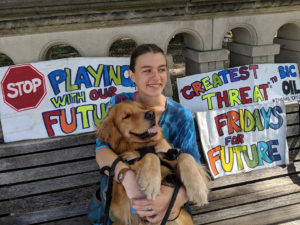
Teenage girl in blue tie-dye shirt sitting on a bench holding a golden retriever. Posters behind her read "Stop playing with our future" and "Fridays for Future" in rainbow marker.

Kallan Benson with her family’s golden retriever, Osage. The dog is their unofficial “Climate Anxiety Therapy.” (Credit: Carl Benson)

It would be tempting say Kallan Benson isn’t your typical teenage student. Homeschooled since preschool age, she has plenty of memories of doing homeschool programs at the Smithsonian Environmental Research Center with her younger brother, Reese.

“We made toothpaste one time,” she recalled. “Reese’s group, him and two of our other friends, their strategy was just put everything in….Every flavor, they just put it all in. No one wanted to taste it.”

But as an organizer for the grassroots climate group Fridays For Future, Kallan is one of thousands. Possibly even tens of thousands. The tidal wave of students striking to demand climate action is gaining momentum, and Benson is among those leading the charge. Click to continue »

Share

Christine Arena: Determined Optimism and Letting Science Speak

Tuesday, April 14th, 2020
head and shoulders picture of young woman with brown hair, in a black jacket and white blouse

Filmmaker and science communicator Christine Arena (Photo courtesy of Christine Arena)

A communicator with a passion for environmental and social issues, Christina Arena left her mark on the environmental film world with the 2018 series Let Science Speak. The short documentary videos go beyond the “war on science” headlines to humanize scientists and let them tell their own stories. Today, she’s donating her time and talent to help produce videos for the Smithsonian Environmental Research Center (SERC). Her newest short film will premiere this April at the Smithsonian’s digital Earth Optimism Summit April 22-24. In this Q&A, she talks about what gives her purpose and optimism. Click to continue »

Share