by Kiran Das-Goel
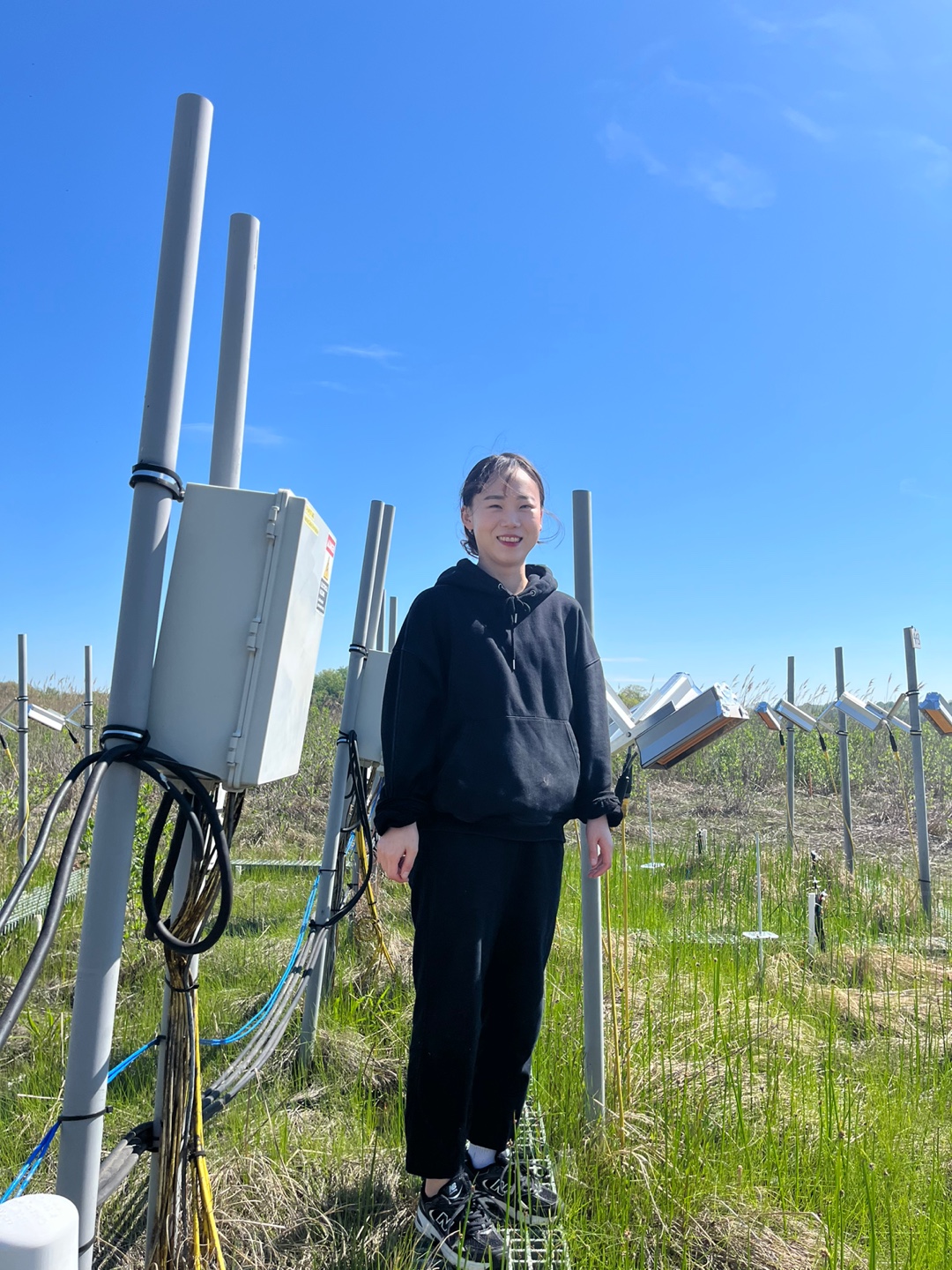
Leaves were changing, the sky was bright and nearly cloudless, and Yerang Yang was looking out into a glimpse of the future. Scientists had controlled the wetlands surrounding her for more than 40 years. In some plots, infrared lamps and underground wires heated the soil. In others, experimental chambers received extra carbon dioxide to simulate a ore carbon-rich atmosphere. Here, on the Global Change Research Wetland, the Smithsonian Environmental Research Center (SERC) was studying climate-driven changes across an entire ecosystem.
She had never seen climate experiments of such scale before.
“It left an impression on me,” said Yang. “I made myself a promise that someday I would build a site like that in Korea.”
Building Blocks
Enter: FreViEW (or “Forest Response to Variability in Ecosystem Warming,” if you’ve got the time).
FreViEW, a collaboration between the Korea Institute of Science and Technology (KIST) and SERC, is a large-scale, long-term forest warming experiment taking place in Seoul, Korea. Unlike previous climate experiments, it uses “pulse heating,” where plots of forest experience a more accurate version of climate change, complete with temperature spikes.
“In the future, there’s going to be more variability in temperature, which doesn’t give plants and microbes time to adapt,” said Jaehyun Lee, senior researcher at KIST and former postdoctoral fellow at SERC. Lee notes that when temperatures get too hot, plants stop performing photosynthesis. This could mean summer months where forests no longer take up carbon.
Click to continue »