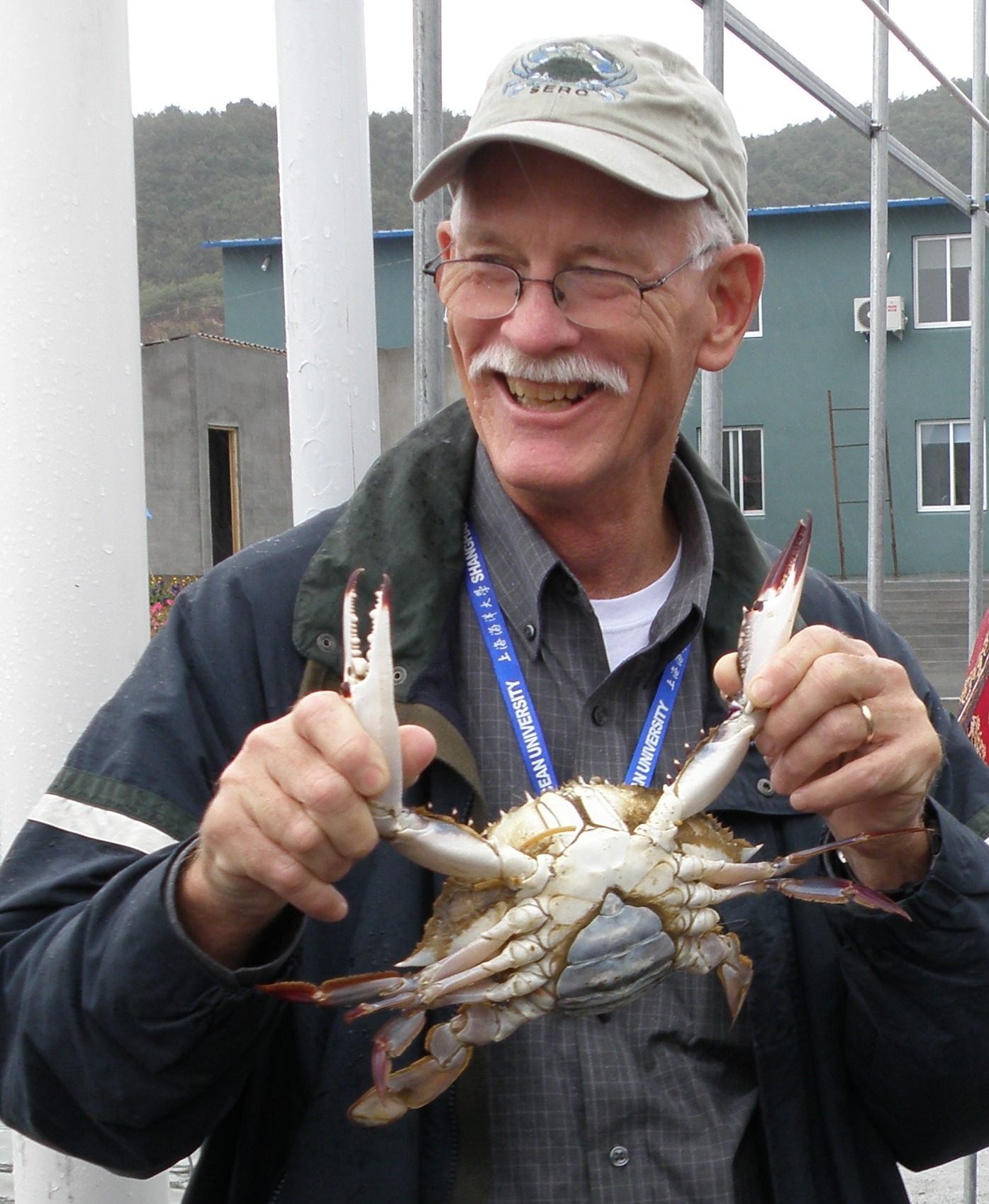
Anson 'Tuck' Hines, director of the Smithsonian Environmental Research Center
This spring we celebrate the 40th Earth Day – an anniversary marking a journey of commitment for me and others at the Smithsonian Environmental Research Center. For the first Earth Day in 1970, I was a new graduate student at University of California, Berkeley. Then as now, it was a raucous time with the country at war and intense focus on civil rights and the role of government.
The first Earth Day developed as a grassroots movement with teach-ins focused on the environment. I focused on a career in ecology, but Earth Day inspired my commitment to solutions for human impacts on the biosphere. In the ivory tower of Berkeley, applied research was then portrayed as a lower calling to “pure research.” But I was committed to merging fundamental ecology applied to human impacts, now a hallmark of SERC research. Click to continue »
“Ms. Karen’s” homeschoolers don’t give her apples to show their thanks. They leave her jars of black sand and shards of volcanic rock. It’s fitting for a teacher who packs her lessons with as much hands-on science as possible.
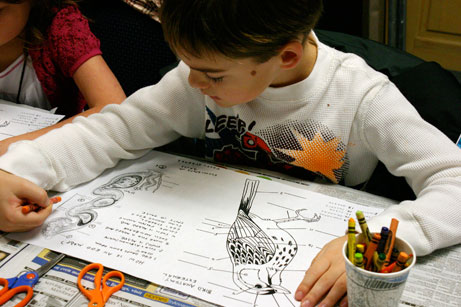
Class begins with a bird-anatomy coloring project. Photo: Kirsten Bauer
There are more than 24,000 students who are homeschooled in Maryland. This spring SERC is offering nine programs to these students. They include new classes on shark dissection and a laboratory-based class focused on Chesapeake Bay fish. Click to continue »
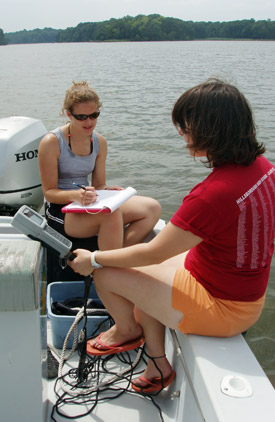
Two summer interns measure the water's dissolved oxygen concentrations. Water is typically considered hypoxic if oxygen concentrations are below 2mg/L. Photo: Courtney Richmond
Habitat destruction comes in many forms. The obvious include the clear-cutting of forests and the removal of mountaintops. Then there is the damage that’s less visible, like hypoxia.
In coastal waters around the world there are more than 500 hypoxic zones. These are areas where dissolved oxygen concentrations are so low that they threaten fish, invertebrates and aquatic food webs. Some fish manage to escape hypoxic areas, but oysters, clams and other sessile creatures are simply stuck.
Hypoxia makes the evening news when there’s a noticeable fish kill. However many of its effects are more subtle. Individuals that fail to escape low oxygen zones can suffer mortality or reduced growth and reproduction. Creatures that flee can become easy targets for fishermen and predators. Click to continue »
The non-native strain of Phragmites australis dominates many Chesapeake Bay wetlands. Photo Melissa McCormick.
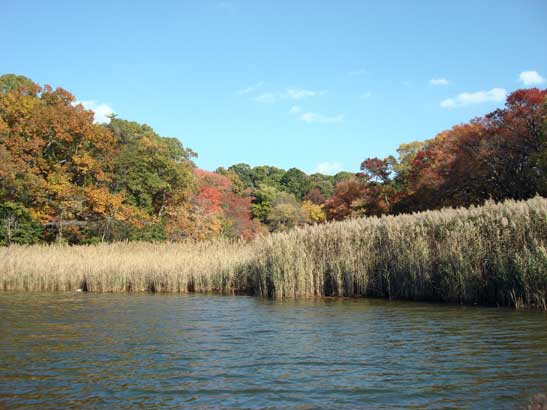
Phragmites australis took its sweet time taking over East Coast wetlands. A non-native strain of the reed arrived in the U.S. around 1800, likely stowed away in the ballast material of European ships. For nearly two centuries the plant grew in relatively small pockets along the coast. Today it’s a poster child for invasive species. In some states along the Atlantic, it covers as much as a third of the tidal wetland acreage. Among other impacts, it challenges native plants for turf. The European strain has even out-competed North America’s native P. australis. Click to continue »
For those of you wondering just what the Smithsonian Environmental Research Center is, what it looks like and what our scientists do, we offer up a slideshow tour. This was created with interns and research fellows in mind. It doesn’t capture all of SERC, but it does include shots of scientists, worms and blue crabs.
Interested in applying for an internship? The summer deadline has passed, but fall applications should be postmarked by June 1, 2010.
Find out more about SERC’s research and training opportunities on SERC’s website.
If you’re looking for a good conversation about science, history or life – talk to Bert Drake. He’s a plant physiologist and renaissance man who’s been with the Smithsonian Environmental Research Center for nearly four decades. Drake retired in January, but will continue his investigations as an emeritus scientist. We caught up with him before he took well-deserved vacation.
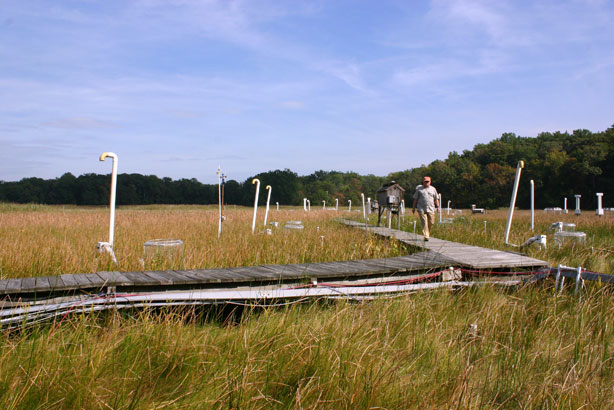
Drake's research unfolds at the Kirkpatrick Marsh, located in Maryland on a subestuary of the Chesapeake Bay.
How did you earn a living before you became a scientist?
I was a drummer in a jazz band, a ski guide, the host of a jazz radio program and a high school science teacher.
How did you get drawn to the world of plant physiology?
Nature has always fascinated me and science is about discovering how nature works. I grew up in northern Maine. My father was a barber, but loved the outdoors. I was outside year-round: skiing, canoeing, trapping animals, fishing and taking photos. I knew I wanted to do something connected with biology. I became a science teacher, but it wasn’t until I attended a summer course in ecology that I wanted to get inside a lab and practice science.
In science you almost always get an approximation of an answer because an experiment is only an approximation of reality.
For many SERC scientists, field research comes to a halt in the winter. Some manage to head off to the tropics to investigate invasive species or mangroves, but not photobiologist Pat Neale. Neale and his assistants are spending a good part of their time these days in his lab with the Beast.
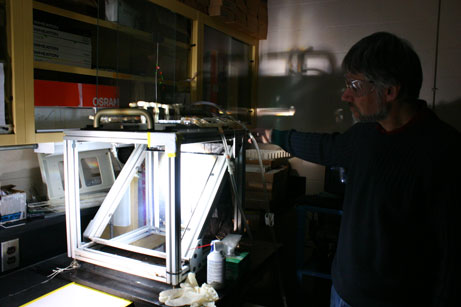
Photobiologist Pat Neale wears eyeglasses that protect him from the Beast's UV rays.
The Beast does not bite, but if you look at it the wrong way it will hurt you. In fact it can char your corneas if you’re not careful. That’s because it reflects and filters ultraviolet light. UV rays are invisible to the naked eye, but are high in energy and potentially damaging to animals and plants. As a photobiologist Neale studies how UV rays affect aquatic environments and the organisms that live in them. Click to continue »
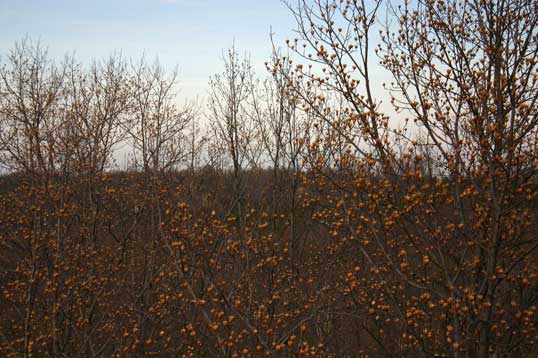
Liriodendron tulipifera, or tulip poplar, is a common tree in the temperate forests surrounding the Smithsonian Environmental Research Center. Other species include sweetgum, American beech, and southern red oak. Photo: Kirsten Bauer.
Speed is not a word typically associated with trees; they can take centuries to grow. However, a new study to be published the week of Feb. 1 in the Proceedings of the National Academy of Sciences has found evidence that forests in the Eastern United States are growing faster than they have in the past 225 years. The study offers a rare look at how an ecosystem is responding to climate change. Click to continue »
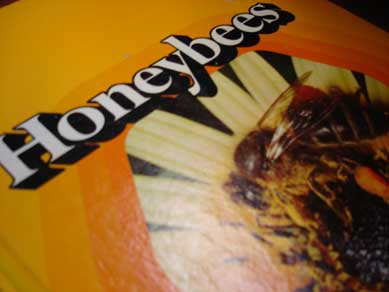
You can't be a beekeeper without doing your homework. McDonald has been reading up on bees to prepare for the new colonies.
Bees. These important pollinators have been struggling in recent years. Their populations have been declining. It’s a cause of concern for anyone who cares about the flowering plants bees help fertilize.
Karen McDonald is not one to sit idly by while a fellow member of planet Earth struggles. McDonald is an educator and the Smithsonian Environmental Research Center’s outreach coordinator. This week she and Elio Cruz prepared three beehives that – come summer – will be full of the flying honey machines. Cruz is a technician at the National Museum of Natural History. He works in the museum’s O. Orkin Insect Zoo. Click to continue »