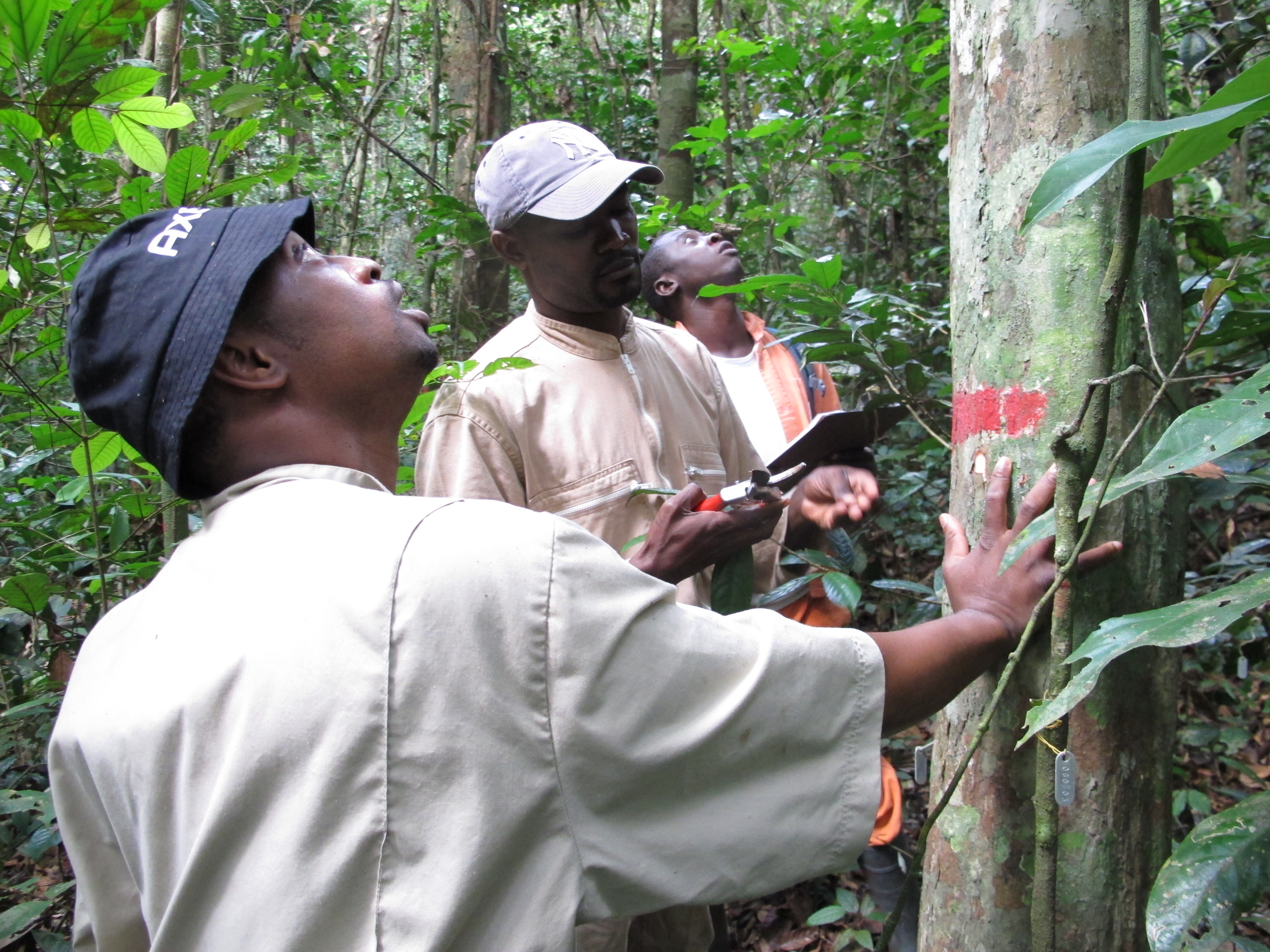
Herve Memiaghe, front, in Gabon’s Rabi forest plot. The red line marks where they measure the tree’s diameter. (Smithsonian Institution)
Herve Memiaghe isn’t the average intern. Before coming to the Smithsonian Environmental Research Center, the 33-year-old Gabonese ecologist had already earned a master’s degree and spent four years working at IRET, the Institute for Research in Tropical Ecology in Gabon. Since 2012 he has also done field work in the Rabi plot as part of the Smithsonian’s global forest study.
The 25-hectare Rabi plot sits on the southwest coast of Gabon. Diversity spikes in the rainforests of Central Africa, where a single hectare can contain more than 400 different species. And that’s just the trees. The animals bring problems of their own. In Memiaghe’s experience, it’s not uncommon for hungry elephants to eat the tree tags along with the leaves.
“Sometimes we find the tag in the dung of elephants,” Memiaghe says. Usually the scientists can figure out where the tag came from, so it doesn’t throw off their research that much. “It just maybe can be a mess for the new people.”
Before joining MarineGEO, Emmett Duffy did research in waters from Australia to Siberia. (Photo: College of William & Mary)
by Kristen Minogue
It’s “the largest, coolest marine biological project on Earth,” according to its new director, Emmett Duffy. On Sept. 16 Duffy came on board the Tennenbaum Marine Observatories Network, a.k.a. MarineGEO–the Smithsonian’s global network to monitor the oceans. So far it has four stations tracking the ocean’s chemistry and biology, from SERC in Maryland to STRI in Panama. They plan to add at least 10 more in the next decade. Now, after two months on the job, Duffy shares his vision in this edited Q&A.
What’s the main purpose of MarineGEO?
The overall goal really is a very ambitious one. In my mind, it’s to understand what’s at the heart of how marine ecosystems work…and that is biodiversity. The living web from microbes to large predators that are responsible for ecosystem processes like fish production and habitat creation. So basically what we want to do is map marine biodiversity and what it’s doing across the globe.
by Monaca Noble, Kristen Larson, Linda McCann and Ian Davidson
Video: Biologists place pennies underwater to test how well volunteers can spot small invaders
What is the Bioblitz, and why would researcher Linda McCann cash in her dollar bills for hundreds of pennies in preparation for it?
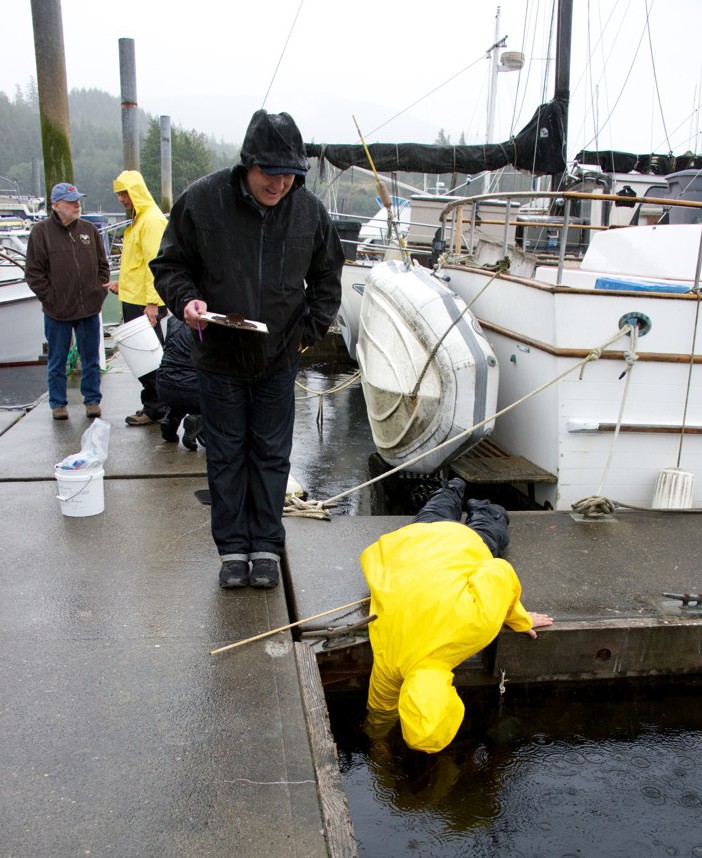
Bioblitzers braved the rain to search for invasive species. (Deborah Mercy)
A Bioblitz is an intensive survey in which trained volunteers head out en masse to catalog species in a specific area. On September 28, volunteers in Ketchikan, Alaska, joined staff from the Smithsonian Environmental Research Center (SERC), San Francisco State and the University of Alaska to search for invasive marine species along Ketchikan’s waterfront. The Marine Invasive Species Bioblitz in Ketchikan had three goals: to engage and teach the public about invasive species, detect newly arriving species that threaten Alaskan coastal waters, and recruit these enthusiastic volunteers for future monitoring efforts.
The goldenrod crab spider (Misumena vatia) blends in almost perfectly with the yellow chamomile flower. (Alvegaspar)
There’s a reason cobwebs make popular Halloween decorations. Spiders rival with snakes, birds and clowns for the most feared creatures in the animal kingdom. But some of nature’s creepiest arachnids don’t build webs at all. They ambush their prey in much more beguiling settings. Like flowers.
That’s a favorite haunt of the crab spider, one of several groups of webless spiders that hunt, instead of trap, their food. The name comes from their four long front legs, which stretch out like claws, and their crab-like method of walking—they’re better at moving sideways and backwards than forwards. But their strategy for capturing prey has earned them another common name: the ambush spiders.
Katrina Lohan and Kristy Hill collect oysters on rocks near Punta Chame, Panama. (Carmen Schloeder)
Katrina Lohan and Kristy Hill have travelled thousands of miles down the Atlantic Coast, from the Chesapeake to the Caribbean. Their goal? Track the range and distribution of parasites in bivalve mollusks that could cause disease. Based on diversity patterns, Hill and Lohan suspect that there are many more protist species in the tropics than have previously been discovered. These parasites could be very similar to the parasites that have caused mass die-offs in Chesapeake oyster beds with diseases like Dermo and MSX.
Close-up of a trematode oyster parasite. These parasites form cysts, and could be similar to the parasites that caused mass die-offs in the Chesapeake.
But there’s one catch: The protists that are parasitizing the bivalves are difficult to identify just by looking at them. Luckily for Lohan and Hill, advances in DNA sequencing can reveal secrets about little-studied and poorly understood organisms. Already famous for helping improve human health, DNA sequencing is proving equally adept at preserving the planet’s health. From the tropics of Panama to the forests of Maryland, the rise in DNA sequencing is opening new realms of possibility for ecologists at the Smithsonian Environmental Research Center and across the world.
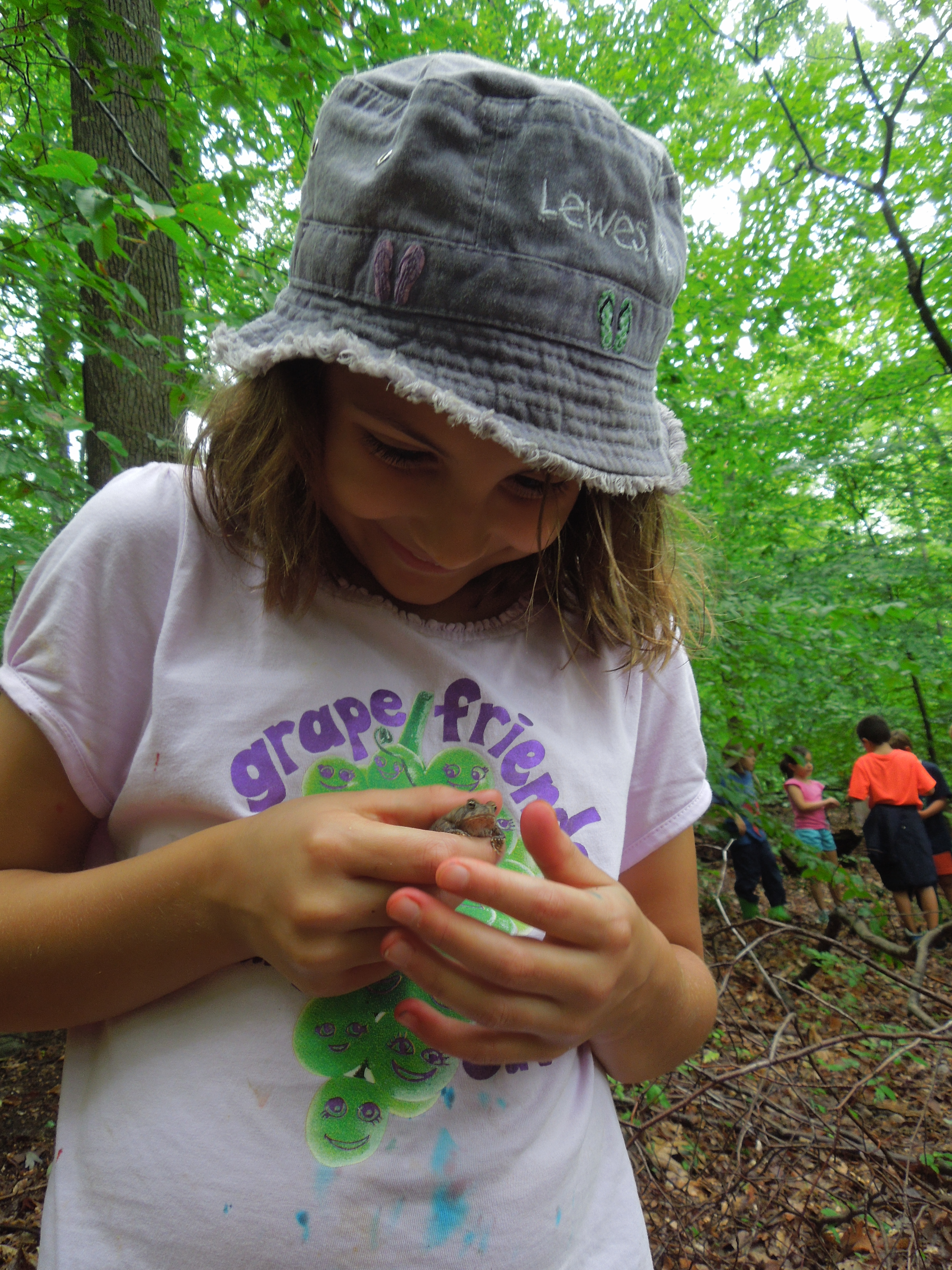
7-year-old Cecilia Bowers collects frogs in the SERC forest. (SERC)
It’s 2 o’clock in the afternoon. In the forest beside SERC’s beaver pond, Dylan McDowell and Shelby Ortiz have just finished helping a dozen 7-to-9-year-old students search for frogs and toads. They’re headed to the stream when McDowell runs into a dilemma: Some of the children don’t want to release their frogs.
“It would be really hard to find frogs around where I live,” says Emma Guy, who doesn’t have any parks or forests near her home.
“Did you know a couple years ago, they found a brand new species of frog in New York City?” McDowell asks her. He’s referring to a new species of leopard frog confirmed in 2012, whose known range has Yankee Stadium almost dead center. Closer to home, SERC biologists discovered juvenile eastern spadefoot toads in one of its wetlands this summer—the toad’s first recorded appearance on the SERC landscape. McDowell’s point, at least for the afternoon lesson: Amphibians can appear almost anywhere if you know where to look.
This finding, published Wednesday in Environmental Science & Technology, explains why methylated mercury, a neurotoxin, is produced in areas with no previously identified mercury-methylating bacteria. Methylmercury—the most dangerous form of mercury—damages the brain and immune system and is especially harmful for developing embryos. Certain bacteria transform inorganic mercury from pollution into toxic methylmercury.
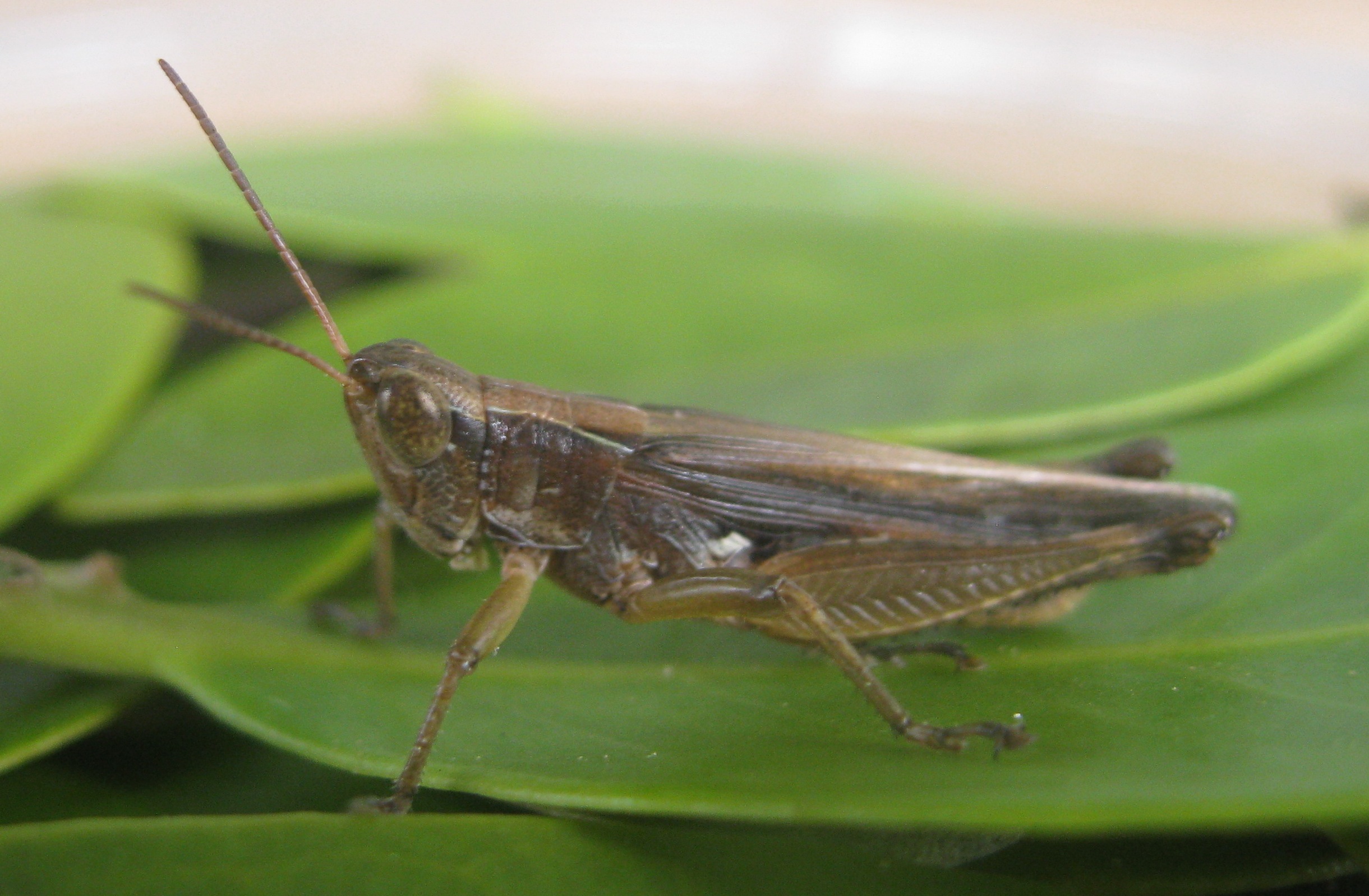
Spotted-winged grasshopper, one of two insect herbivores the team tested to see if they would eat mangrove leaves. (Alex Forde/UMD)
After spending five weeks working indoors as a research intern at the University of Maryland in College Park, walking out into the salt marsh at the Guana Tolemato Matanzas (GTM) Reserve in Florida was a welcome change of scenery. The sky was a crystal clear blue, egrets and herons soared overhead, and crabs scuttled haphazardly on the sand as we waded into the cordgrass, ready for a hard week of field work.
My mentor, Alex Forde, and I were there conducting experiments for his dissertation and for my internship project. This whole summer we had been studying plant resistance to herbivores, so we were excited to document interactions between leaf-eating insects and black mangrove trees (Avicennia germinans) in Northern Florida salt marshes.
Over the past several decades, climate change has allowed black mangroves to move north along the Florida coastline. As a result, they are invading salt marshes and coming into contact with novel herbivores that are not common in mangrove forests further south. Depending on the behavior and food preferences of marsh herbivores, these species may affect how fast mangroves spread into salt marshes and where the trees are able to survive within marsh landscapes. Therefore, we wanted to test (1) whether salt marsh herbivores will eat mangrove leaves when marsh plants are also available, and (2) if salt marsh herbivores show a preference for leaves of different ages or for trees growing in different habitats.
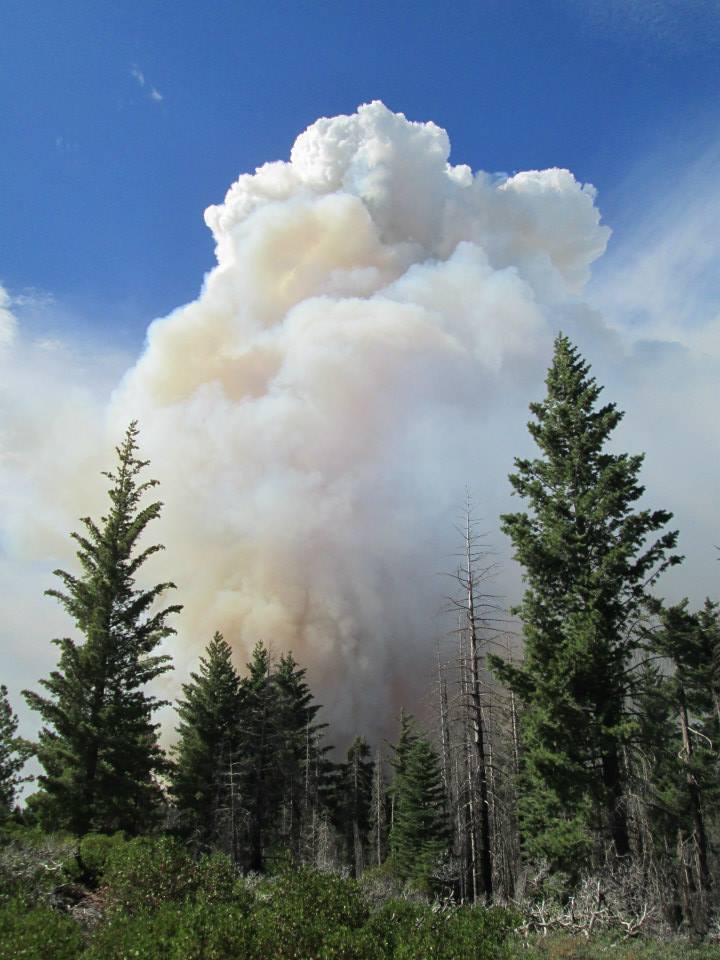
Intense fire burns near Crane Flat helibase, close to the Yosemite research plot. (Gus Smith/NPS)
As the Rim Fire burns deeper into Yosemite, park managers are fighting fire with fire—and one of the Smithsonian’s ForestGEO plots was caught in the middle this weekend.
The Yosemite Forest Dynamics Plot sits just north of Yosemite Valley, and south of the wildfire that has already consumed more than 60,000 acres of the national park. It is part of the Smithsonian’s Forest Global Earth Observatory (ForestGEO), a network of 48 plots around the globe that scientists are measuring to understand forest dynamics and climate change. Two of Yosemite’s giant sequoia groves and many large trees also sit near the plot, and managers didn’t want to see the entire forest go up in flames.
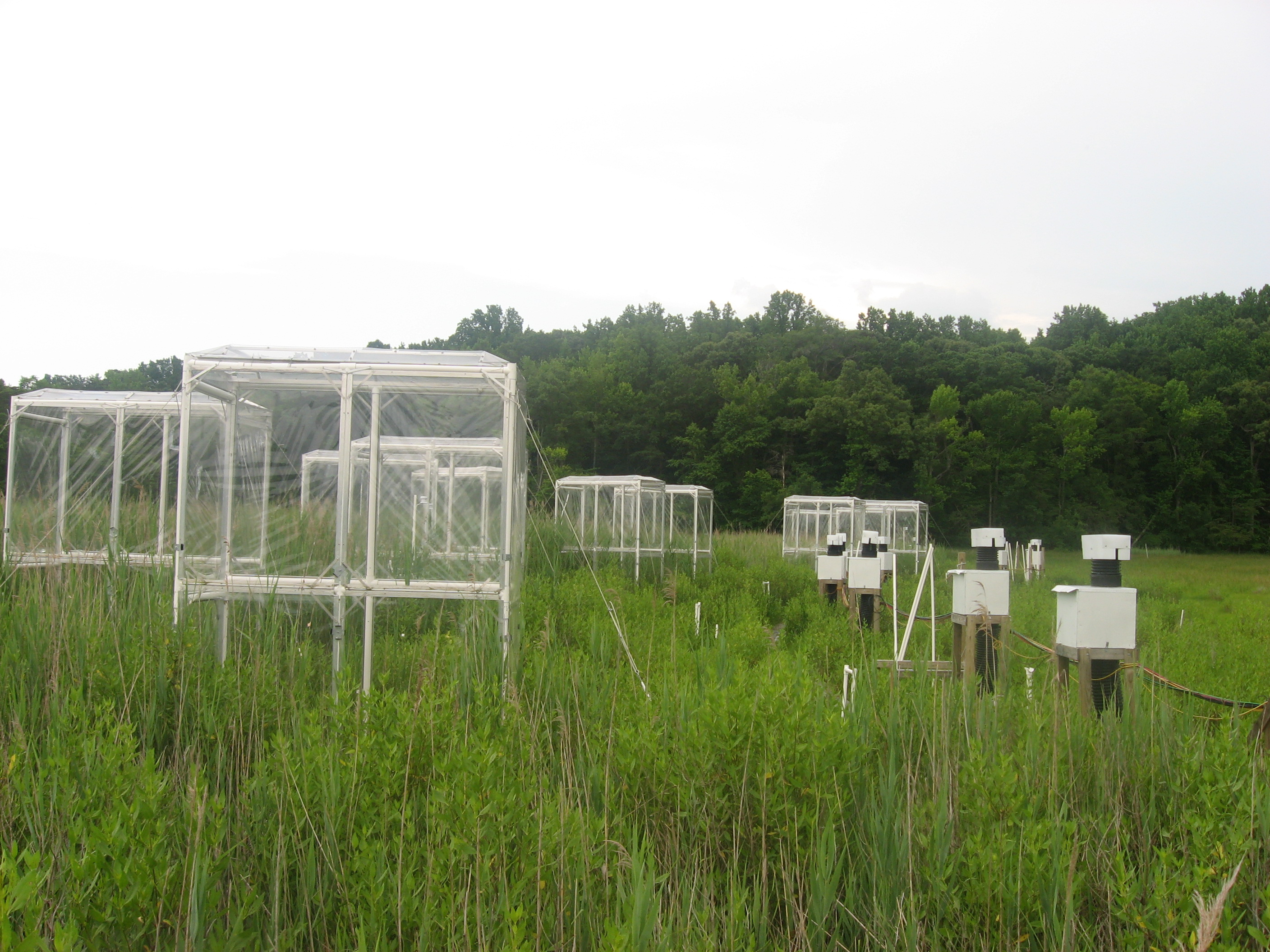
These chambers at Kirkpatrick Marsh allow the amount of CO2 and nitrogen to be manipulated, allowing researchers to understand how climate change will affect the growth of Phragmites.
An invasive reed from Europe is conquering marsh habitat throughout the Chesapeake, displacing native marsh grasses and drastically changing the face of the wetlands. Phragmites australis, a “jack and master” plant grows to nearly 10 feet tall and is adept at extracting nutrients from the soil, outcompeting native Phragmites genotypes. Climate change could increase the spread of this invasive plant. But other human activities, such as development, shoreline hardening and agriculture, could also determine the spread and range of Phragmites.
Climate Change Spurs Phragmites Growth
Rachel Hager, who interned with the Biogeochemistry lab, wanted to see if human activities were giving Phragmites even more of a competitive edge. Excess nitrogen from agriculture and industry, as well as increased CO2 levels, could increase Phragmites growth. Working in the Global Change Research Wetland (GCReW), she tracked the growth of Phragmites under conditions that had more CO2 added, more nitrogen added, and both CO2 and nitrogen added. She found that CO2 and nitrogen led to increased Phragmites growth, and plots with both CO2 and nitrogen grew the most.
Increased growth is only part of the story, however. Rachel wanted to see if taller Phragmites would inhibit other plants’ access to light. She analyzed leaf length, number, thickness and canopy cover to see if Phragmites exposed to additional CO2 and nitrogen were better at blocking light from their competitors. She found that Phragmites exposed to more CO2 and nitrogen had more, thicker and longer leaves, but their canopy cover was the same as control Phragmites plots. Thicker, longer leaves could lead to a longer leaf lifespan and more leaf litter, however, which could still block other plant’s access to light. Rachel hopes to see further research done on the amount of light that makes it through a Phragmites canopy. Click to continue »
Posted in Publications | Comments Off on Franken Phrag: Tales of a Super Invader