For decades, efforts to conserve Chesapeake river herring have run into a black hole of uncertainty. Managers knew populations had plummeted, but no one knew how many remained. A team of biologists from the Smithsonian Environmental Research Center has found a way forward, recording the first complete spawning run of river herring in the Choptank River since the 1970s.
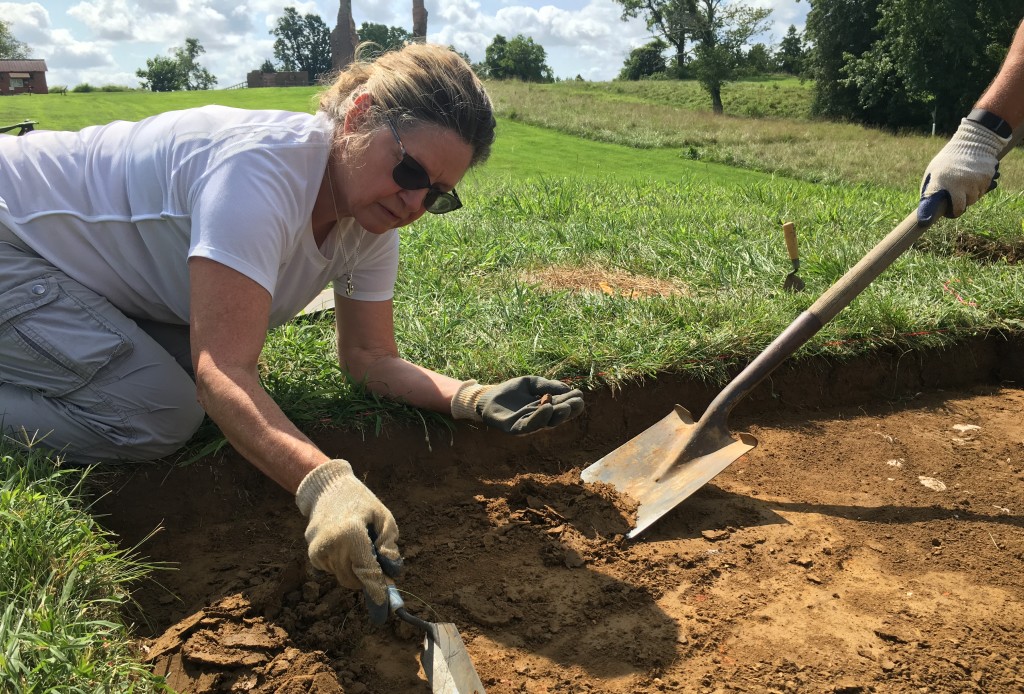
Citizen scientist Linda Perkins helps excavate a soil plot in front of the Contee mansion ruins. (Photo: SERC)
People don’t usually think of archaeologists as dumpster divers. Then again, sifting through trash for hidden treasures is exactly what the volunteer citizen scientists of the Smithsonian Environmental Research Center (SERC) Archaeology Lab do every Wednesday. But they don’t scavenge anything for themselves. (The market for millenia-old oyster shells is very unpredictable, and any food they find is always up to three centuries past its expiration date.) Instead, they take away new skills and a chance to put together a historical puzzle larger than themselves.
“We look back thousands of years,” said Jim Gibb, the lead volunteer and coordinator of the lab. “I always tell people—we’re the time lords.” Click to continue »
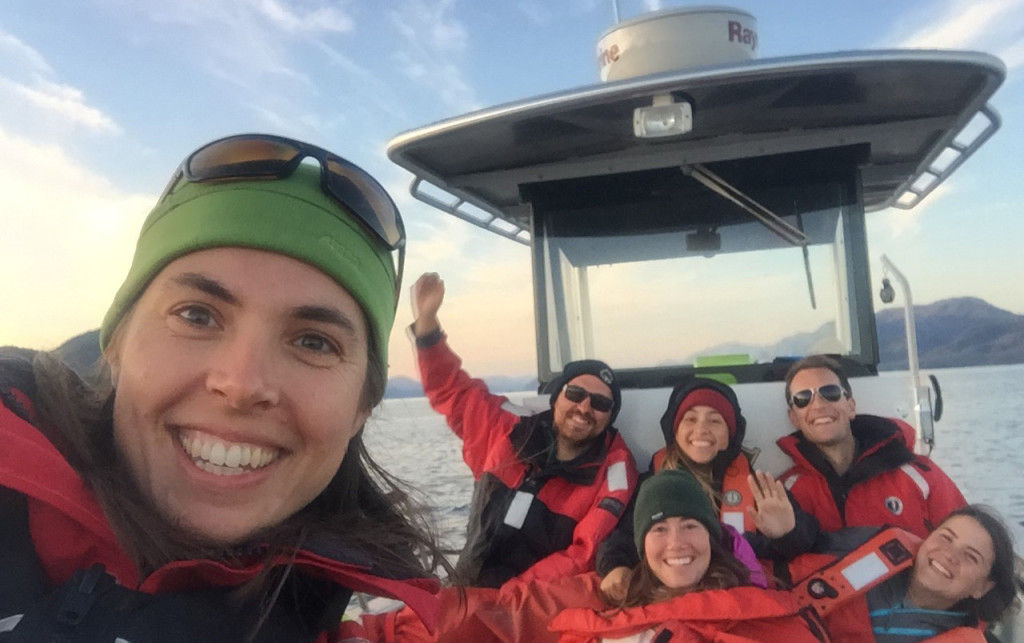
Margot Hessing-Lewis and the Nearshore Tech Team of the Hakai Institute, British Columbia, one of the newest MarineGEO sites on the Pacific. (Photo: Margot Hessing-Lewis, Hakai Insititute)
Imagine gazing into the ocean off Maryland knowing what life is under the waves, what’s driving the food web, and how healthy the water is. Then, imagine being able to discover the same thing for another coast halfway around the world. That vision—of a network vast enough to take the pulse of coastal waters worldwide—began becoming a reality at the Smithsonian in 2012. It’s called the Marine Global Earth Observatory, or MarineGEO.
“The MarineGEO aspiration has always been to extend around the world … The ocean is connected everywhere,” said Emmett Duffy, MarineGEO’s director based out of SERC. Click to continue »
Last year marked the 40th anniversary of the movie Jaws, regarded by many as “the movie that changed Hollywood.” While true, Jaws shaped more than just Hollywood. With its ominous, adrenaline pumping two-note score and imagery of a bloodthirsty, torpedo-shaped predator with rows of razor-sharp teeth, Spielberg’s film shaped our perception of sharks.
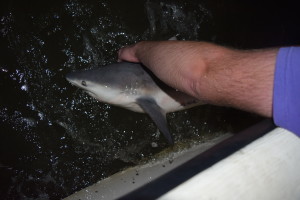
The team’s first tagged juvenile bull shark (Photo credit: Kim Richie)
After Jaws, fear of the unknown arrested us, and our lack of knowledge helped demonize sharks. But the winds are shifting. New research initiated by the Smithsonian Environmental Research Center’s Fish and Invertebrate Ecology Lab aims to investigate habitat use, migration patterns, and species interactions of four underrepresented shark species found in the Chesapeake Bay and along the Atlantic Coast.
Community mural in a Baltimore neighborhood. (BES-LTER)
Preserving the environment is often seen as a battle of development versus nature. But in America today, roughly three-fourths of us live in metropolitan areas. To preserve our health and the planet’s health, we need to create something new: A sustainable city.
Enter urban ecology. Plant ecologist Steward Pickett of the Cary Institute of Ecosystem Studies has been exploring the ecology of cities—hot spots where society, culture, economics and the environment collide—for more than two decades. In 1997, he and a handful of colleagues started the Baltimore Ecosystem Study, a long-term project that now involves more than 100 people. Pickett talks about some of their surprising discoveries in this edited Q&A. To learn more, you can meet him in person on Tuesday, Nov. 15, at the Smithsonian Environmental Research Center’s keynote evening lecture.
*Note: Edited for brevity and clarity
Steward Pickett (Xiaofang Hu)
How strange was the idea of “urban ecology” when you began?
It was sort of a marginal pursuit. Most ecologists in the United States preferred to think they were working in pristine areas, or at least in areas where the human hand was relatively light on the land… There was this deep, deep bias in ecology to not look at places where people were part of the system … Urban ecology is kind of a way to say, let’s recognize this and see what it’s doing. Click to continue »
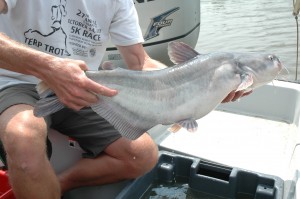
Blue catfish SERC biologists dubbed “Megalodon,” which they tracked moving almost 60 miles along the Patuxent River. (Brooke Weigel/SERC)
White perch, menhaden and darters: These are just a few favorite foods of Maryland’s invasive blue catfish, according to a new study from the Smithsonian Environmental Research Center (SERC). They’re also known to gorge themselves on larvae of channel catfish—and, occasionally, juveniles of their own kind.
The study, published in the journal Environmental Biology of Fishes, used DNA barcoding to get to the gut of what blue catfish prey on. Blue catfish arrived in Chesapeake Bay in the 1960s, brought by Virginia managers to establish a fishery. They quickly developed a reputation as voracious predators, threatening to devour many popular fisheries and edge out the Chesapeake’s native white catfish. However, to discover how much they could disrupt the ecosystem, marine biologists need to know exactly what they eat. The only way to do that is to look into their stomachs, where the majority of their prey has been reduced to almost-unrecognizable slop.
Rob Aguilar would know: A biologist with SERC’s Fish and Invertebrate Lab, he’s spent the last few years dissecting blue catfish stomachs and analyzing their insides. Click to continue »
Baby oysters are a lot stronger than they look. Living mainly in shallow coastal waters, where oxygen plummets and acidity spikes on a nightly basis, building a decent shell should be a challenge. But after a couple of weeks, young oysters are often able to adjust to the harsh conditions—and, sometimes, even grow more quickly to make up for lost time.
“It’s really impressive what these oysters are able to do in terms of acclimating to potentially harmful conditions,” said lead author Andrew Keppel, who worked on the project as a graduate student and later technician in SERC’s Marine Ecology Lab, before becoming an oceanography lab manager at the U.S. Naval Academy. Click to continue »
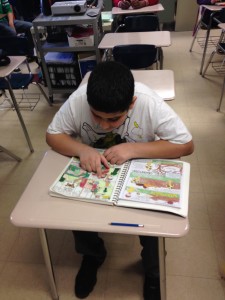
Middle school can be a tough and unforgiving rite of passage, filled with raging hormones, ill-fitting highwater pants, voices akin to trumpet-wielding geese, and a multitude of distractions. Trying to learn while being swept up in puberty’s turbulence can be challenging. Equally challenging is trying to teach science to often-distracted tweens and teens. Right now, as most U.S. schools begin a new school year, some science educators might be looking for ways to engage their middle-school students with science. One science educator suggests meeting them where their interests lie – comics.
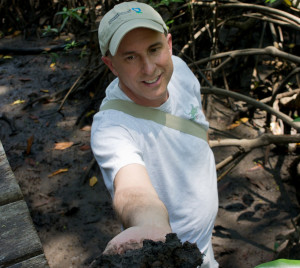
SERC biogeochemist Pat Megonigal holds up soil from a marsh in Costa Rica. Marsh soils store vast amounts of carbon, but as temperatures warm, microbes in the soil could release into the atmosphere. (SERC)
by Kristen Minogue
All over the world, marshes are hanging in a precarious balance. Rising temperatures from climate change could help them grow stronger and store more carbon—or cause them to flood and disappear, says a new article from the Smithsonian Environmental Research Center (SERC). To find answers, scientists need to look underground.
The article is part of a much larger report on the future of warming oceans, released Monday at the International Union for Conservation of Nature’s annual conference. Tidal marshes sit right on the boundary of the land and the ocean. For humanity, marshes act as Mother Nature’s guardians. They provide habitat for fish and shellfish, filter out pollution in estuarine water, and help shield homes along the coast from flooding. They’re also hot spots of carbon storage, burying carbon 10 times faster than an equal area of forest. Yet much of their fate remains a mystery. Click to continue »
SERC intern Cole Caceres collects Japanese invasive beetles from a hormone trap for his experiment (Photo: Emily Li/SERC)
Smithsonian Environmental Research Center (SERC) intern Cole Caceres has two passions: science and cooking. He enjoys doing research and adding to the larger body of knowledge, but he hasn’t given up on owning his own restaurant. When he’s not studying nitrogen filtration as a laboratory assistant at the University of California, Davis, he’s probably watching Food Network or frying chicken wings in a sweet soy sauce glaze.
But Caceres found the perfect mix of his interests as an intern with SERC’s Terrestrial Ecology Lab. There, he cooks for invasive Japanese beetles, hoping to help shed light on their dietary preferences so that plant conservation initiatives can be more fully informed—one beetle bite at a time.