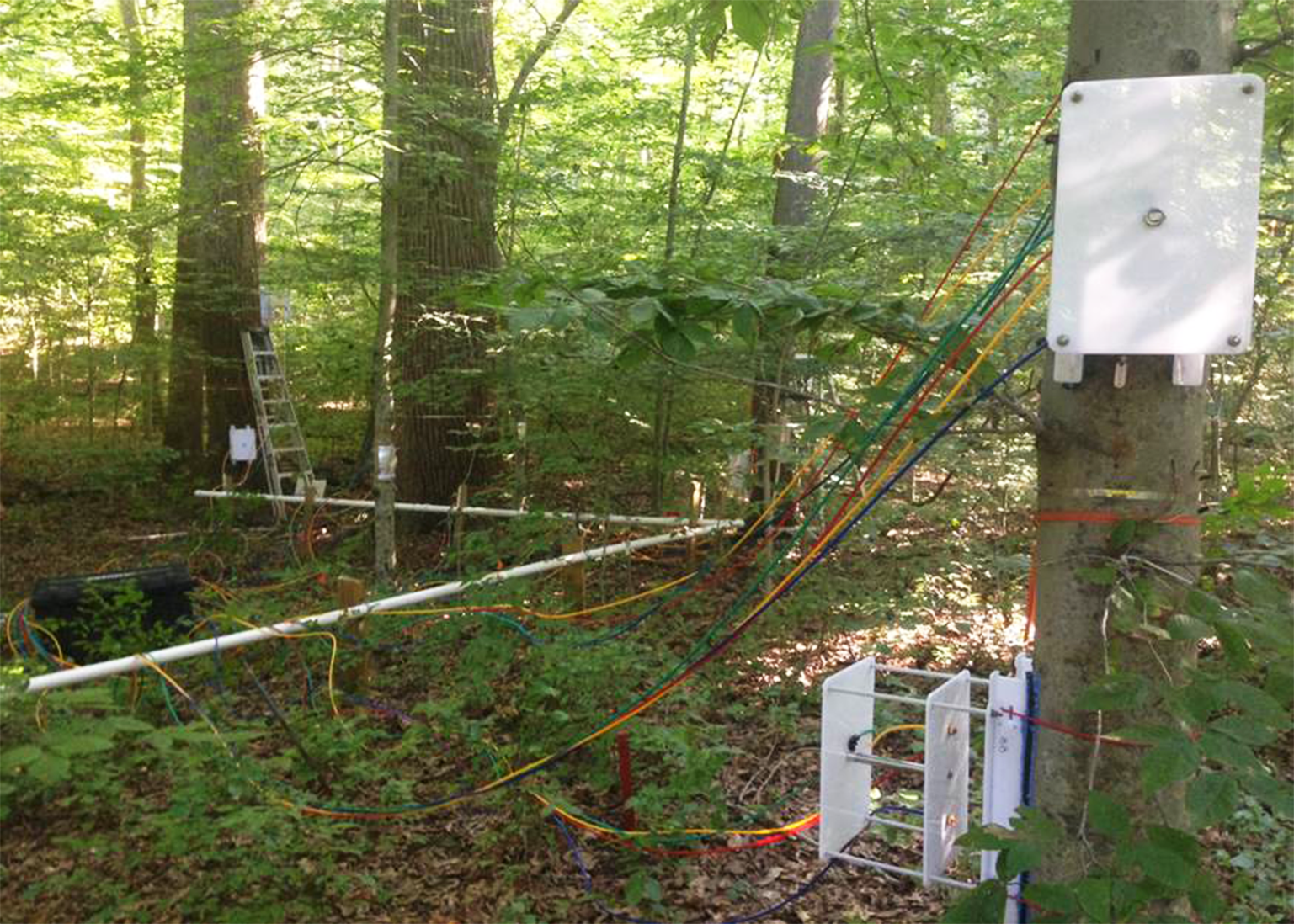
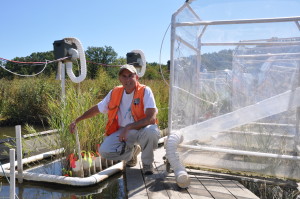
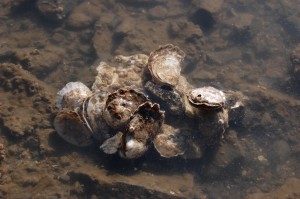
Methane flux chambers keep track of how much methane a tree trunk releases or consumes. Credit: Pat Megonigal/SERC
Rainbow-colored tubes snake through the undergrowth. White acrylic chambers sit mounted to tree trunks like giant bleached snails. At first glance, it’s not quite clear what the heck is going on. Cryptic as it may seem, these tubes and chambers are the key to a recent study showing that trees in upland forests are capable of emitting the planet-warming greenhouse gas, methane.
Scientists have long considered upland forests to be methane sinks due to the presence of methane-hungry microbes called methanotrophs in their soils. But new research by Pat Megonigal, an ecosystem ecologist who heads up the Biogeochemistry Lab at the Smithsonian Environmental Research Center (SERC), and Scott Pitz, a graduate student from Johns Hopkins, has shown that when it comes to upland forest methane cycling, soil isn’t the only game in town. Trees and their emissions are part of the equation too.
In a recently published study in New Phytologist, Megonigal and Pitz found that trees in upland forests are actually capable of emitting methane through their trunks. This means that some of the methane absorbed by methanotrophs in the forest soils may be offset by tree emissions.
Why, though, does any of this even matter?
When researchers think about global climate change, they need to think about heat-trapping greenhouse gases like carbon dioxide (CO2) and methane (CH4). Specifically, they’ve got to track these gases to see where they’re coming from (their sources) and where they’re getting stored (their sinks). Carbon dioxide receives much of the spotlight (and rightfully so, given its enormous impact on the global climate), but it’s also critical to keep an eye on methane. Although methane stays in the atmosphere for far less time than carbon dioxide, it’s capable of trapping up to 45 times more heat. In other words, methane is a big deal. If temperate forests are consuming less of it than we thought, as Megonigal and Pitz’s research suggests, that could be a big deal too. Click to continue »
Posted in Climate Change, Ecology, Publications | Comments Off on Surprising Tree Emissions Show Forests Consume Less Methane Than Thought
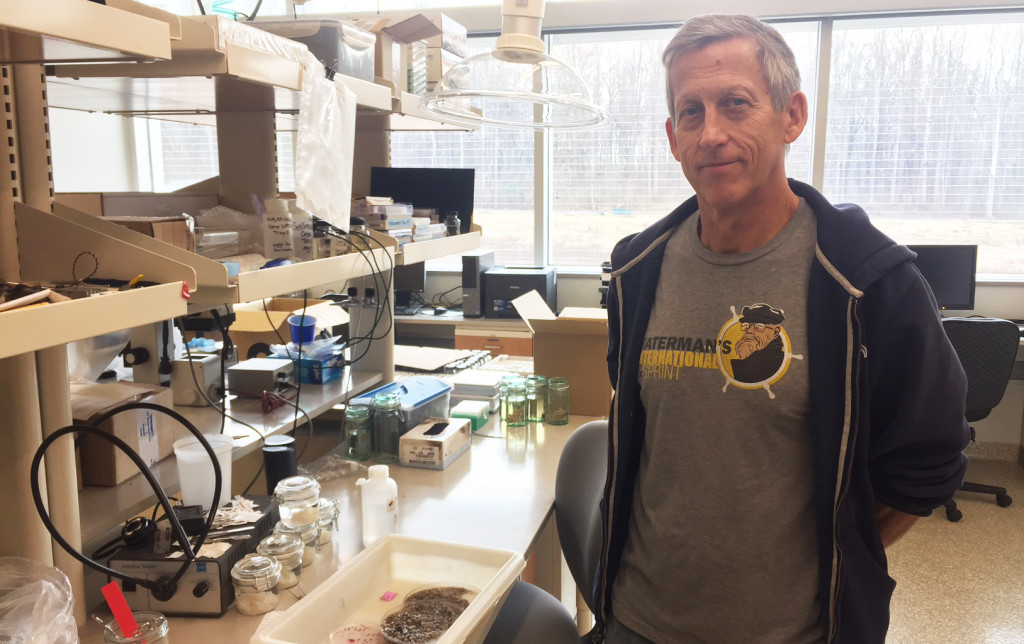
SERC citizen scientist Dave Norman stands beside a collection of sediment samples from the bottom of Chesapeake Bay. (Sara Richmond)
Dave Norman’s first visit to the Smithsonian Environmental Research Center (SERC) wasn’t to help with a field trip or assist researchers in the crab lab, as he has done for the past two years. In fact, he knew very little about SERC, but was competing in a triathlon on its campus. The experience stuck with him, and when he retired a year later, he contacted SERC to ask how he could get involved as a volunteer.
The volunteer program offered a mix of science and education opportunities that turned out to be a perfect fit for Dave. He says he was part of the “Jacques Cousteau generation,” who grew up with the explorer’s books and movies, and eventually started college with plans to become a marine biologist. Those plans changed—he would practice law for 30 years before becoming a seventh-grade math teacher—but when he retired, his love of the water brought him back to the field. Click to continue »
Strategy To Flush Invaders From Ballast Water Coming Up Short
by Kristen Minogue
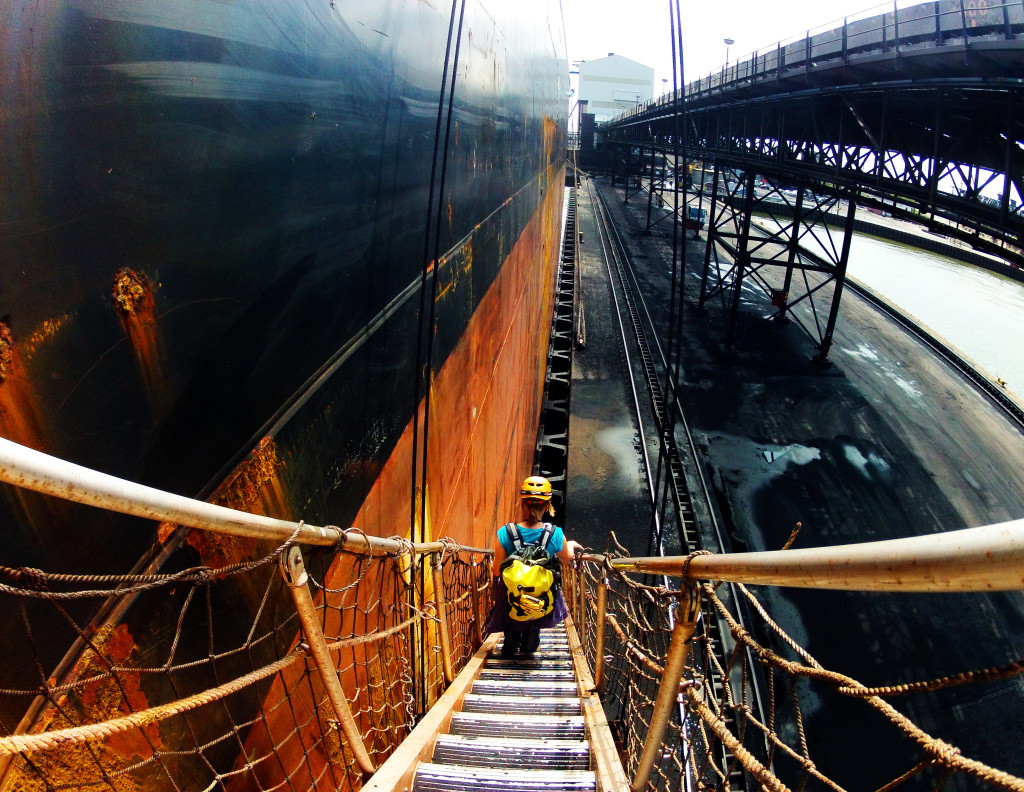
SERC marine biologist Jenny Carney descends the gangway of a giant bulker ship in Virginia. When ships export coal and other goods, they return loaded with ballast water from foreign ports—and often inadvertently bring invasive species with them. (Credit: Kim Holzer/SERC)
In the battle against invasive species, giant commercial ships are fighting on the front lines. But even when they follow the rules, one of their best weapons is coming up short, marine biologists from the Smithsonian Environmental Research Center (SERC) discovered in a new study published in PLOS ONE Monday.
As ships move goods around the world, they often inadvertently ferry invasive species as well. These new species can come over in the ships’ ballast water—the water ships pump on board for stability, to keep them from becoming top-heavy. But when the ships arrive to port, they often discharge their ballast water from distant global regions, along with the unseen, unwanted hitchhikers.
Shipping companies and biologists have known about this problem for decades and are still struggling to combat it. Currently, their main strategy is called “open-ocean exchange.” The idea is to flush out ballast water from their original port in the open ocean, to remove most coastal organisms, and replace it with water more than 200 nautical miles from shore. When they arrive at their destinations and discharge their new ballast water, any open-ocean organisms they picked up are unlikely to survive in ports and coastal waters.
“Ballast-water exchange provides a stop-gap measure until new technologies can be implemented to further reduce species transfers,” said Greg Ruiz, SERC senior marine biologist and a co-author of the new study. Since 2004, the U.S. Coast Guard has required most commercial ships entering the U.S. from overseas to do open-ocean exchange before discharging ballast in ports. However, this strategy has some serious limitations and may not be as effective as scientists and policymakers once hoped. Click to continue »
Posted in Invasive Species, Publications | Comments Off on Ships Struggle To Battle Invasive Species As Global Trade Surges
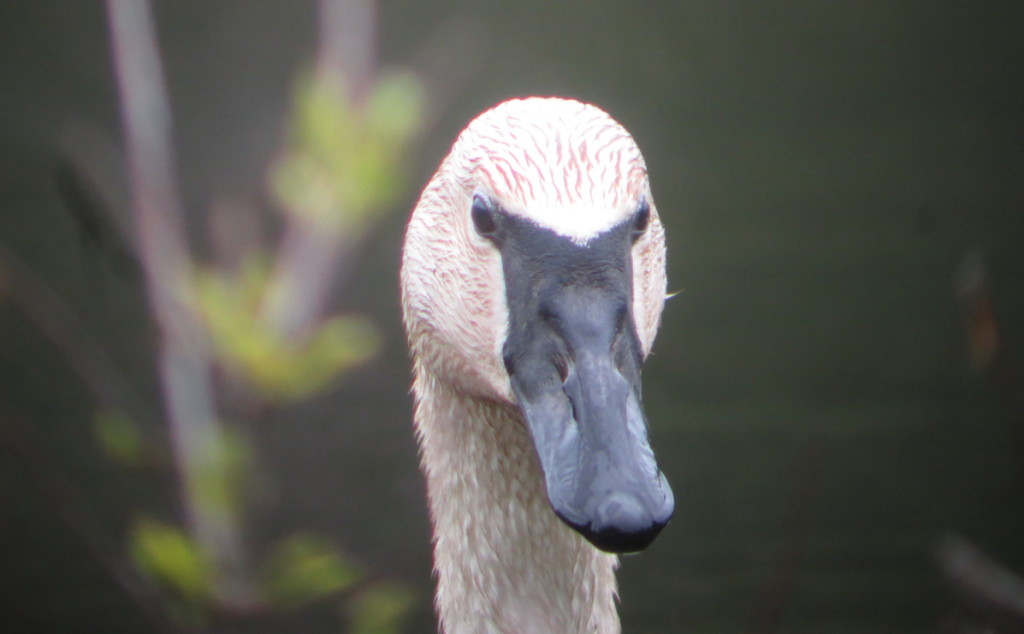
Not long ago, a trumpeter swan sighting was nearly unheard of in the Chesapeake Bay region—or many places in the United States, for that matter. After being hunted to near-extinction in the early 1900s, the birds, who can boast an 8-foot wingspan and are the largest waterfowl in the world, struggled to recover. Now the swans are starting to reappear, including two spotted recently at the Smithsonian Environmental Research Center (SERC).
Unlike tundra swans, the other native swans in the Chesapeake, trumpeter swans have a small triangle of feathers above their beak. (Tyler Bell)
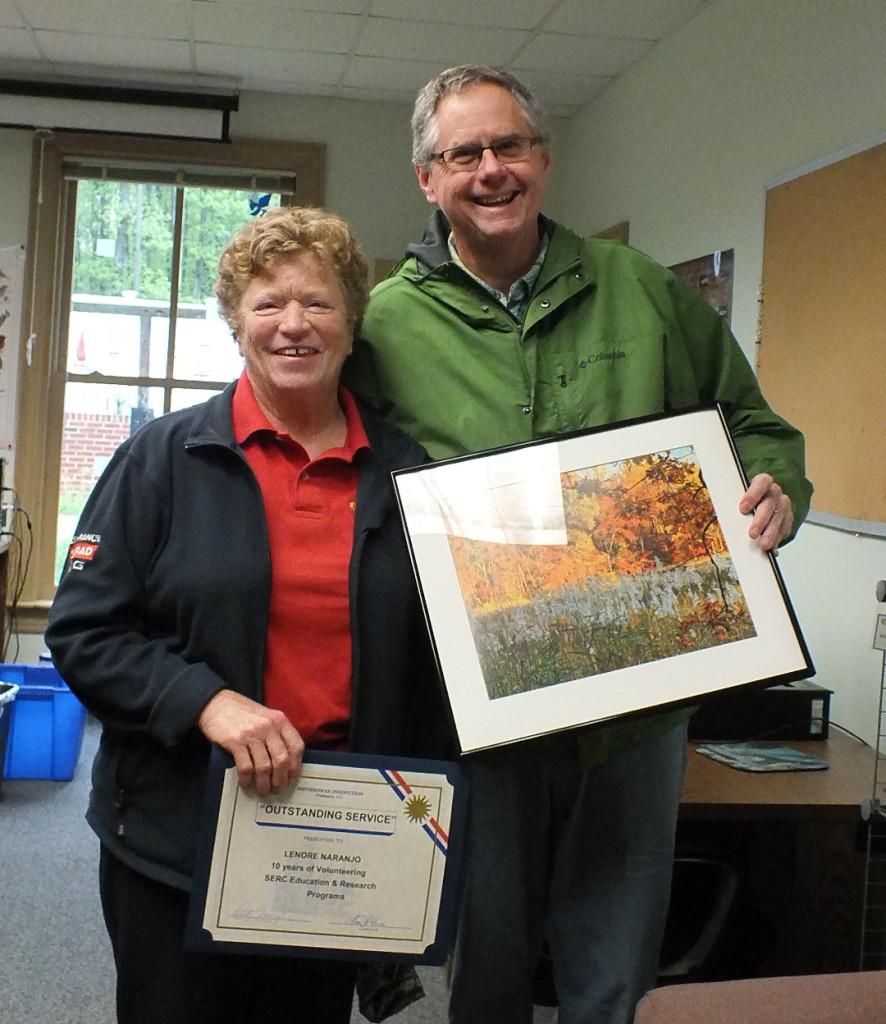
Lenore Naranjo celebrates 10 years of volunteer, with SERC volunteer coordinator Dan Gustafson. (SERC)
by Sara Richmond, communications volunteer
In 2016, nearly 5,000 students and other visitors learned about the Chesapeake Bay ecosystem firsthand through education programs at the Smithsonian Environmental Research Center (SERC). They ventured on hikes and canoe trips, hauled in fish and invertebrates with seining nets, and studied the anatomy of blue crabs. SERC’s education programs are possible through the help of dozens of volunteers who lead field trips and assist behind the scenes. In the coming months, we’ll highlight the work of some of these volunteers in the SERC newsletter and on our blog.
Lenore Naranjo has been volunteering with SERC for over 13 years. After starting as a volunteer in SERC’s canopy labs, she began working with the education program, leading field study groups that give children a hands-on approach to a variety of marine habitats.
“We set up baskets with oysters, and they stay sitting on the bottom of the river through spring, summer, and fall, where they act as a habitat for fish and small critters,” she explains. During field trips, she pulls the baskets from the river bed and sets them in a tray of water so children can explore the baskets’ contents. “Some kids are very hesitant and don’t want to put their hands in something unfamiliar. But then they watch their friends who aren’t hesitant, and the next thing you know, they’re in there too, pulling out fish and crabs.”
Marine biologists Kim Holzer (right) and Jenny Carney sample ballast water from a cargo ship in Virginia’s James River. (Kim Holzer)
The U.S. is on the brink of a natural gas boom—but that could expose its shores to more invasive species, Smithsonian marine biologists report in a new study published this winter.
Over the last decade, U.S. natural gas imports have dropped as the country tapped into its own resources. Now, thanks to new technology that makes it easier to extract and store natural gas, it’s poised to be the world’s third largest exporter of liquefied natural gas by 2020.
“We’ve hit an inflection point,” said Kim Holzer, lead author and biologist at the Smithsonian Environmental Research Center (SERC). Exports haven’t yet reached historical import highs, but they are climbing.
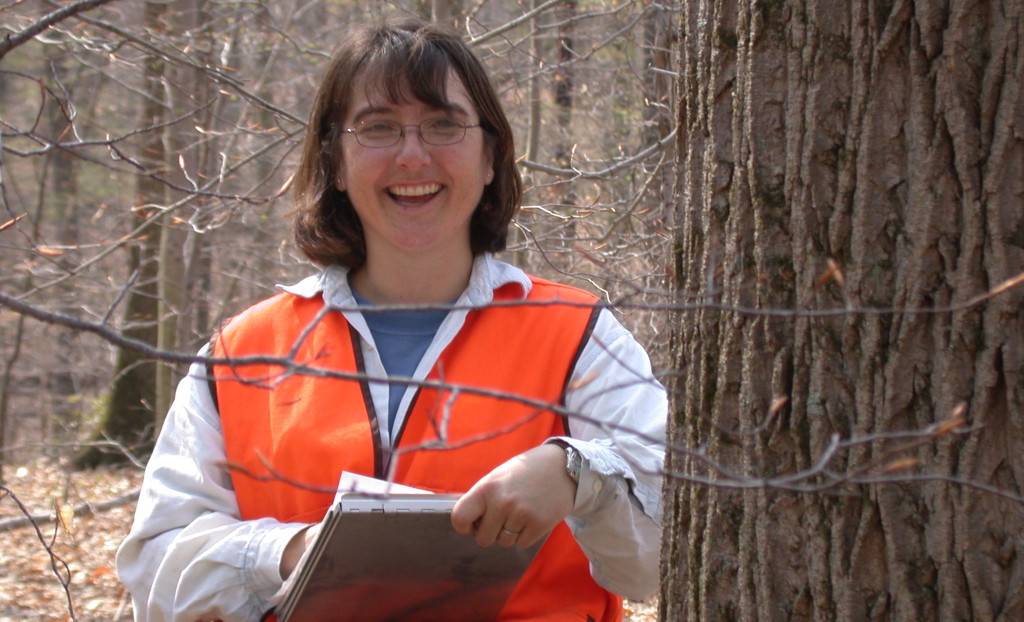
Ecologist Dawn Miller surveys trees in a SERC forest. (SERC)
by Kristen Minogue
The Smithsonian has a new resolution for 2017: Earth Optimism. This is the year the Smithsonian is celebrating environmental success stories, and shifting the focus to how we can fight battles to save species and preserve our planet—and win. Despite breaking a wide swath of climate records, 2016 gave us reasons for optimism as well. In our 2016 Year in Review, we’ve pulled out the most encouraging stories and discoveries at the Smithsonian Environmental Research Center from the previous year. Here are the top 10 that make us hopeful about the planet’s future:
If you are a plant, when life aboveground turns harsh, you have few options. Some orchids respond by going dormant, spending years to decades underground before reemerging aboveground. But an army of the right fungi may help jolt them out of dormancy, ecologists from the Smithsonian Environmental Research Center (SERC) discovered in a new study published in the American Journal of Botany Friday.
Smithsonian scientists have been working to understand the ecology of one particular orchid – including why it enters and exits dormancy. The small-whorled pogonia is widely regarded as the rarest orchid east of the Mississippi. Federally listed as threatened, the orchid has vanished from Maryland and is endangered in 16 other states.
Pat Megonigal studies the invasive reed Phragmites australis on the Smithsonian’s Global Change Research Wetland. (Tom Mozdzer)
It’s easy to dislike Phragmites. The invasive brown reed can grow over 15 feet tall and tends to crowd out anything in its shadow. But in the story of global change, Phragmites is a gray character, like Mad Men’s Don Draper, or the enigmatic Professor Snape. Beneath the surface, Phragmites australis—a European reed sweeping over East Coast wetlands—can empower wetlands to grow higher soils and possibly survive rising seas. Biogeochemist Pat Megonigal of the Smithsonian Environmental Research Center (SERC) prefers an analogy from classic literature: Jekyll and Hyde.
“The Jekyll part is that Phragmites helps marshes maintain elevation and keep pace with sea level rise,” he said. “The Hyde part is that they are poor habitat for native plants and animals.”
The latest discovery in Megonigal’s lab could tip things in favor of Mr. Hyde. Phragmites’ deep-growing roots were once thought an advantage that helps wetlands build soil. But those same roots could be disturbing ancient soils deep underground—triggering them to release planet-warming carbon dioxide (CO2).
Olympia oysters (Matthew Gray/Oregon State University)
Act local. Diversity pays. Those two phrases could hold the key to saving young Olympia oysters, the only native oysters on the West Coast of North America. What they need are large networks of adult oyster beds to settle on—and a diverse “environmental portfolio,” finds a new study in Ecology.