add_filter('bloginfo_url', function($output, $property){ error_log("====property=" . $property); return ($property == 'pingback_url') ? null : $output; }, 11, 2);
 

Archives

...now browsing by author


Beyond the desert: Exploring Saudi Arabia’s mangroves

Tuesday, December 22nd, 2009

Dennis Whigham and Candy Feller both noticed the mangroves’ odd shape. “They almost looked like bonsais,” said Whigham. The shrubs had mature trunks, but the shoots were all new. Feller and Whigham are ecologists at the Smithsonian Environmental Research Center (SERC). To their trained eyes, these trees looked like they were recovering from something like a hurricane. These mangroves survived a different kind of storm: camel grazing.

Saudi Arabia conjures images of the desert, but along the Red Sea coast there are pockets of green dominated by mangroves. Feller and Whigham hunted around for these mangroves during a November visit to the country. They are part of a team of ecologists that’s partnering with the staff of the new King Abdullah University of Science and Technology (KAUST). The school is located on the Red Sea in city of Thuwal.

Click to continue »

Share

Snow falls on the ruins

Friday, December 18th, 2009

It’s Friday and the weekend forecast calls for snow here in Edgewater, Maryland. With that in mind, here’s a frosty photo and poem.

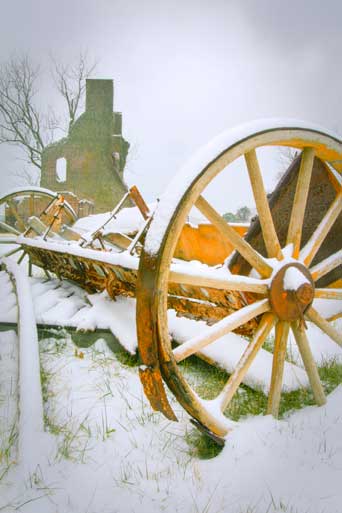
The Contee Mansion Ruins at the Smithsonian Environmental Research Center, in Edgewater Maryland.  Photo by Chuck Gallegos

The Contee Mansion Ruins at the Smithsonian Environmental Research Center, in Edgewater Maryland. Photo by Chuck Gallegos

Senior scientist and avid photographer Chuck Gallegos took this wintry image of the Contee Mansion. The ruins are part of the Smithsonian Environmental Research Center (SERC). SERC officially acquired the property in 2008. We’re now working to stabilize the structure and prepare it for future use. Archeologists have guided volunteers in past research excavations. More digs will take place once the weather warms up. Eventually the ruins will be part of an interpretive trail that explores the history and ecology of the old farm.

Now for the poem. This month marked what would have been Emily Dickinson’s 179th birthday. The Massachusetts native had a rich education in science and natural history at what is now known as Amherst College. Many of her poems are infused with her botanical knowledge. Dickinson had her own herbarium and flowers are a reoccurring subject of her work. You won’t find any petals or stems in this winter poem.

The Sky is low – the Clouds are mean.
A Travelling Flake of Snow
Across a Barn or through a Rut
Debates if it will go –

A Narrow Wind complains all Day
How some one treated him
Nature, like Us is sometimes caught
Without her Diadem.
— by Emily Dickinson

You can read more about Emily Dickinson and her education in science and natural history at The Poetry Foundation.

Share

Climate change may drastically alter Chesapeake Bay, scientists say

Thursday, December 3rd, 2009

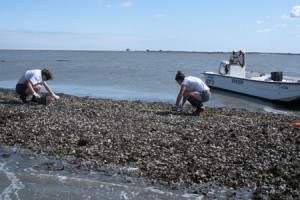
Smithsonian researchers Lori Davias and Jenna Malek collect oysters on an intertidal reef in the Chesapeake Bay. It is difficult to predict the effect of climate change on oyster populations because increasing temperatures will likely have at least two opposing effects. On one hand, intertidal oyster populations may be able to expand northward as winter temperatures rise. On the other hand, increasing summer temperatures are likely to worsen the problem of low oxygen concentrations and may reduce the extent or suitability of some subtidal habitat currently used by oysters. At this point, scientists are unable to predict whether the combination of these two factors will result in a net increase or net loss of habitat.  Photo: Sean Fate

Smithsonian researchers Lori Davias and Jenna Malek collect oysters on an intertidal reef in the Chesapeake Bay. It is difficult to predict the effect of climate change on oyster populations because increasing temperatures will likely have at least two opposing effects. On one hand, intertidal oyster populations may be able to expand northward as winter temperatures rise. On the other hand, increasing summer temperatures are likely to worsen the problem of low oxygen concentrations and may reduce the extent or suitability of some subtidal habitat currently used by oysters. At this point, scientists are unable to predict whether the combination of these two factors will result in a net increase or net loss of habitat. Photo: Sean Fate

It is one of the largest and most productive estuaries in the world, yet dramatic changes are in store for the Chesapeake Bay in coming decades if climate change predictions hold true, say a team of scientists from the Smithsonian Environmental Research Center, the University of Maryland, Pennsylvania State University, and other research organizations in a recent paper published in the journal “Estuarine, Coastal and Shelf Science”

Using forecasts of atmospheric carbon dioxide production for the coming century, the scientists predict the water of the Bay will see rising levels of dissolved carbon dioxide and higher water temperatures. As a result, climate change is expected to worsen problems of low dissolved oxygen concentrations in the Chesapeake’s water and cause sea levels to rise.
Click to continue »

Share

Wetlands on the rise, a conversation with biogeochemist Pat Megonigal

Tuesday, December 1st, 2009

Pat Megonigal is a biogeochemist here at the Smithsonian Environmental Research Center (SERC). The following is an interview with him about his recent research.

Smithsonian biogeochemist Pat Megonigal

Smithsonian biogeochemist Pat Megonigal

Climate change scenarios are driven largely by greater concentrations of carbon dioxide in the atmosphere. One common narrative includes faster-rising seas and the potential drowning of coastal regions. You recently published a paper in the Proceedings of the National Academy of Sciences that gives hope to some coastal wetlands. Tell us what you found.
PM: We conducted a study for two years on the Kirkpatrick Marsh, here on the Chesapeake Bay. We discovered that higher levels of atmospheric CO2 actually stimulated the surface elevation of saltwater marshes. The additional CO2 caused them to basically pop up, or rise in elevation, because the plants developed more roots. It’s kind of a silver-lining story.

How did you simulate climate change?
PM: We put out clear open-top chambers that are about two yards in diameter. They allow us to manipulate the atmosphere around a chunk of marsh. Then, in some of the chambers, we pumped in extra CO2; we raised it to a level that will be roughly what the whole world will be exposed to at the end of the century. And then we measured the changes in the soil’s elevation throughout the growing season.

When you think of measuring elevation, mountains come to mind, not soil. How did you measure the soil’s height?

PM: Well, we needed a stable point of elevation reference, so first we drove a steel rod about 20 feet into the ground. Then came the hard part. We had to design a tool that would give us not only precise, but multiple measurements of the soil elevation – both in and outside of our chambers. We came up with an instrument we dubbed the “monster arm.”

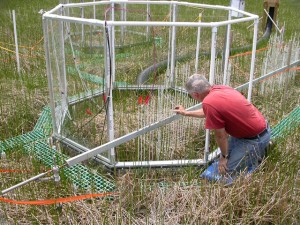
Technician Jim Duls measures the soil elevation with the 'monster arm.'

Technician Jim Duls measures the soil elevation with the 'monster arm.'

The monster arm?
PM: The technical name is “surface elevation table.” Basically it’s a long metal bar with 90 fiberglass pins running perpendicular through it. It looks like a big comb, but instead of the teeth being fixed in place, they can move up and down. So by gently placing the monster arm across the chambers we could measure where the top of each pin was in relation to the main crossbar. So if a pin rose 100 millimeters above the bar in April and in August it rose 102 millimeters, the soil elevation increased by two millimeters.

Your study showed that the marsh receiving the extra CO2 rose by an additional 3mm a year. Is that enough to keep pace with the rising sea level?
PM: It should help for a while, but we don’t know how much sea level rise a marsh can handle before it will disappear. We do know that rising sea level is one reason that some marshes in mid-Atlantic and around the world are disappearing right now. Our research indicates that some of these wetlands literally have an organic ability to fight back by building new soil. This is especially true for wetlands with brackish water, like Kirkpatrick Marsh. Saltier coastal wetlands won’t be able to accumulate as much soil because their plants are different and don’t respond to CO2 in the same way. But we’re now conducting a new experiment to look at sea-level rise and its effect on soil elevation. We think the pop-up effect we’ve observed will be even more pronounced when the water level rises. We’ll see!

Share

Happy 150th ‘Origin of Species’

Tuesday, November 24th, 2009

On this day in 1859, Darwin went public with his case for the theory of natural selection. The arguments he set forth in The Origin of Species, have guided scientific explorations of evolution ever since. The biologists and ecologists here at the Smithsonian Environmental Research Center apply Darwin’s theory perhaps as much as they do soap. They may use modern genetics to investigate rare orchids, blue crabs and parasitic dinoflagellates – but Darwin’s discoveries continue to influence their research.

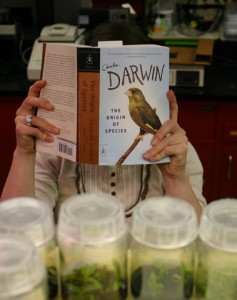
"The Origin of Species" may be 150 years old, but it can still hold its own in the Smithsonian’s research labs.

'The Origin of Species' may be 150 years old, but it can still hold its own in the Smithsonian’s research labs.

To mark the anniversary of Darwin’s landmark publication, here are two passages from the book; the first is from the introduction, the second is from the final page.

No one ought to feel surprised at much remaining as yet unexplained in regard to the origin of species and varieties, if he make due allowance for our profound ignorance in regard to the mutual relations of the many beings which live around us. Who can explain why one species ranges widely and is very numerous, and why another allied species has a narrow range and is rare? Yet these relations are of the highest importance, for they determine the present welfare and, as I believe, the future success and modification of every inhabitant of this world. Still less do we know of the mutual relations of the innumerable inhabitants of the world during the many past geological epochs in its history. Although much remains obscure, and will long remain obscure, I can entertain no doubt, after the most deliberate study and dispassionate judgment of which I am capable, that the view which most naturalists until recently entertained, and which I formerly entertained—namely, that each species has been independently created—is erroneous. I am fully convinced that species are not immutable; but that those belonging to what are called the same genera are lineal descendants of some other and generally extinct species, in the same manner as the acknowledged varieties of any one species are the descendants of that species. Furthermore, I am convinced that Natural Selection has been the most important, but not the exclusive, means of modification.

It is interesting to contemplate a tangled bank, clothed with many plants of many kinds, with birds singing on the bushes, with various insects flitting about, and with worms crawling through the damp earth, and to reflect that these elaborately constructed forms, so different from each other, and dependent upon each other in so complex a manner, have all been produced by laws acting around us. These laws, taken in the largest sense, being Growth with Reproduction; Inheritance which is almost implied by reproduction; Variability from the indirect and direct action of the conditions of life, and from use and disuse: a Ratio of Increase so high as to lead to a Struggle for Life, and as a consequence to Natural Selection, entailing Divergence of Character and the Extinction of less-improved forms. Thus, from the war of nature, from famine and death, the most exalted object which we are capable of conceiving, namely, the production of the higher animals, directly follows. There is grandeur in this view of life, with its several powers, having been originally breathed by the Creator into a few forms or into one; and that, whilst this planet has gone cycling on according to the fixed law of gravity, from so simple a beginning endless forms most beautiful and most wonderful have been, and are being evolved.

Listen to the recent broadcast of PRI’s Studio 360 for a look at the cultural impact of Darwin’s book.

Share

‘Tidal Freshwater Wetlands’ gives an overlooked ecosystem its due

Tuesday, November 17th, 2009

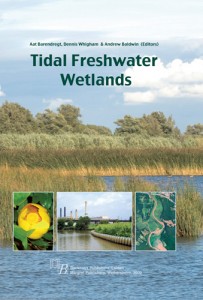
Tidal Freshwater Wetlands book cover

Tidal Freshwater Wetlands

There are certain obstacles you have to embrace if you are going to edit a book about tidal freshwater wetlands. They include: mud, mosquitoes and leeches. Smithsonian plant ecologist Dennis Whigham has accepted all three and then some.

Whigham, along with colleagues Aat Barendregt from Utrecht University and Andy Baldwin from the University of Maryland, has edited the new book Tidal Freshwater Wetlands. It’s a weighty work containing more than 20 chapters written by more than 40 authors. For the first time ever, they have systematically peeled back the layers of these overlooked coastal ecosystems. The book explores how these wetlands work, the animal and plant life they support, and the threats they face.
Click to continue »

Share

$5 million grant from NOAA funds Chesapeake Bay research

Tuesday, November 10th, 2009

If the Chesapeake Bay could drive, it would have a severe case of road rage. The nation’s largest estuary is stressed out. That’s putting it mildly.

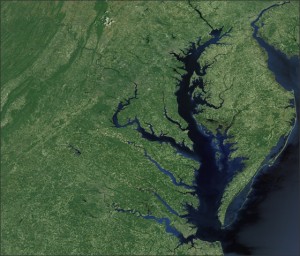
The Chesapeake Bay Watershed.  Landsat imagery courtesy of NASA Goddard Space Flight Center and U.S. Geological Survey.

The Chesapeake Bay Watershed. Landsat imagery courtesy of NASA Goddard Space Flight Center and U.S. Geological Survey.

Nutrient runoff, shoreline development and invasive species are just a few of the factors contributing to the Chesapeake Bay’s poor health. For decades, scientists at the Smithsonian Environmental Research Center (SERC) have been teasing out how these “stressors” impact the Bay’s plants and animals. A new $5 million grant from the National Oceanic and Atmospheric Administration (NOAA) will help bolster their efforts.
Click to continue »

Share

What one marsh tells us about rising CO2

Tuesday, October 27th, 2009

In the world of unassuming marshes, the Kirkpatrick Marsh stands apart. Smithsonian plant physiologist Bert Drake has studied this wetland for more than two decades. It’s located in Maryland, along the Rhode River, a sub-estuary of the Chesapeake Bay. Drake and his colleagues have used this community of grasses and sedges to explore whether plants have the potential to become a carbon source or a carbon sink. Watch the audio slideshow below, for a tour of the field experiment.

You can read more about Drake’s experiment on the Smithsonian Environmental Research Center’s Web site.

Share

Intern Logs: Methanogenesis and nail polish

Tuesday, October 27th, 2009

Q&A with David Gonzalez, 2009 Summer Intern
Major: Evolution, Ecology and Biodiversity
School: University of California-Davis, Class of 2011

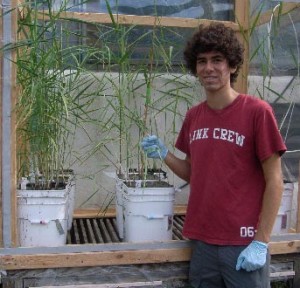
Intern David Gonzalez poses with some of his <i>Phragmites australis</i> plants

Intern David Gonzalez poses with some of his Phragmites australis plants


What drew you to the Smithsonian Environmental Research Center?
The big-picture research that the scientists do here interested me, particularly the experiments relating to global climate change. Among other things, scientists of my generation are going to have to understand how climate change will impact organisms. We talk about it a lot in my classes, so it was cool to have the opportunity to have hands-on experience exploring some of these issues as an undergrad.

You were here for ten weeks. What was your research project about?

I worked on a global change project that examined the relationship between microbes in the soil and Common Reed, or Phragmites australis. Through a process called methanogenesis, the microbes produce methane, a powerful greenhouse gas, which the plants help to emit into the atmosphere. Because Phragmites australis is found in wetlands worldwide, it’s important to look at how its methanogenesis rates might be affected by global change. Basically we wanted to see if rising CO2 and nitrogen levels exacerbate the problem of methane emissions. So I spent the summer growing Phragmites australis under conditions of elevated CO2 and nitrogen and then measured the response of the microbes and plants.

Do you feel like you spent your summer being an active scientist?
Half of the summer I felt like a scientist; the other half I felt like a gardener. There were a lot of day-to-day chores like watering the plants, counting them, giving them fertilizer, and weeding them. I had to make sure these plants grew to the best of their ability in the short time we had to grow them.

So you learned about the challenges and realities of doing science?

A lot of things I learned this summer relate to how many little things go into doing scientific research – from going out and buying fuses for a machine when it broke down, to purchasing nail polish at a drug store so we could take a peel from a leaf to count stomatal density.

What exactly did you do with nail polish?
We used it in some pilot studies. You apply nail polish to the leaf, let it dry, put scotch tape on it, and then pull it off. This creates a kind of caste of the leaf that you can put on a microscope slide so you can examine a leaf’s cellular structure. For instance, we can go through and count the guard cells, which lets us figure stomatal density and helps us understand how the leaf is responding to the treatments we applied.

You were in the biogeochemistry lab. Did you interact much with the other labs at SERC?
Yeah, one of the great things about SERC is that you’re surrounded by scientists with all these different areas of expertise. I got a lot of help from the forest ecology lab; they let me use some of their instruments for measuring leaf area. But we also got to go on lab exchanges. I spent a day on the water with the “Crab Lab;” I helped them catch and tag blue crabs. And then I also spent a number of evenings setting up mouse traps in the forest with a friend who was interning in the Terrestrial Ecology Lab. In general, we were encouraged to find out what the other labs were up to, which I often did just by talking with the other interns.

What are the dorms like?
The Green Village is awesome. It has a kitchen, a common area and feels like a nice cozy dorm.

How much independence did you have?
Usually you put in eight hours of work a day; occasionally you work more. After that though, you’re free. We cooked dinners together in the evenings. Some of the interns had a garden with a behemoth of a basil plant – that made for a great pesto party. And then we spent weekends exploring the East Coast. I saw fireworks in Washington, DC, on the Fourth of July; camped in Shenandoah National Park; and swam in the Atlantic Ocean.

SERC's summer interns on a day-trip to the Shenandoah Valley

SERC's summer interns on a day-trip to the Shenandoah Valley


Was it difficult to get around?

A lot of the interns had cars. That was something I was worried about in the beginning, but everybody turned out to be really friendly. If you needed groceries, there were always people going to the grocery store. If you wanted to visit Washington, DC, it was easy to round up people to hit the Smithsonian Museums. The weekend excursions were great.

You’ll graduate in 2011. How do you want to use the knowledge you’ve gained here at SERC?
I’m definitely planning on doing more scientific research – maybe related to climate change, maybe not. Something that I’m very interested in is communicating the importance of environmental science to the general public and to policy makers. I want to be able to convey why it’s important to think about things like climate change, where your food comes from, farming practices, carbon emissions and things like that. That’s sort of my long-term interest – which I hope will go hand-in-hand with my future studies and research experiences.

Visit our web site for more information on internships and fellowships at the Smithsonian Environmental Research Center.
Share

Salad science: Coaxing caterpillars to reveal the secrets of their leafy desires

Tuesday, October 20th, 2009

Hold your chef’s knife Emeril. You too Wolfgang and Rachael Ray. Insect ecologist Eric Lind is in the kitchen. Toss him a handful of poison ivy or kudzu and he’ll whip up fare fit for…a caterpillar.

Lind is a postdoctoral research fellow in the Terrestrial Ecology Lab at the Smithsonian Environmental Research Center (SERC) on the Chesapeake Bay. Along with his advisor, John Parker, he’s trying to figure out the taste buds of the woolly bear caterpillar (Pyrrharctia isabella), a common insect herbivore in the Mid-Atlantic. Lind and Parker want to know if these fuzzy eaters prefer to chomp invasive or native plants. It’s a question related to biodiversity.

Ecologists around the world are concerned with preserving native plants and trees. In the temperate forest surrounding SERC about two thirds of the understory ground cover is comprised of non-native plants. Lind and Parker want to know if these exotic plants have a competitive advantage over native plant species, because woolly bears and other herbivores find them distasteful.

Testing caterpillars’ taste buds is no simple task. Just like your local salad bar, plants in the wild come in different shapes, textures and flavors. Herbivores rely on each of these cues to tell them what to eat. Deciphering this code is Lind’s task. He’s examining 40 different plant species – half invasive, half native.

First he measures the physical and nutritional elements of the plants. Then he isolates and tests the flavor alone.

To do this, Lind follows one master recipe. He’s actually tasted it, multiple times. It is equal parts cellulose, wheat germ, and then the key ingredient: carefully-extracted plant essence. He tosses in a pinch of agar, pours in boiling water, mixes and viola: plant paste aux poison ivy. Or mile-a-minute weed. Or kudzu. You get the point.

For each plant-flavored paste, Lind also prepares a plain version, minus the plant essence. This is his control. He spreads the mixtures into long, thin, molds and lets them firm up until they look and feel something like a fruit rollup. Then, Lind chops each rollup into pieces about the size of a thumbnail, roughly the amount of food a woolly bear eats in a day.

Now it is time for the hungry caterpillars to feast. Each woolly bear gets two carefully-weighed servings: one plant-flavored, one plain. They dine in the peace and quiet of a temperature-controlled incubator. When they’ve had their fill, Lind weighs the leftovers and records the data.

Lind’s data quickly piles up. When the feeding trials finish, he’ll begin the hard work of statistical analysis. Lind is careful not to make any predictions, “You can always convince yourself you see differences in the data. The question is whether or not they’re significant.” Caution-aside, Lind hopes this experiment will offer scientists a richer understanding of the relationship between exotic plants and the native herbivores that may or may not munch on them.

Share