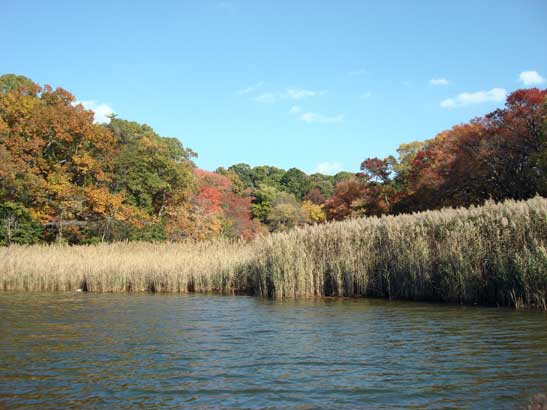
The non-native strain of Phragmites australis dominates many Chesapeake Bay wetlands. Photo Melissa McCormick.
Click to continue »
The non-native strain of Phragmites australis dominates many Chesapeake Bay wetlands. Photo Melissa McCormick.
For those of you wondering just what the Smithsonian Environmental Research Center is, what it looks like and what our scientists do, we offer up a slideshow tour. This was created with interns and research fellows in mind. It doesn’t capture all of SERC, but it does include shots of scientists, worms and blue crabs.
Interested in applying for an internship? The summer deadline has passed, but fall applications should be postmarked by June 1, 2010.
Find out more about SERC’s research and training opportunities on SERC’s website.
If you’re looking for a good conversation about science, history or life – talk to Bert Drake. He’s a plant physiologist and renaissance man who’s been with the Smithsonian Environmental Research Center for nearly four decades. Drake retired in January, but will continue his investigations as an emeritus scientist. We caught up with him before he took well-deserved vacation.
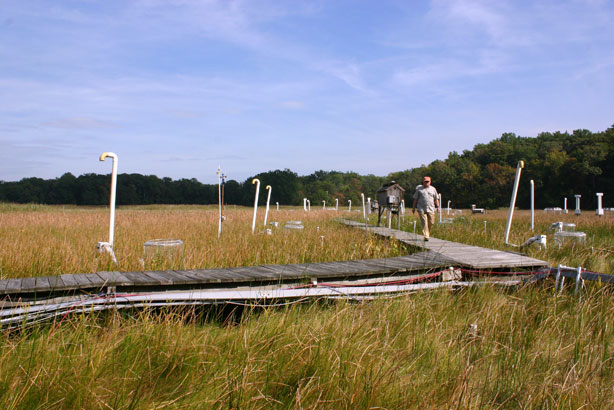
Drake's research unfolds at the Kirkpatrick Marsh, located in Maryland on a subestuary of the Chesapeake Bay.
How did you get drawn to the world of plant physiology?
Nature has always fascinated me and science is about discovering how nature works. I grew up in northern Maine. My father was a barber, but loved the outdoors. I was outside year-round: skiing, canoeing, trapping animals, fishing and taking photos. I knew I wanted to do something connected with biology. I became a science teacher, but it wasn’t until I attended a summer course in ecology that I wanted to get inside a lab and practice science.
In science you almost always get an approximation of an answer because an experiment is only an approximation of reality.
For many SERC scientists, field research comes to a halt in the winter. Some manage to head off to the tropics to investigate invasive species or mangroves, but not photobiologist Pat Neale. Neale and his assistants are spending a good part of their time these days in his lab with the Beast.
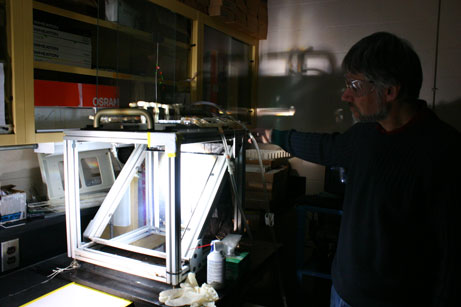
Photobiologist Pat Neale wears eyeglasses that protect him from the Beast's UV rays.
The Beast does not bite, but if you look at it the wrong way it will hurt you. In fact it can char your corneas if you’re not careful. That’s because it reflects and filters ultraviolet light. UV rays are invisible to the naked eye, but are high in energy and potentially damaging to animals and plants. As a photobiologist Neale studies how UV rays affect aquatic environments and the organisms that live in them.
Click to continue »
by Tina Tennessen
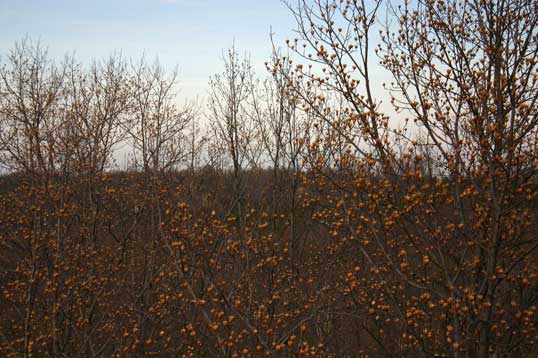
Liriodendron tulipifera, or tulip poplar, is a common tree in the temperate forests surrounding the Smithsonian Environmental Research Center. Other species include sweetgum, American beech, and southern red oak. Photo: Kirsten Bauer.
You can't be a beekeeper without doing your homework. McDonald has been reading up on bees to prepare for the new colonies.
Karen McDonald is not one to sit idly by while a fellow member of planet Earth struggles. McDonald is an educator and the Smithsonian Environmental Research Center’s outreach coordinator. This week she and Elio Cruz prepared three beehives that – come summer – will be full of the flying honey machines. Cruz is a technician at the National Museum of Natural History. He works in the museum’s O. Orkin Insect Zoo.
Click to continue »

A photo of one end of the dinoflagellate Amphisolenia quadrispina. Photo by Sharyn Hedrick
It’s not an exaggeration to say Hedrick was ecstatic when she peered into her inverted phase contrast microscope and found Amphisolenia quadrispina floating in her sample. “For 20 years I’ve been hoping to see something like this,” she said. A. quadrispina has a unique long, thin shape that resembles a stick, more than it does other dinoflagellates. It’s huge too — between 600 to 700 microns, which is still smaller than the tip of a needle, but large by phytoplankton standards.
Click to continue »
An interview with Cindy Gilmour, mercury researcher.

Senior scientist Cindy Gilmour studies how anaerobic bacteria – found in places like the marsh soils above – transform mercury into methylmercury. Methylmercury poses a bigger problem than inorganic mercury because it bioaccumulates.
This January the Maryland Healthy Air Act goes into effect. It aims to significantly reduce emissions of air pollutants from the state’s coal-fired power plants. Mercury, like sulfur dioxides and nitrogen oxides, is one of the pollutants that can be released into the atmosphere during the combustion of coal and other fuels. The new law requires mercury emissions to be reduced by 80% now, and 90% by 2013, relative to a 2002 baseline. Maryland is just the latest to join a growing roster of states that have adopted tougher emissions regulations.
Cindy Gilmour will pay close attention to the impact of these new regulations on mercury levels in the Chesapeake Bay and its watersheds. Gilmour is a senior scientist at the Smithsonian Environmental Research Center (SERC), in Edgewater, Maryland. She took a few minutes to answer some questions about the science of mercury, why it’s of concern and what she does to monitor it in ecosystems.
Click to continue »
Forget about a tree growing in Brooklyn, there’s an orchid growing in the snow. Its name is Aplectrum hyemale. It’s a clever and contrarian little thing.

The orchid Aplectrum hyemale is not afraid of a little snow. Winter is the perfect time for it to photosynthesize.
Aplectrum hyemale waits until the fall to unfurl a solitary leaf. It’s an ellipse of broad green with thin cream stripes. The plant sits low to the ground. In the summertime it would have to compete like crazy for an ounce of sunlight. And it would likely lose out to oaks, tulip trees and the like. During the winter though, after the forest canopy has been stripped bare, Aplectrum hyemale can get all the rays it needs. So a winter green it is.
Click to continue »
Yesterday we gave you a glimpse of Saudi Arabia’s mangroves. Today we offer you free passage to the Caribbean. Smithsonian Environmental Research Center senior scientist Ilka “Candy” Feller organized this virtual tour of Mangal Cay, a mangrove island in the tropics. You can journey with her through the forests and underwater to learn more about the ecology of mangroves. This virtual tour was supported by the National Science Foundation. Click the image below to start the voyage.
The tour’s also available in Spanish. Happy travels.
