This summer from August 7th through August 13th, 9 students went on a journey through the Chesapeake Bay watershed. This trip was organized and led by Josh Falk, an Education Specialist at SERC, and Kevin Schabow, an educator at the NOAA Chesapeake Bay Office. The purpose of this trip was to immerse high school age students in the complex nature of the science, culture and natural resources that the Bay’s watershed has to offer. This year, the students were assigned to report on what they learned and what they did. Here is their story. Click to continue »
As summer wanes in the Chesapeake Bay, many female blue crabs are preparing for an epic journey. Come September they will walk and swim their way toward the mouth of the Chesapeake to release their eggs. Some will travel more than 150 miles. SERC scientists have studied the blue crab’s migratory patterns for more than a decade. Their findings have revealed new insight into the life history of this important species and have helped inform management policies. Tracking these invertebrates is not easy: it involves thousands of pink plastic tags, a unique collaboration with watermen and a blue crab hotline…
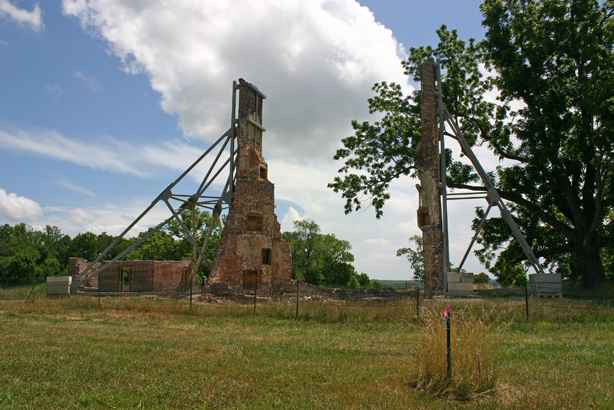
The Contee Mansion ruins, 2010. Photo: Tina Tennessen
The Contee Farm has attracted a motley crew in recent months. Architects, archaeologists, beekeepers, construction crews and trailblazers have all descended upon the grounds. Their interest in the property varies, but they share a common purpose: to prepare the farm for visitors. In the coming years the public will be able to use the site to explore the various ways humans impact the environment.
The Smithsonian Environmental Research Center acquired the 575-acre Contee Farm in 2008. The mansion dates back to 1747 and for many decades served as a hub for the surrounding tobacco plantation. In 1890 lightening struck the house and caused it to burn. Since then, it has been vacant and left to disintegrate brick-by-brick. Click to continue »
Go behind the scenes and into SERC’s photobiology lab. This is where photobiologist Pat Neale spends a great deal of time examining the impact of UV radiation on photosynthesis. In this video you’ll get a look at one experiment that seeks to determine what would happen to the ocean’s phytoplankton if the ozone layer was suddenly destroyed by cosmic radiation.
Video credits: Anne Goetz, Editor; Lia Kvatum, Producer/Writer/Camera; Tony Franken, Music.
Learn more about this experiment in an earlier Shorelines post.
SERC senior scientist Denise Breitburg will lead the NOAA-funded study of hypoxia and acidification in the Chesapeake Bay.
Marine ecologist Denise Breitburg and her colleagues have thought up many novel ways to investigate the impacts of dead zones and acidification on Chesapeake Bay fish and invertebrates. Among their ideas: attaching tiny transmitters to fish and monitoring their movement in relation to oxygen and pH levels. A new $1.4 million grant from the National Oceanic and Atmospheric Administration will enable them to pursue this experiment and a host of others. Click to continue »
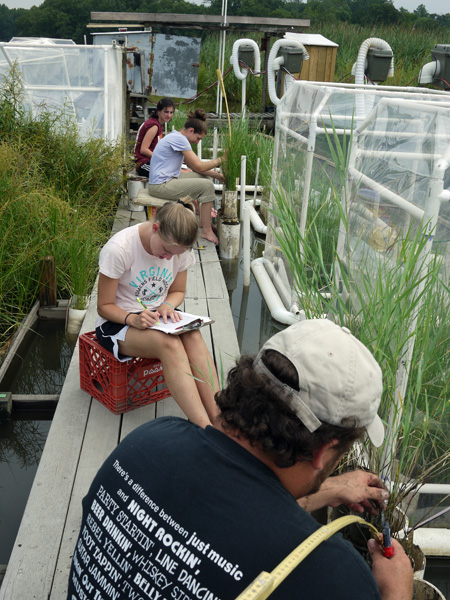
Seal collects data with other interns for Smithsonian scientists who are investigating the impact of global change on tidal marshes.
I know the title sounds like another great Ben Stiller Night at the Museum movie. However, in this real story of life at the Smithsonian, you will get a first-hand look at what really goes on behind the scenes at the Smithsonian Environmental Research Center. Although the movies show the Smithsonian as talking exhibits, in reality the Smithsonian is a multitude of museums and scientific research centers where students of all ages and specialties do research. The two movies did a very good job of characterizing some of the more popular characters in history such as Theodore Roosevelt, but in reality the most interesting people at the Smithsonian are the researchers. Click to continue »
Hallmark may not have a card for it, but today is International Mangrove Action Day.
Photo: Ilka C. Feller/Smithsonian Institution
The occasion is a small but vibrant tradition that has been observed annually on July 26th for nearly a decade in countries around the globe, including the U.S., India, Ecuador, Micronesia and many others. To celebrate, some communities organize protests or restoration projects. Some convene discussions or offer educational lectures about mangrove ecology. Others simply take a moment to appreciate the importance of mangrove forests. Click to continue »
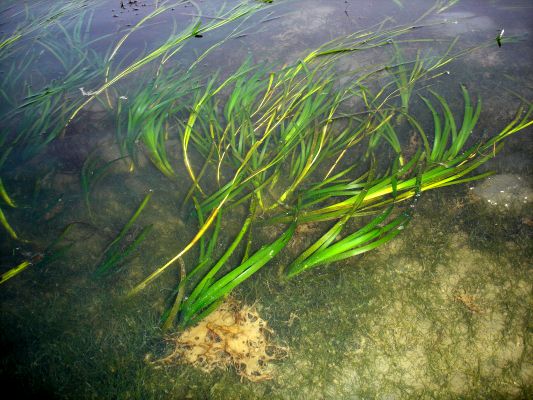
Around the world seagrasses are being lost. Turbidity is one factor that impedes their growth. However, in some places water quality has improved, but the grasses have not rebounded. SERC scientists wonder if a 'carpet of fluff'—a mix of organic and inorganic particles that floats just above the sediment—is blocking the sunlight seedlings need to grow. Photo: Tim Carruthers courtesy of IAN/UMCES.
Peculiar phenomena have always brought researchers together. For SERC senior scientist Chuck Gallegos and Danish PhD student Troels Møller Pedersen it was a mutual interest in the “carpet of fluff” that floats just above the sediment in estuaries like the Chesapeake Bay. The fluff is a soupy mix of organic and inorganic particles. These particles pose a problem to underwater vegetation because they cloud-out sunlight that the plants, particularly seedlings, need. No one has documented just how much light this layer blocks. Pedersen and Gallegos hope to change this. Click to continue »
Scientists Find Excess Nitrogen Favors Plants That Respond Poorly to Rising CO2
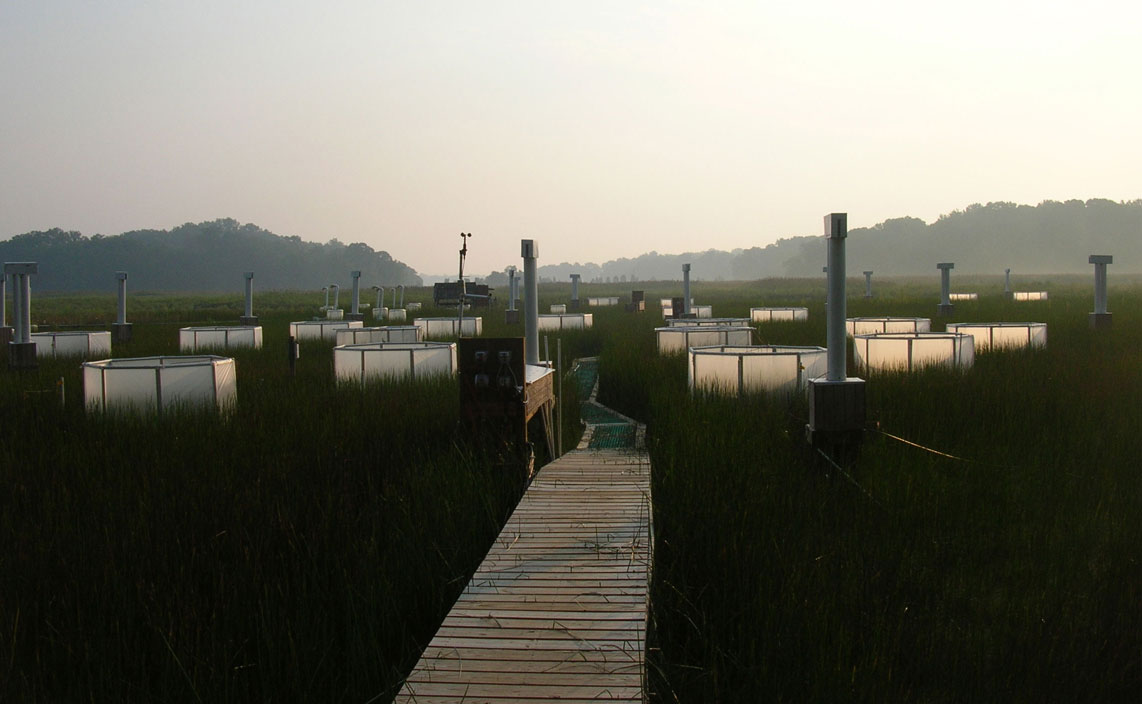
The Smithsonian's Global Change Research Wetland. Photo: SERC
As atmospheric carbon dioxide levels rise, so does the pressure on the plant kingdom. The hope among policymakers, scientists and concerned citizens is that plants will absorb some of the extra CO2 and mitigate the impacts of climate change. For a few decades now, researchers have hypothesized about one major roadblock: nitrogen.
Plants build their tissue primarily with the CO2 they take up from the atmosphere. The more they get, the faster they tend to grow—a phenomenon known as the “CO2 fertilization effect.” However, plants that photosynthesize greater amounts of CO2 will also need higher doses of other key building blocks, especially nitrogen. The general consensus has been that if plants get more nitrogen, there will be a larger CO2 fertilization effect. Not necessarily so, says a new paper published in the July 1 issue of Nature. Click to continue »
A Tintinnophagus acutus dinospore, with a flagellum. Photo: Wayne Coats
In the microscopic world of marine protists, many species drift in the ocean currents unstudied and nameless. This is no longer the case for the parasitic dinoflagellate Tintinnophagus acutus. SERC plankton ecologist Wayne Coats recently finished an extensive description of the organism and thus earned naming rights.
Of the approximately 2,000 known species of living dinoflagellates, about 150 are parasitic. These organisms can alter the marine food web, in some cases destroying prey that consumers like copepods and larval fish rely upon. Coats first spotted T. acutus in the 1980s, in plankton samples he had collected from the Chesapeake Bay. Through his microscope, he noticed a ciliate being edged out of its lorica (shell) by a dinoflagellate. It looked different from others he had observed. Click to continue »