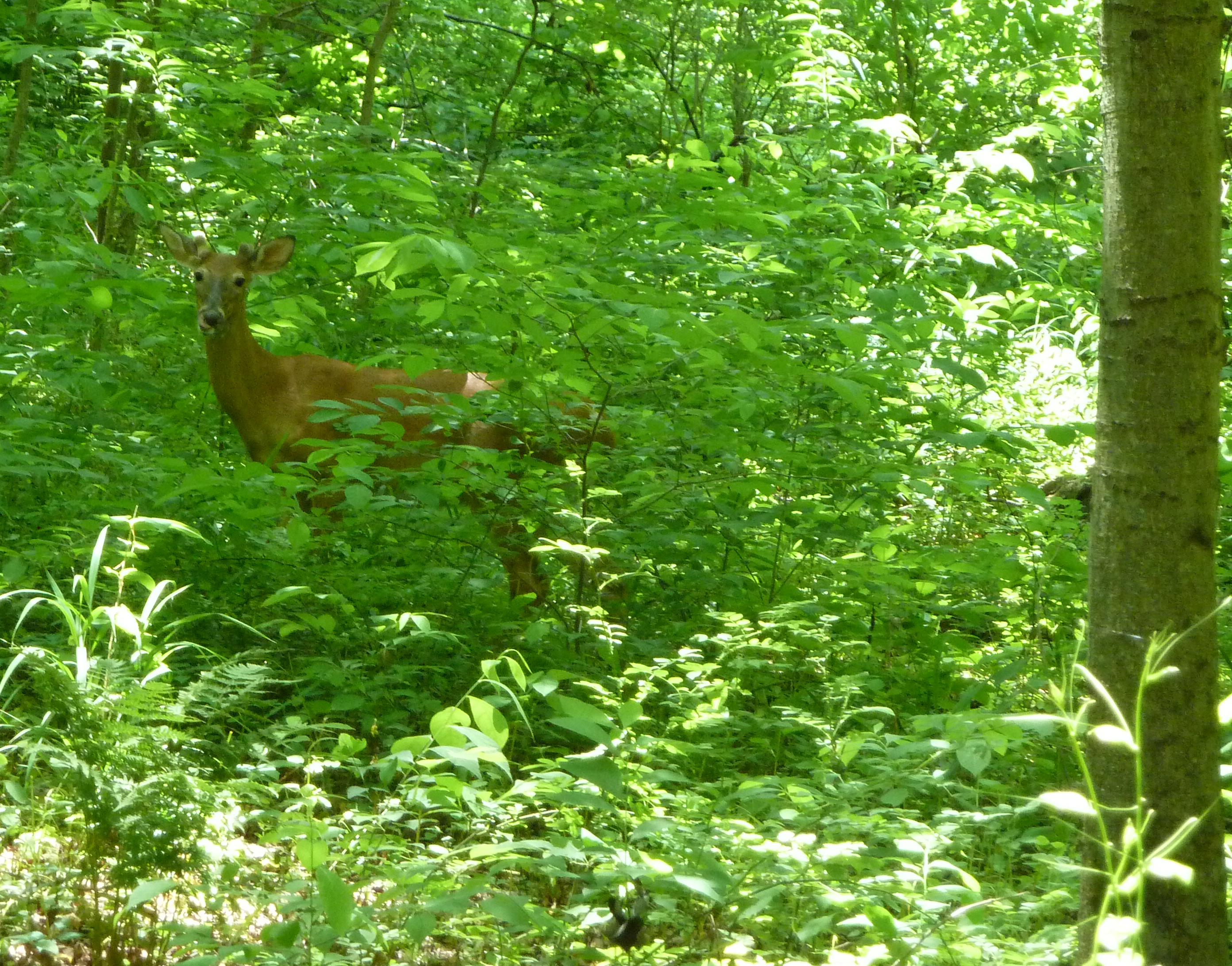
In deer-populated forests, tastier plants can avoid being eaten if they are surrounded by less appealing plants. But with deer gone, diverse plots become weaker and plants are better off sticking to their own kind.
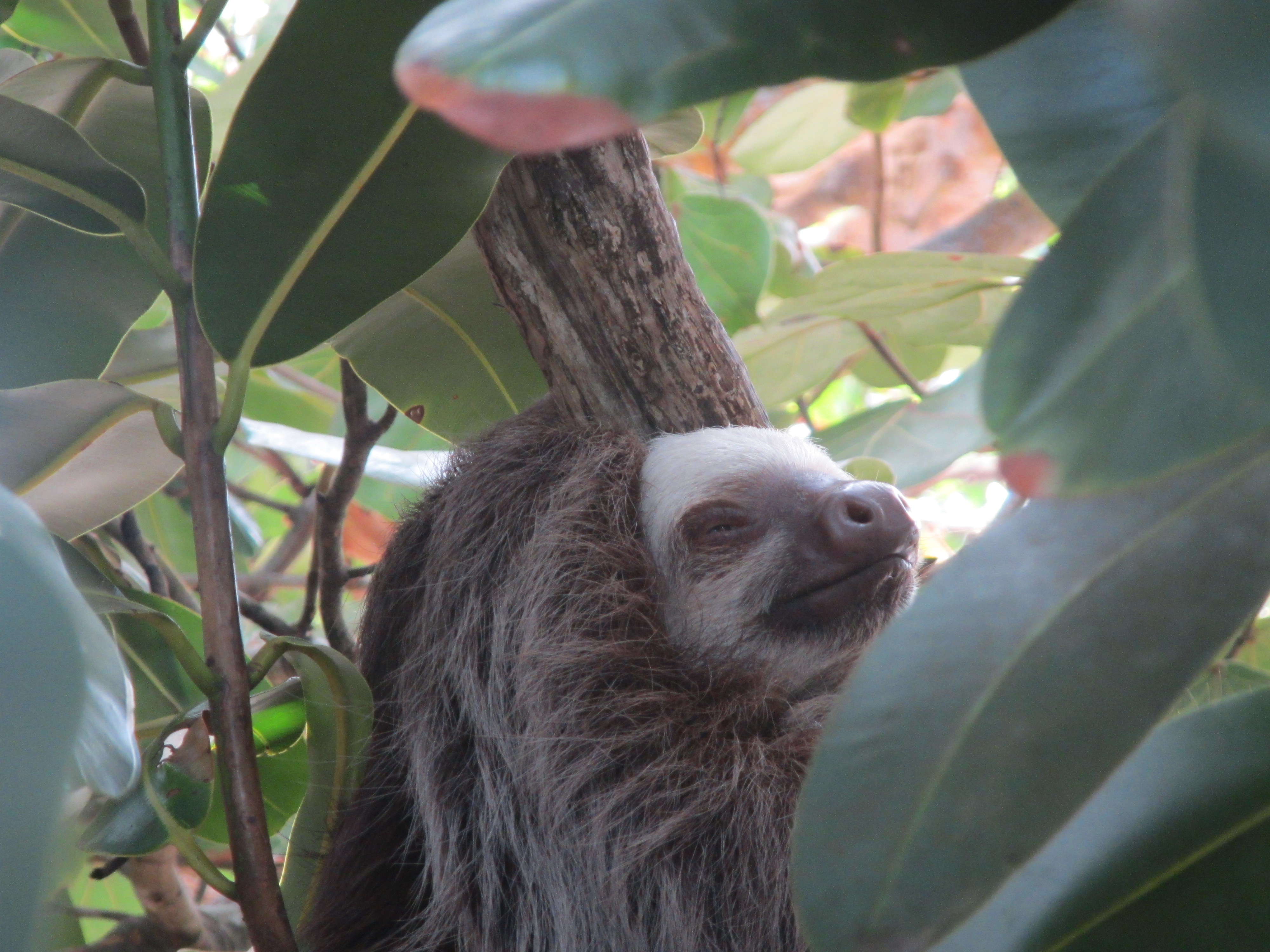
Sloth in Isla Galeta, near the Smithsonian’s marine station on the Panama Canal. (Kristen Larson/SERC)
March 10
Got up at o-2:30 to catch a shuttle to the airport, after singing a concert the night before and not getting to bed until 12:30. Finally arrived at our lodging in Panama about 10:30 p.m., bleary-eyed but happy to be back in this special place!
March 11
Our first day. Usually we start out a bit slowly, shopping for food, getting our IDs at Tupper, getting set up, but today we dive right in. We collect samples from the STRI dock in Naos and begin the process of reacquainting ourselves with the species in Panama. Warmer water means we are looking at a whole different suite of species than we see back in San Fran or Chesapeake. The lab is on an island situated just outside the canal on the Pacific side.
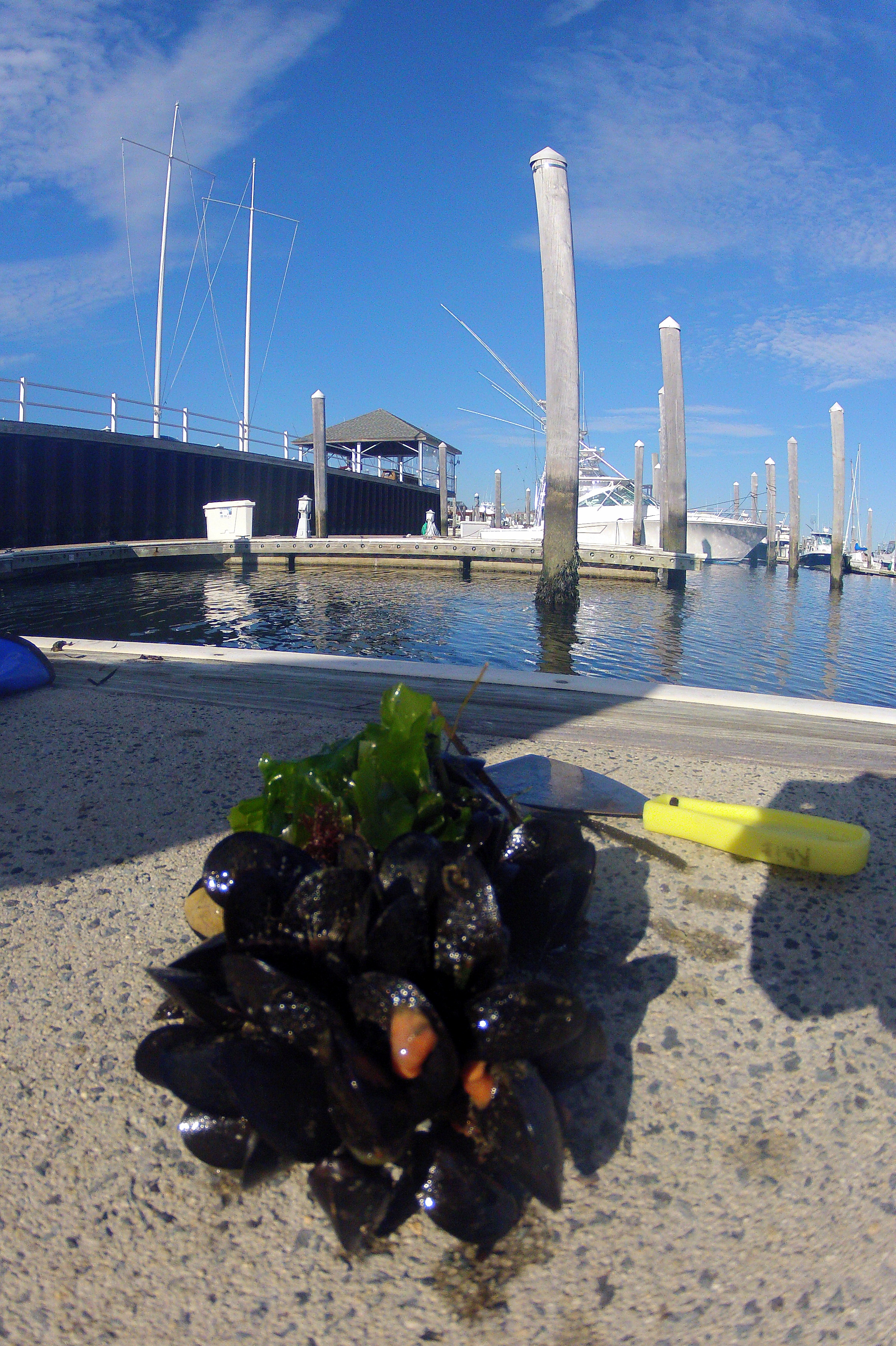
Mytilus mussels in Point Judith Marina, Rhode Island. (Kim Holzer)
Imagine after settling down on a place to stay, your home picks up speed and moves without any forewarning, bringing you along with it to a new place. You get off to explore. It seems livable and similar to home, but a few adjustments will be necessary.
This story would be possible — if you were a mussel, a barnacle, or a myriad of other intertidal organisms. Once there, these new arrivals are sometimes able to escape their predators at home and thrive—often at the expense of native species, or the ecosystem as a whole.
Such is the dilemma of Mytilus galloprovincialis, a mussel from the Mediterranean. Mytilus galloprovincialis is native to southern Europe but has branched out to numerous non-native regions around the globe. It is the most prevalent non-native marine species in South Africa. There, it not only competitively displaced native species but also catalyzed the decline of swimming crabs and the increase of whelks.
Scientists uncover milk composition of naked mole-rat queens
by Micaela Jemison
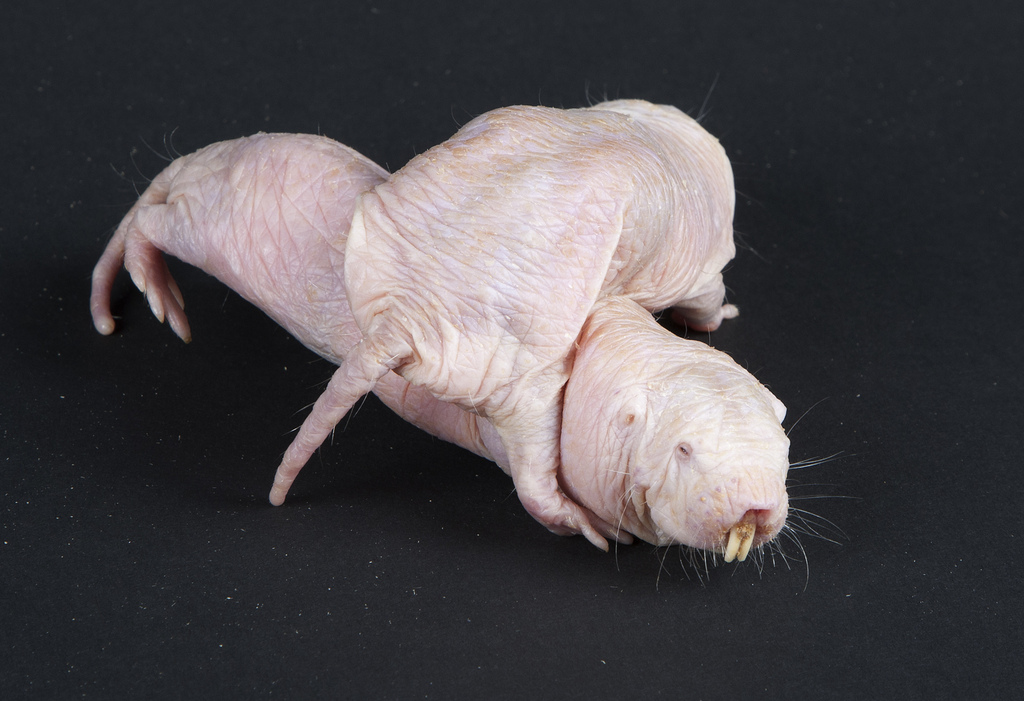
Naked mole rats at the National Zoo (Meghan Murphy)
Parents normally feel the need to provide well for their kids. For humans, that number of offspring is usually in the single digits, but a naked mole-rat queen can have as many as 900 pups in a lifetime spanning up to 30 years.
Naked mole-rats live their lives entirely underground in Africa, digging tunnels in a perpetual search for plant tubers to eat. These bizarre creatures are unlike nearly every other mammal on earth in that the burdens of reproduction and milk feeding of young are placed solely on a single queen and are not shared among the females of the colony.
While this system may work well for insects like bees where the young are fed by a horde of workers and nurses, scientists were perplexed as to how this system works for a mammal where one mother must produce milk for her very large brood.
A Chesapeake Bay NOAA mullet skiff. Note the motor near the bow. (SERC)
With its motor located near the bow (front) of the boat, the modern-day mullet skiff could have been a character in Lewis Carroll’s novel “Alice’s Adventures in Wonderland.” Similar to the unpunctual rabbit, vanishing cat and hookah smoking caterpillar, it seems illogical…or does it?
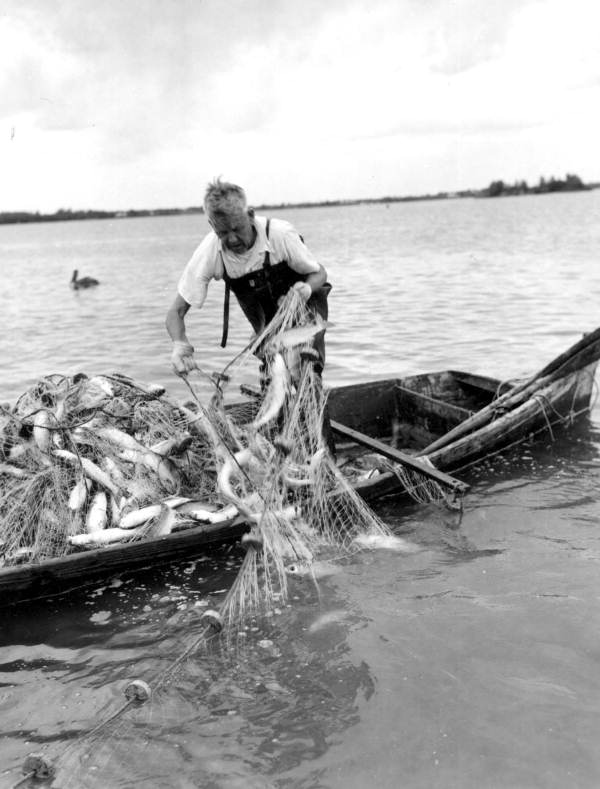
Commercial mullet fishing in 1955. (Monts de Oca, C. Morris courtesy of State Archives of Florida)
In the early 1900s, the mullet skiff was originally designed for use in the commercial mullet fishery of the south. Popular for its simple construction, flat-bottom dory style hull with vee entry, and rounded stern (back) design, the mullet skiff was ideal for operating in shallow waters while carrying heavy loads of fish. However, during Prohibition, entrepreneurs souped up their mullet skiffs with straight-8 engines (precursor V8s) to run rum from the Bahamas and Cuba to the states. Since then, many mullet skiffs have undergone less scandalous modifications and have evolved to have an outboard motor in a well near the bow.
Why place a motor here? For three important reasons: 1) It places the motor higher in the water for maneuvering in shallow water, 2) it leaves the stern (back) open to work a net, and 3) it eliminates the risk of net entanglement in the propeller. So, with “the wrong end in front,” the mullet skiff was the perfect choice for the near-shore predator study our field crew conducted this summer throughout the Chesapeake Bay.
Most animals are quite pragmatic in their gift-giving. When attracting mates, elaborate dance routines and ostentatious coloring certainly help. But when offering presents, males tend to give their significant others something they can actually use (unless they are sleazeballs—but more on that later).
Of course, what a female bush cricket finds enticing wouldn’t necessarily go over well for a chimpanzee, or an Arctic tern. What follows is a glimpse of romance in the rest of the animal kingdom. Below are four gifts animals can use to attract or care for their mates, and while they are usually thoughtful in context, we don’t recommend trying them at home.
Eleven-year-old Lucy Paskoff knows something about the hazards of filming wildlife. She and fellow home-school student McKenna Austin-Ward spent weeks documenting one of Chesapeake Bay’s most destructive pests: the mute swan.
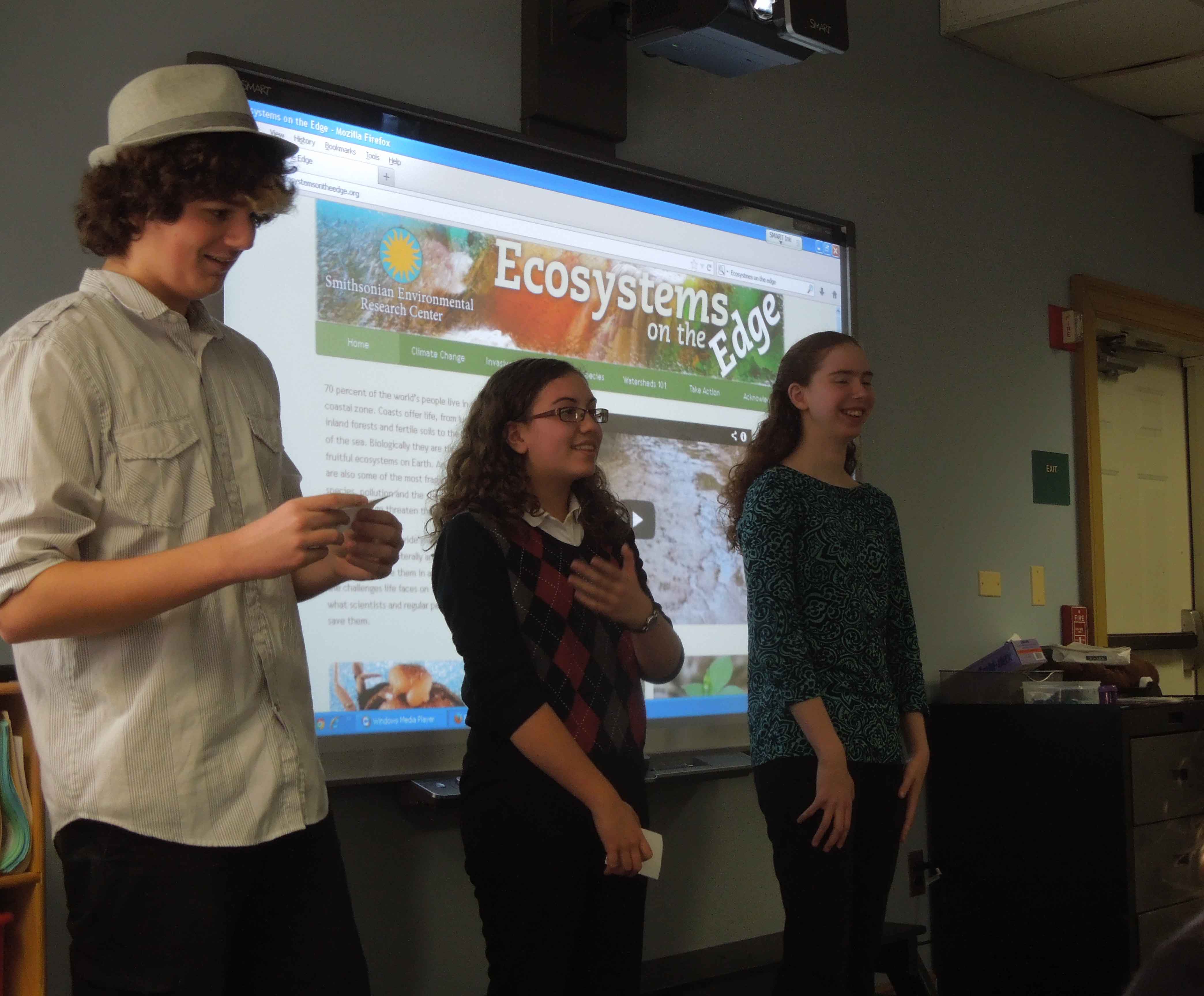
From left: SERC home-school students Joe Giardina, Molly Enriquez and Anne Marie Nolan at the student documentary film screening. (SERC)
It began with a video series called Ecosystems on the Edge. Home-school students ages 11 to 16 came to the Smithsonian Environmental Research Center every two weeks, from September 2013 to January 2014, to create short science documentaries. Their abilities ranged from knowing how to shoot film to knowing how to turn on a computer, but full-scale video production was new to all of them. The Ecosystems series–short videos of SERC scientists working to save the coast–provided a springboard of ideas. The rest of the creative process was up to the students.
They broke into teams, ranging from one student to three. Instructor Karen McDonald walked them through the documentary-making process. Each team had to draft a proposal, draw a story board, create a shot list and script, interview SERC scientists on camera, film “B” roll (extra film) and find narrators, or read the narration themselves. Then came post-production, when the students spent weeks learning to use editing software.
By January, four teams overcame the environmental snags and technical difficulties and produced their own documentary shorts. From invasive earthworms to mute swans, here are their films:
Invisible Invasion: Joe Giardina, Molly Enriquez, Anne Marie Nolan. Using ideas from the video Earthworm Invaders, this group focused on the silent and invisible invasion of earthworms in forests and the effects of invasive worms on forest ecosystems.
Beauty and Beast: McKenna-Austin Ward, Lucy Paskoff, Max Gwinn. This documentary was inspired by the video Alien Invader, which looked at invasive barnacles in the Chesapeake Bay. For their video the students chose the invasive mute swan, and compared people’s perception of the bird as beautiful to its beastly effect on the flora and fauna of the Bay.
Invertebrates as Bioindicators: Xanthia Strohl. Inspired by the video Stream Health, Xanthia explored the idea of using blue crabs and crayfish as indicators of water quality and health in the Bay, and suggested ideas for helping reduce runoff.
Blue Crabs-The Soul of the Chesapeake Bay: Abbie and Katie Cannon. This team of sisters was moved by the Blue Crabs: Top Predator in Peril film. Their documentary is based on the plight of the blue crab in the Bay, and factors affecting its population and success.
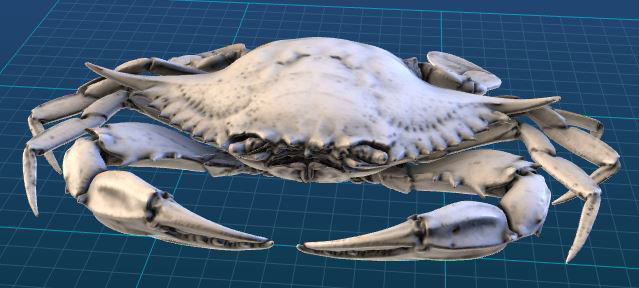
Image capture of the blue crab from Smithsonian X3D. (Credit: Smithsonian Institution)
Can’t get to water to fish up a blue crab? Want to teach about blue crabs and Smithsonian research but can’t make it to SERC or the Chesapeake Bay? Landlocked, but you want students to measure a crab’s carapace and learn about its life cycle? SERC has the answer: a virtual blue crab.
The blue crab is just part of the new Smithsonian X3D—a revolutionary way for visitors to interact with Smithsonian collections and research. In November 2013 the Smithsonian launched the Smithsonian X3D (beta) program, which allows visitors to flip, rotate and zoom in on digitized 3D images of objects from across the Institution. Right now they can explore more than 20 objects, including Amelia Earhart’s flight suit, the Wright brothers’ plane and a life mask of Lincoln.
Wood frogs (Lithobates sylvaticus) freeze solid over winter and come back to life in spring
by Karen McDonald
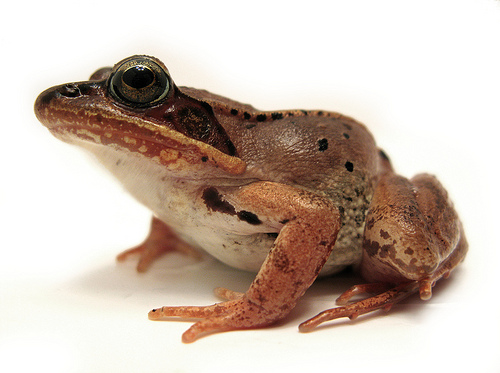
Wood frog (Dave Huth)
Here in North America there are a wide variety of toads and frogs, but perhaps none are so unusual as the wood frog. These frogs are found in Eastern North America, Canada, and up into Alaska. On a warm spring night you might hear them singing(click here for sound clip) near bogs, vernal pools or upland forests, but something remarkable happens to them this time of year in the winter: They freeze solid. Now freezing solid isn’t remarkable by itself, but what is remarkable is that the frogs will literally come back to life in the spring, after having no heartbeat or brain activity (they don’t even breathe) for up to eight weeks! This baffles and amazes scientists, who are actively studying them even now.