add_filter('bloginfo_url', function($output, $property){ error_log("====property=" . $property); return ($property == 'pingback_url') ? null : $output; }, 11, 2);
 

Archives

...now browsing by author


Wiring the Marsh: Intern Helps Build the Wetland of the Future

Wednesday, July 11th, 2018

By Philip Kiefer

Maya Bhalla-Ladd, who is beginning her second summer as an intern at the Smithsonian Environmental Research Center (SERC), didn’t think growing up that she would be a scientist. “In high school, I spent all my time on ballet,” she says. “I danced professionally. I lived on my own in New York.”

But when health problems forced her to turn away from ballet, she found herself drawn to the ocean. “I remember going to the aquarium as a kid and watching the rays,” she says. “The way they move is very naturally beautiful. So when I stopped being able to dance, I wanted to spend the rest of my life preserving that kind of natural beauty for other people to enjoy.”
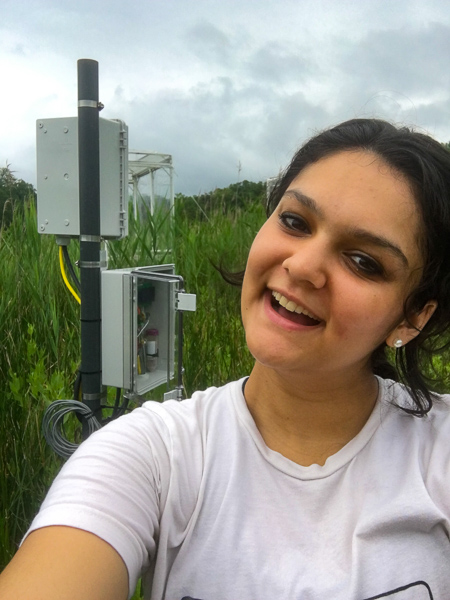
Maya Bhalla-Ladd with a temperature sensor.

Maya with a hand-crafted temperature sensor! (Maya Bhalla-Ladd/SERC)

Maya spent last summer at SERC’s Global Change Research Wetland (GCREW), investigating how climate change could affect photosynthesis in marsh plants. While there, she became fascinated with a tool used to measure photosynthesis in leaves. The tool seals a single leaf in a chamber and exposes it to light, causing the leaf to begin photosynthesis. It can then measure the precise gas composition of the chamber as the plant produces sugar. In effect, it can watch the plant breathe.

“I think that the instrumentation that enables science is so cool, and that we don’t spend enough time thinking about it,” Maya says. Click to continue »

Share

“Orchids In Classrooms” Turns Sixth-Graders Into Citizen Scientists

Monday, July 9th, 2018

By Hannah-Marie Garcia, science writing intern

Think back to your early childhood science classes. Was there
ever a time you had to watch a plant grow? Your first natural sciences teacher may have used plant growth to explain basic concepts of plant biology. The process is a rewarding learning experience for students to observe their hard work pay off as those first few leaves sprout from the soil.

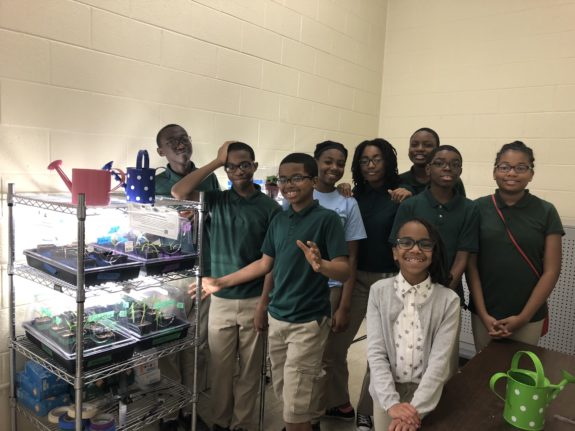
Walker Mill Middle School sixth-grade students and their orchid experiments.
(Credit: Hannah-Marie Garcia/SERC)

Now, imagine the work you did was part of a larger scientific project, with real-world applications. That is exactly what four sixth-grade classes are doing this year at Walker Mill Middle School. Located in a Capitol Heights neighborhood of the Prince George’s County school system, Walker Mill is one of seven schools in the Maryland area working with the Smithsonian Environmental Research Center (SERC) on a project called “Orchids in Classrooms.”

Click to continue »

Share

Meet Pepper, The Android Docent

Tuesday, July 3rd, 2018

by Kristen Minogue

Pepper close up, with blue eyes and tablet displaying options (Tell a Story, Do Something Fun and Need Information)Don’t panic. The new robot greeting visitors at the Reed Education Center isn’t about to stage a technological coup over the SERC campus. But it can pose for selfies, tell people about SERC programs and break out a dance move or two.
The robot goes by the name Pepper. Technically, Pepper has no gender, though most visitors—and a few staff—have taken to calling the robot “she” by default. The Smithsonian received a team of Pepper robots in February from SoftBank Robotics, to test out in their museums and other programs. Two Peppers went to the Smithsonian Environmental Research Center (SERC), where staff and students are programming them to interact with the public. Click to continue »

Share

800 Million Tons of Blue Carbon May Lie Buried in U.S. Tidal Wetlands

Thursday, June 21st, 2018

by Kristen Minogue

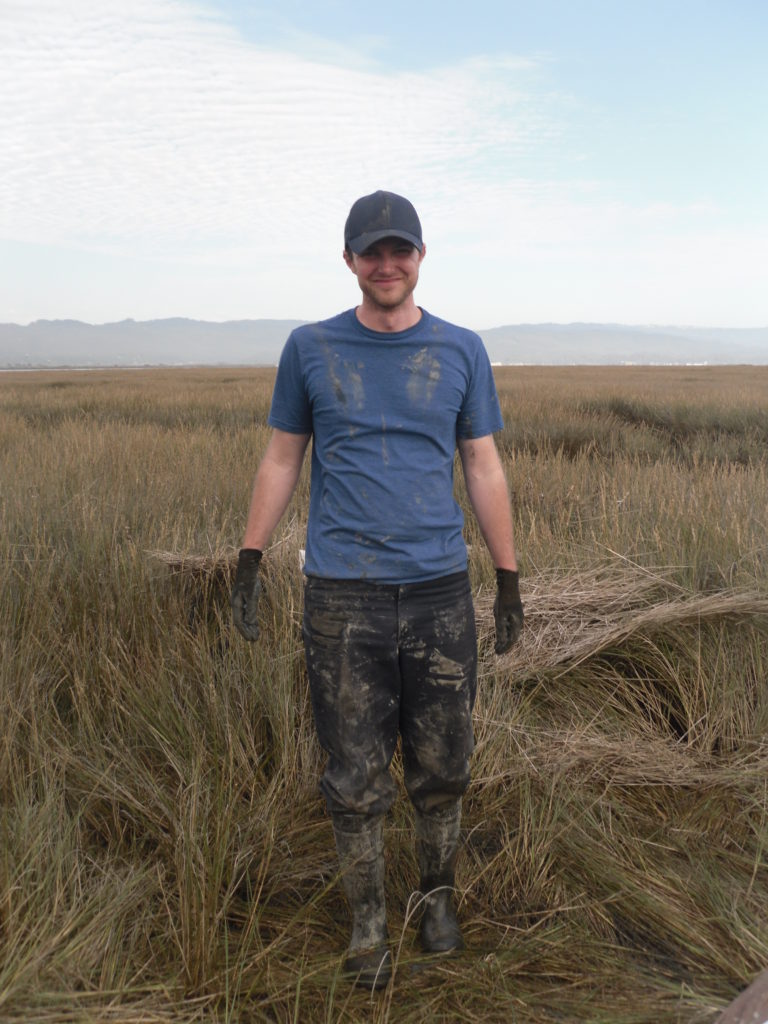
Man with muddy clothes in grassy wetland

Smithsonian ecologist James Holmquist explores a wetland in Humboldt Bay, California. (Credit: Lauren Brown)

It’s a true story of “grassroots science.” A team of over two dozen researchers set out to estimate how much carbon tidal wetlands across the U.S. can store. But the official datasets didn’t give them much info to work with. So they pooled their resources, creating a new dataset of nearly 2,000 wetland soil cores.

Their final estimate: Nearly 800 million tons of carbon may lie buried in the tidal wetlands of the contiguous U.S. The team published the discovery June 21, in a new study in Scientific Reports led by the Smithsonian Environmental Research Center. The study also leaves another major legacy. The 1,959 soil cores they compiled could help finally unlock some secrets of wetlands, ecosystems that have been overlooked for centuries.

Click to continue »

Share

Understanding Sharks One Tag at a Time

Thursday, June 14th, 2018

by Mollie McNeel

Close-up of shark in profile, held by scientist

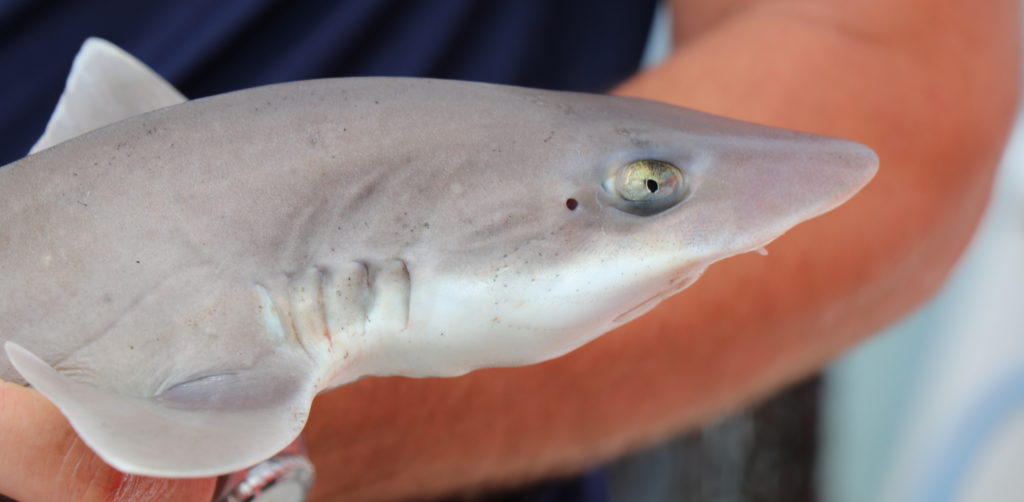
Smooth dogfish shark (Mustelus canis), one of four species Smithsonian scientists are tagging and tracking along the Atlantic. (Mollie McNeel)

Sharks. They’re everyone’s favorite underwater enemy. Between nerve-wracking dramas like Jaws to stories about prehistoric mega-sharks, we have all but made the shark species a completely fictionalized being. But scientists at the Smithsonian Environmental Research Center (SERC) are hoping to change that.

Charles “Chuck” Bangley, a marine ecologist at SERC, travels up and down the East Coast catching and tagging four species of sharks found in the Chesapeake Bay and along the Atlantic: smooth dogfish sharks (Mustelus canis), bull sharks (Carcharhinus leucas), blacktip sharks (Carcharhinus limbatus) and dusky sharks (Carcharhinus obscurus).

Click to continue »

Share

Confessions of a Real Life Scientist: Grasslands of the World

Friday, May 25th, 2018
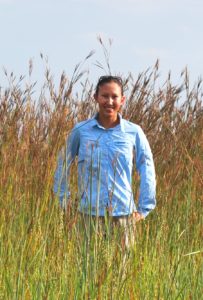
Kim La Pierre in tall grasses

Kim Komatsu stands in a grassland at Konza Prairie Biological Station, in Manhattan, Kansas.
(Credit: Cynthia Chang)

by Kim Komatsu,
ecosystem conservation ecologist

One of the unexpected perks of my life as a scientist has been the opportunity to travel for work. As a grassland ecologist, my studies have taken me to South Africa and Tanzania to investigate the roles of fire, grazing, and nutrient availability in determining plant growth and species diversity. In these exotic field sites, I would drive by impalas, zebras, elephants, giraffes, cheetahs, lions, and leopards before arriving at my experimental plots. Then I would spend my day working in the hot sun to survey the plant communities in my plots, all the while guarded by a park ranger with a loaded rifle to protect me from the very animals I marveled at on the way to the field site. (Thankfully those rifles were never fired during my trips.) With grasslands all over the world, I have many more grassland types on my research wish list, including the Mongolian steppes, the Pampas of South America, the Cerrado of Brazil, and the rangelands of Australia and Europe. Click to continue »

Share

Wetlands of the Warmer World

Tuesday, May 22nd, 2018

SERC researchers race to find out how higher temps will affect coastal wetlands

by Mollie McNeel

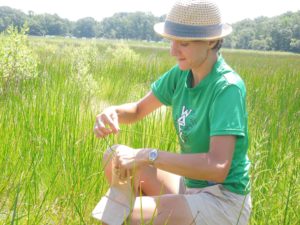
Woman in hat collecting marsh plants

Genevieve Noyce collects a blade of marsh sedge to measure in lab, in the Smithsonian’s “wetland of the future.”
(Kristen Minogue/SERC)

Wetlands are typically filled with the sounds of crickets chirping, bees buzzing and frogs croaking. But at the Smithsonian Environmental Research Center (SERC), those are all accompanied by the whirring of motor-powered pumps. These pumps are driving air from hexagonal carbon dioxide chambers to a greenhouse gas analyzer, helping scientists create a “wetland of the future.”

Scientists at SERC are attempting to predict how the warming climate and rising carbon dioxide levels will impact coastal wetlands with an experiment called SMARTX—Salt Marsh Accretion Response to Temperature eXperiment. It’s one of many futuristic experiments on the center’s Global Change Research Wetland.

“Wetlands are a really important part of our planet in terms of storing carbon, and we’re hoping to get an idea of how higher temperatures will affect them,” said Genevieve Noyce, an ecology postdoc at SERC, as she moved among grass-covered warming plots, measuring gas exchange over five-minute intervals.

Click to continue »

Share

Wanted: The Hunt for Chinese Mitten Crabs Is Back On

Tuesday, May 15th, 2018
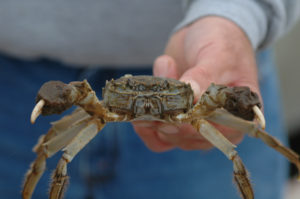
Chinese mitten crab held in outstretched hand

A Chinese mitten crab found in Chesapeake Beach, Md., in 2007. Chinese mitten crabs are most recognizable by their brown, spiny shells and furry “mittened” claws. (Credit: SERC)

by Kristen Minogue

An army of invading crabs has disappeared. But scientists are skeptical about whether they’re gone for good, or just hiding. As warmer temps lure people onto the water, Smithsonian scientists are asking boaters to report any sightings of the elusive Chinese mitten crab.

In 1992, a team of fishermen unexpectedly caught a Chinese mitten crab while trawling for shrimp in southern San Francisco Bay. From there, sightings of the brown, furry-clawed crustaceans exploded. In 1998, nearly three quarters of a million appeared in the North Bay alone. The mitten crabs threatened to collapse river banks with their burrows and made fishing nearly impossible in some places, as they clogged gear, stole bait or ate trapped fish.

“It was spectacularly abundant. A true outbreak,” said Greg Ruiz, a biologist with the Smithsonian Environmental Research Center (SERC). “And it clogged the water intakes. Water is the economy in California.”

Mitten crab numbers remained high through 2005. And then they vanished. Chinese mitten crabs haven’t been seen in California since 2010. Click to continue »

Share

Is Your Plant Dead or Just Dormant?

Thursday, May 10th, 2018

by Mollie McNeel

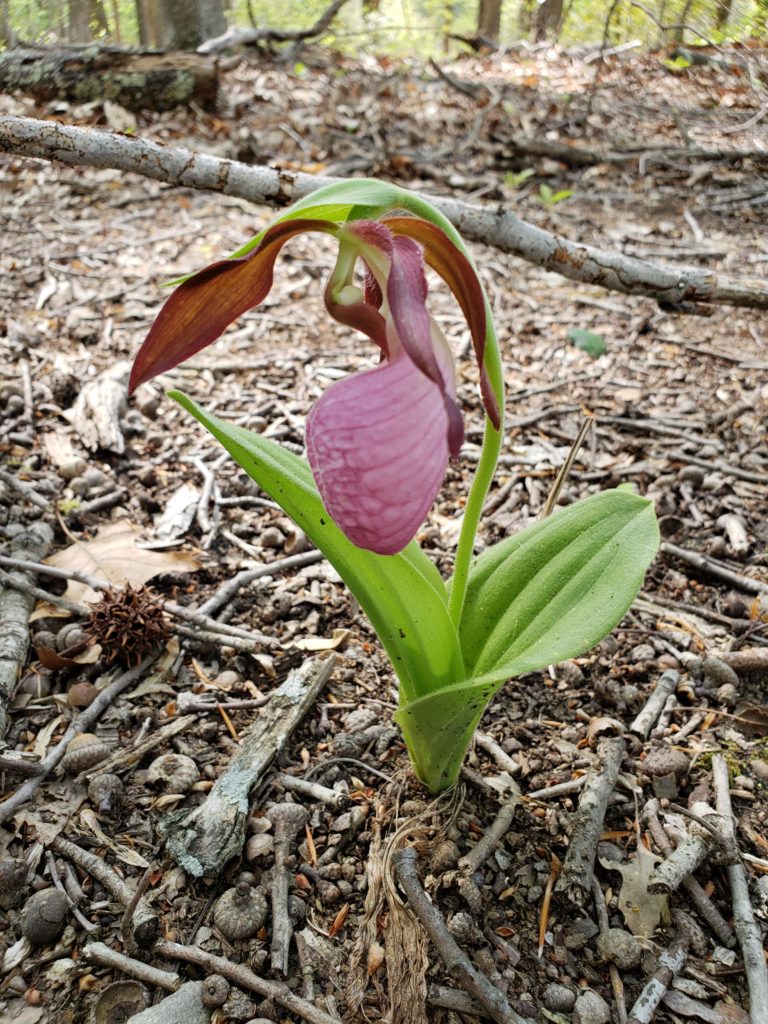
pink lady's slipper orchid

Pink lady’s slipper (Cypripedium acaule), an orchid that can remain dormant for over 20 years. (Credit: SERC)

If a gardener told you that her plants had died and had come back to life years later, you might think she had gone crazy. But actually, she may be on to something.

Some fully-grown plants can “hibernate” in the soil for up to 20 years, researchers from the Smithsonian Environmental Research Center (SERC) discovered in a study published in the May issue of Ecology Letters.

The so-called “Rip Van Winkle” plants, nicknamed after the fictional character who slept for two decades, include many species of orchids and some ferns. Click to continue »

Share

The Ugly Fish That Sings Its Own Song

Friday, April 27th, 2018

by Kristen Minogue

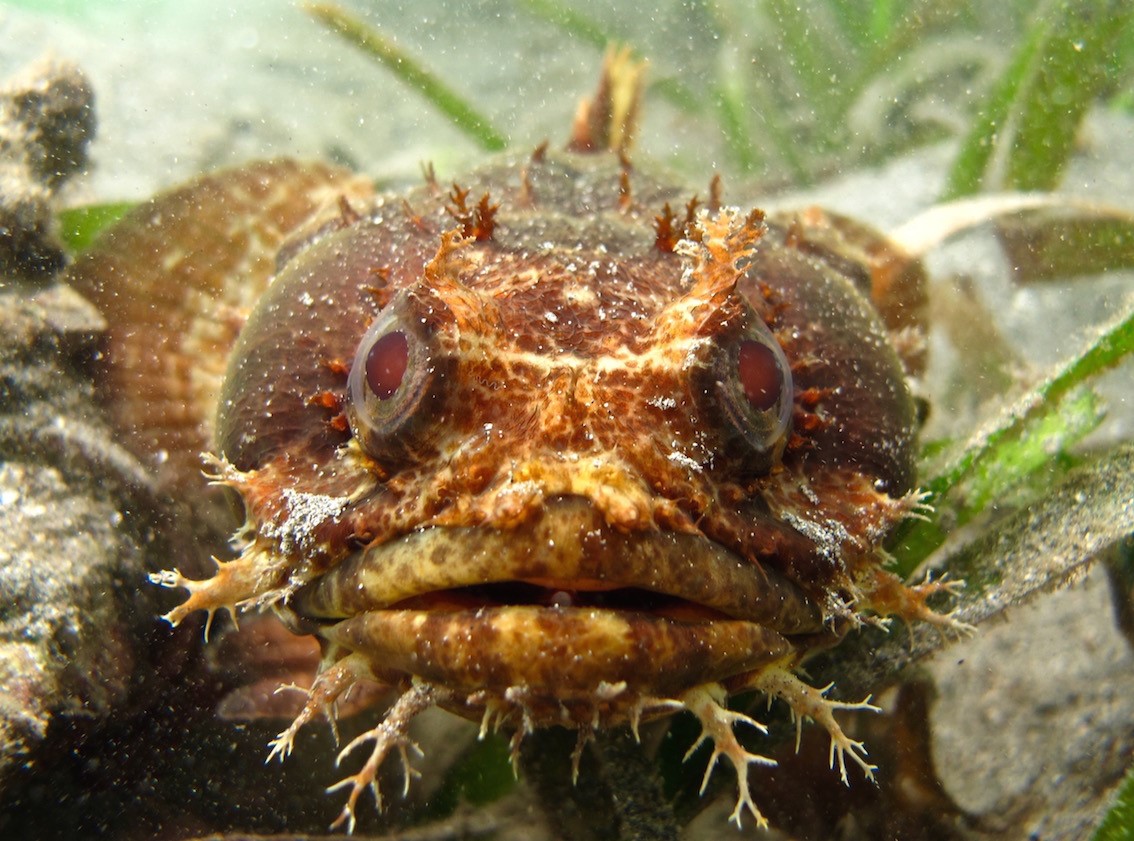
Orange-brown toadfishwith red eyes

Male Bocon toadfish of Panama attract mates by singing in a series of “grunts” and “boops.”
(Photo: Study authors)

The sing-off begins when the sun goes down. Every night off the coast of Bocas del Toro, Panama, Bocon toadfish start calling from their burrows, trying to win over females by showing off their vocal talents and drowning out the competition.

If you’ve never heard of the singing toadfish, you’re not alone. They don’t have the charisma of dolphins or whales. They’re mud-colored reef dwellers, with bulging eyes, puffed-out cheeks and fleshy barbels dangling from their mouths. By most human standards, the toadfish isn’t exactly the prettiest fish in the sea.

“It’s kind of like a troll that lives under a bridge and sings,” said Erica Staaterman, a marine biologist who recorded individual toadfish songs in Panama for a new study published this month.

Click to continue »

Share