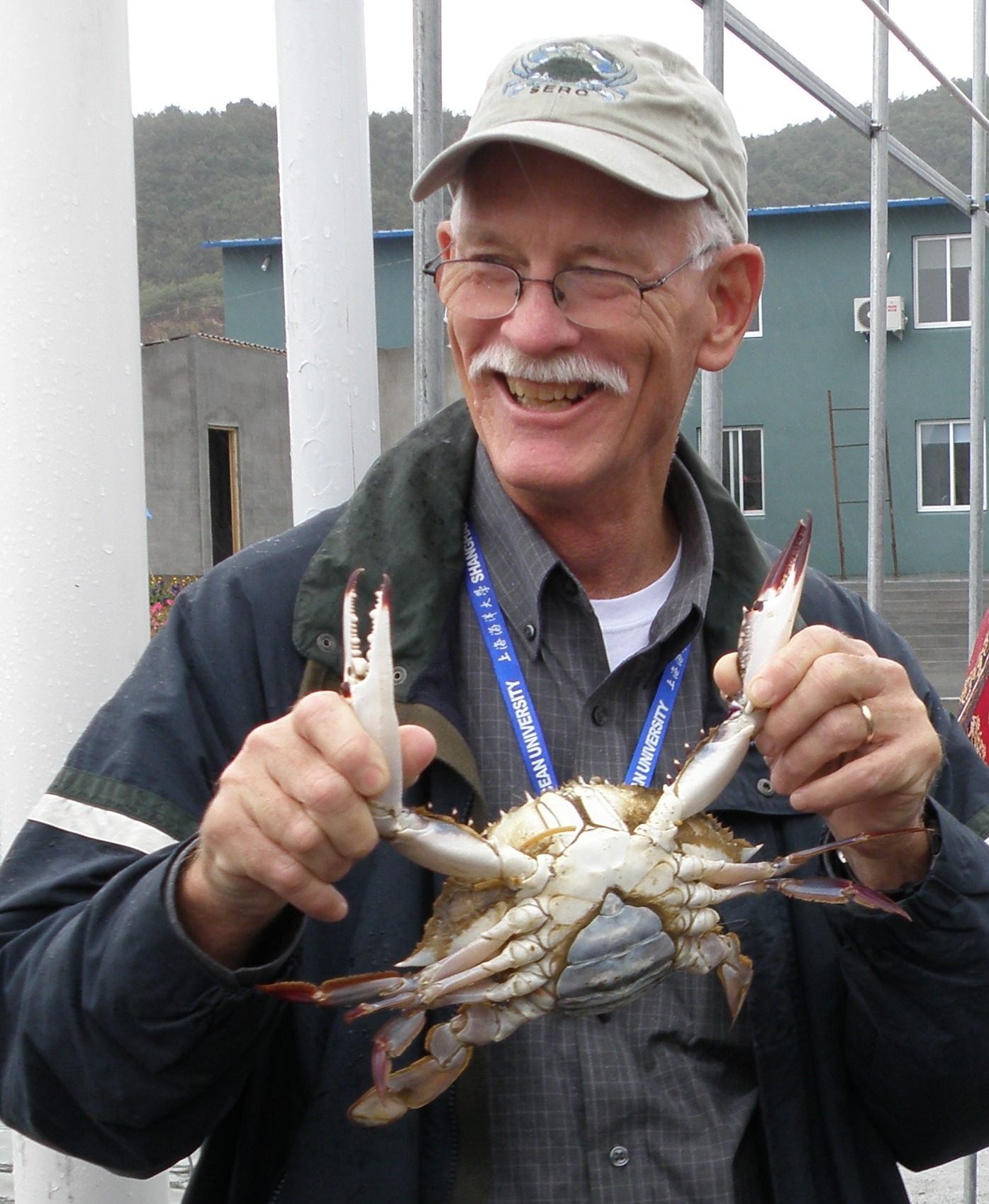
Of the approximately 2,000 known species of living dinoflagellates, about 150 are parasitic. These organisms can alter the marine food web, in some cases destroying prey that consumers like copepods and larval fish rely upon. Coats first spotted T. acutus in the 1980s, in plankton samples he had collected from the Chesapeake Bay. Through his microscope, he noticed a ciliate being edged out of its lorica (shell) by a dinoflagellate. It looked different from others he had observed.
Click to continue »
Ecology
...now browsing by category
Introducing Tintinnophagus acutus
Thursday, June 24th, 2010Three questions for a novice, but well-informed beekeeper
Wednesday, June 9th, 2010The Smithsonian Environmental Research Center’s outreach coordinator, Karen McDonald, has assumed a second title: beekeeper. This spring she and Elio Cruz, from the National Museum of Natural History, set up three hives in a remote field on SERC’s campus. The bees feast on the nectar and pollen of tulip poplars, walnut trees, clover and other nearby plants. With help from NMNH’s Insect Zoo, McDonald is doing her part to help the struggling bees.
Have scientists figured out what’s causing Colony Collapse Disorder (CCD)?
No. They’ve been studying the large-scale losses of hives since American beekeepers began reporting the phenomenon in 2006. Scientists think a combination of factors—not just one—is leading to CCD. They’re currently exploring the role of pesticides, parasites, pathogens and overall stress on the bees.
They produce honey, they sting…what else do bees do?
Humans, not to mention, alfalfa, apples and almonds owe a great deal of gratitude to the honey bee. In its quest for nectar and pollen, one bee can visit several thousand flowers in a single day. In the United States, more than 3.5 million acres of crops rely on bees for pollination, which helps the plant’s flowers turn into fruits and nuts. That figure doesn’t include all the wild plants that need bees as well.
What do you find most interesting about the insect?
It’s amazing to me that they live—and work—mostly in the dark. The bees seal the hives with propolis, a sticky resin collected from plants. This helps them regulate the temperature of the hive. The dark also helps them secrete more wax for the comb. Without light, bees communicate by touch, smell and taste. The queen produces chemical pheromones that tell the worker bees that everything in the hive is okay. And after collecting nectar and pollen, workers return to the hive and perform waggle dances to communicate where they gathered the food. Again it’s all in the dark, so the others line up behind the returning bee as it dances and tap it with their antennae to figure out where the nectar and pollen are. Bees can even distinguish intruder bees from other hives simply by their smell; it’s a remarkable set of adaptations.
One species, 20 genotypes, 3,808 plants and a plague of voles: Study reveals new benefits of genetic diversity
Thursday, May 27th, 2010If you’re designing an ambitious field experiment that involves more than 3,800 plants and 240 deer cages, ecologist John Parker has some words of wisdom for you: beware of the unexpected. Beware of meadow voles. Parker is a senior scientist at the Smithsonian Environmental Research Center, in Edgewater, Maryland. He studies the relationship between plants and the herbivores that eat them.
In a recent paper published in Ecology Letters, Parker chronicles the ups, downs and findings of a study investigating the links between genetic diversity in plants and herbivory. “Most people think about biodiversity in terms of species diversity, where you have a rich variety of plants and animals living in an ecosystem,” explains Parker. “I’m interested in exploring the importance of genetic diversity within a species.” Scientists have recently discovered that plants can benefit from growing in genetically-rich polycultures, where neighboring plants of the same species have different genotypes. Parker’s new research shows that these benefits include better protection against hungry herbivores like deer and voles.
Click to continue »
Key to invasive plants’ success is not simply a matter of taste
Thursday, May 6th, 2010
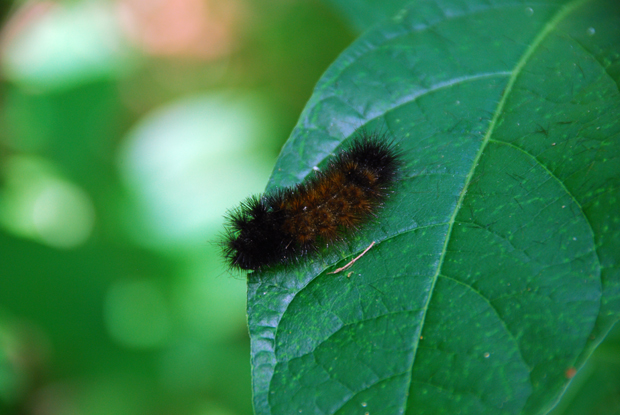
The woolly bear caterpillar (Pyrrharctia isabella) is a generalist herbivore; it feeds on many of the trees and plants in the woods surrounding SERC. Photo: John Parker
Unless you are a famished hiker on the Appalachian Trail, chances are you have not given much thought to how the forest tastes. Plant flavor is an important area of study for ecologists examining invasive plants. A common theory holds that the success of kudzu and other exotic species is due to foreign biochemistry that makes them repugnant to native herbivores. In a new study published in PLoS ONE, scientists at the Smithsonian Environmental Research Center in Edgewater, Md., have cast doubt on this popular but little-tested idea.
Click to continue »
From the director: Earth Day and the next 40 years
Thursday, April 22nd, 2010The first Earth Day developed as a grassroots movement with teach-ins focused on the environment. I focused on a career in ecology, but Earth Day inspired my commitment to solutions for human impacts on the biosphere. In the ivory tower of Berkeley, applied research was then portrayed as a lower calling to “pure research.” But I was committed to merging fundamental ecology applied to human impacts, now a hallmark of SERC research.
Click to continue »
Ecologist examines deer diet and its impact on invasive plants
Tuesday, March 23rd, 2010— Produced by John Barrat, for Smithsonianscience.org
Hypoxic waters: Researching beyond the surface to understand the impact on fisheries
Friday, March 19th, 2010
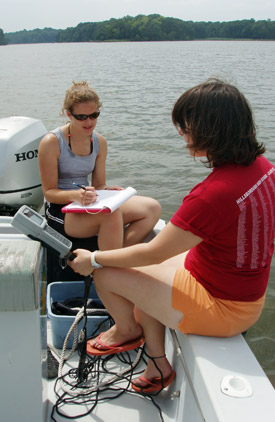
Two summer interns measure the water's dissolved oxygen concentrations. Water is typically considered hypoxic if oxygen concentrations are below 2mg/L. Photo: Courtney Richmond
In coastal waters around the world there are more than 500 hypoxic zones. These are areas where dissolved oxygen concentrations are so low that they threaten fish, invertebrates and aquatic food webs. Some fish manage to escape hypoxic areas, but oysters, clams and other sessile creatures are simply stuck.
Hypoxia makes the evening news when there’s a noticeable fish kill. However many of its effects are more subtle. Individuals that fail to escape low oxygen zones can suffer mortality or reduced growth and reproduction. Creatures that flee can become easy targets for fishermen and predators.
Click to continue »
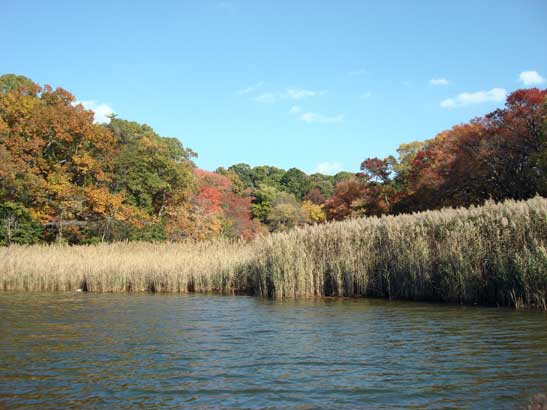
Phragmites australis: Genetic analysis reveals the promiscuous nature of the invasive reed
Friday, March 12th, 2010
The non-native strain of Phragmites australis dominates many Chesapeake Bay wetlands. Photo Melissa McCormick.
Click to continue »