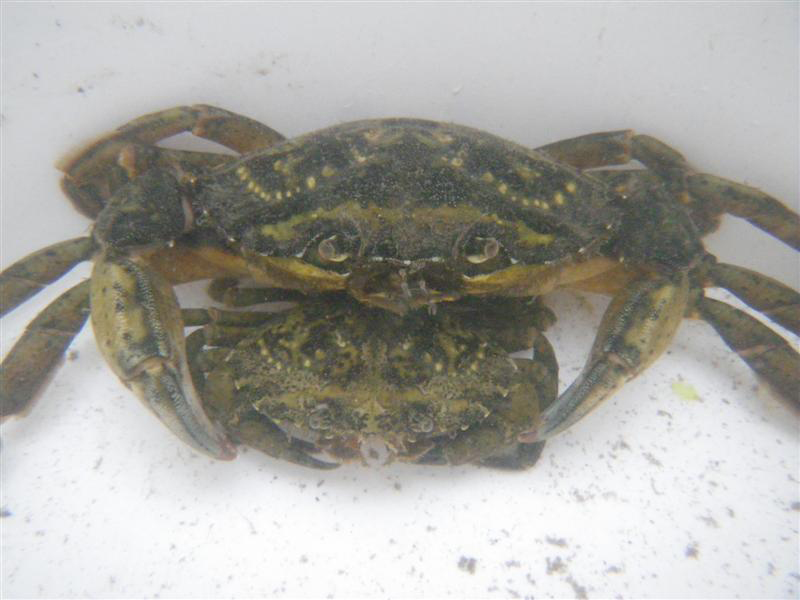
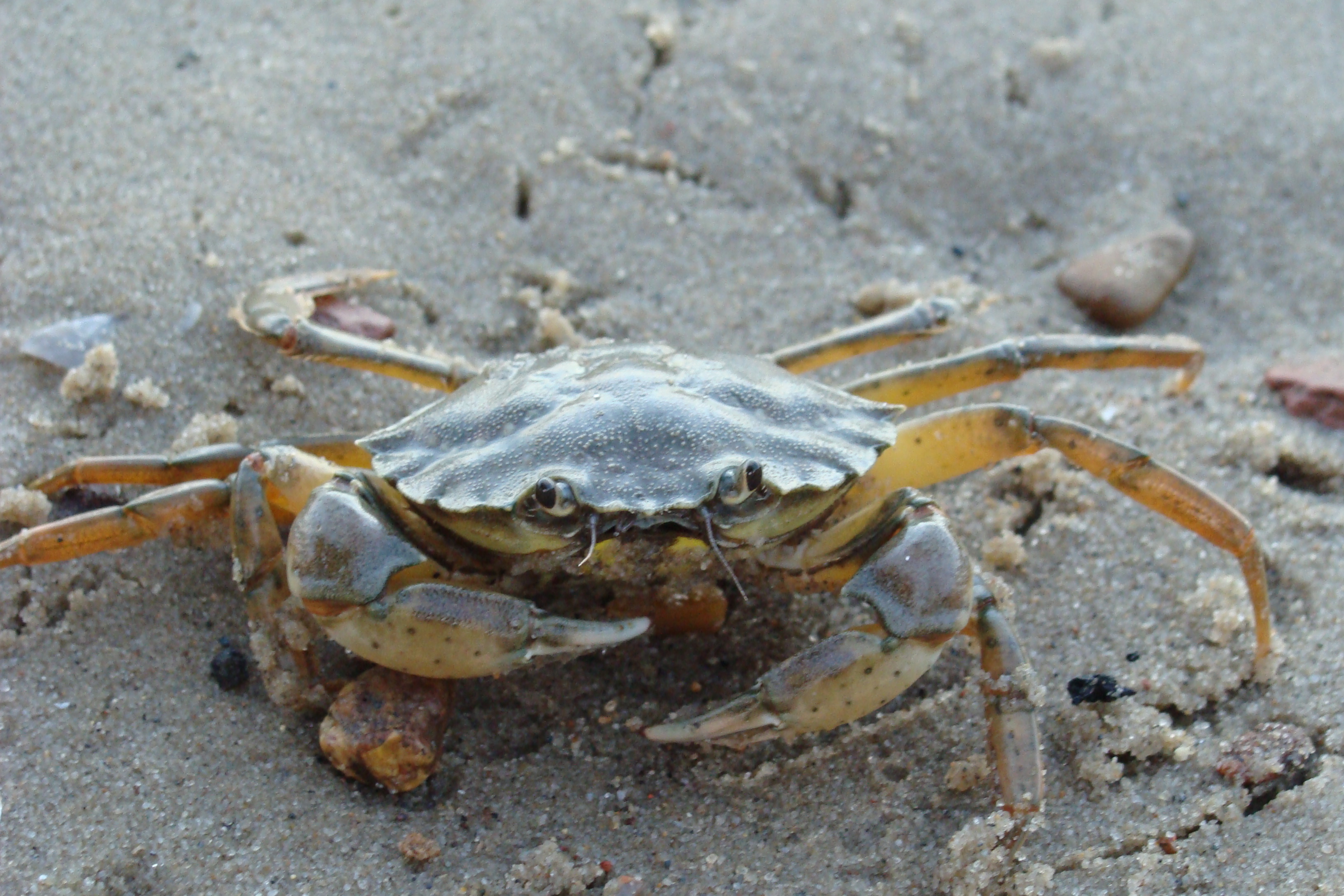
The European green crab has been on the east coast of the U.S. since 1817. (SERC)
The title question was raised by one of the readers of last month’s feature story on green crabs(Carcinus maenas). The reader asked, “If the green crab was first seen here [the East Coast of the US] in 1817, is it still considered an invasive species 200 years later? How far back do you go to claim something is invasive vs. native?” Several groups of people have drawn their own lines in the sand, but we wanted to examine current thoughts and perceptions. The following article is based on views expressed in a recent listserve discussion.
The term invasive was used in the green crab article because the crab is on the list of the world’s 100 worst invasive species. But it is also commonly used as a synonym of introduced. Which brings us to the importance of terms and definitions.
As one respondent pointed out, there are different interpretations of the term “invasive.” Some people define invasive in terms of a species’ ecological impact or behavior, while others use it to refer to a species’ origin, and sometimes both are part of the definition. If a species’ characterization as invasive is based only on its ecological behavior, then it is possible for a species to be both native and invasive. But if the species’ origin is part of the definition, then only nonnative species can be invasive. Others add another dimension to the word by making the mode of introduction important. Species can be spread naturally through dispersal and/or through human-mediated transport. Some people use invasive in reference to human-mediated introductions of nonnative species. Unfortunately, when we hear the word “invasive” we rarely know the definition behind it.
But whether something is considered invasive appears to be largely a matter of perception rather than just definition, and there are many contributing factors that muddy the water. Most responses from the discussion fell into three perception categories represented by these questions:
1) Do we benefit from the species, or is it harmful?
2) Is the species part of what we consider the natural landscape?
3) Is the species native?
Maybe our problem is that we view nature in the time frame of a biologist’s career-span.”
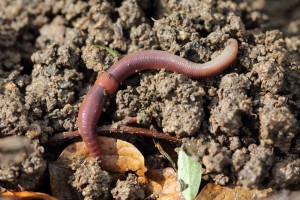
Lumbricus rubellus, a European earthworm that is now one of the most common in the eastern U.S. More than 10,000 years ago, Pleistocene glaciers wiped out native earthworms. Today virtually all earthworms in the U.S. north of Pennsylvania are invasive. (Holger Casselmann)
Most gardeners consider the sight of an earthworm writhing in the dirt a good omen. The slimy invertebrates chew up and churn up the soil, making it easier for vegetables and flowers to access nutrients.
But for wild orchids, they’re more of a menace. Earthworms could prevent roughly half a forest’s orchid seeds from even germinating, ecologists from Smithsonian Environmental Research Center and Johns Hopkins University discovered in a study published online this March in Annals of Botany Plants.
The small size of orchid seeds (they are barely the size of dust grains) makes them particularly vulnerable. As earthworms chew up forest litter, they ingest orchid seeds as well. When that happens, two things can keep the seeds from germinating: One, the process of passing through an earthworm’s gut can render them unviable. Or two, if the seeds survive ingestion, they can end up buried so deep that they can’t access the fungi they need to germinate and grow. As a general rule, deeper soils are much less likely to have those fungi.
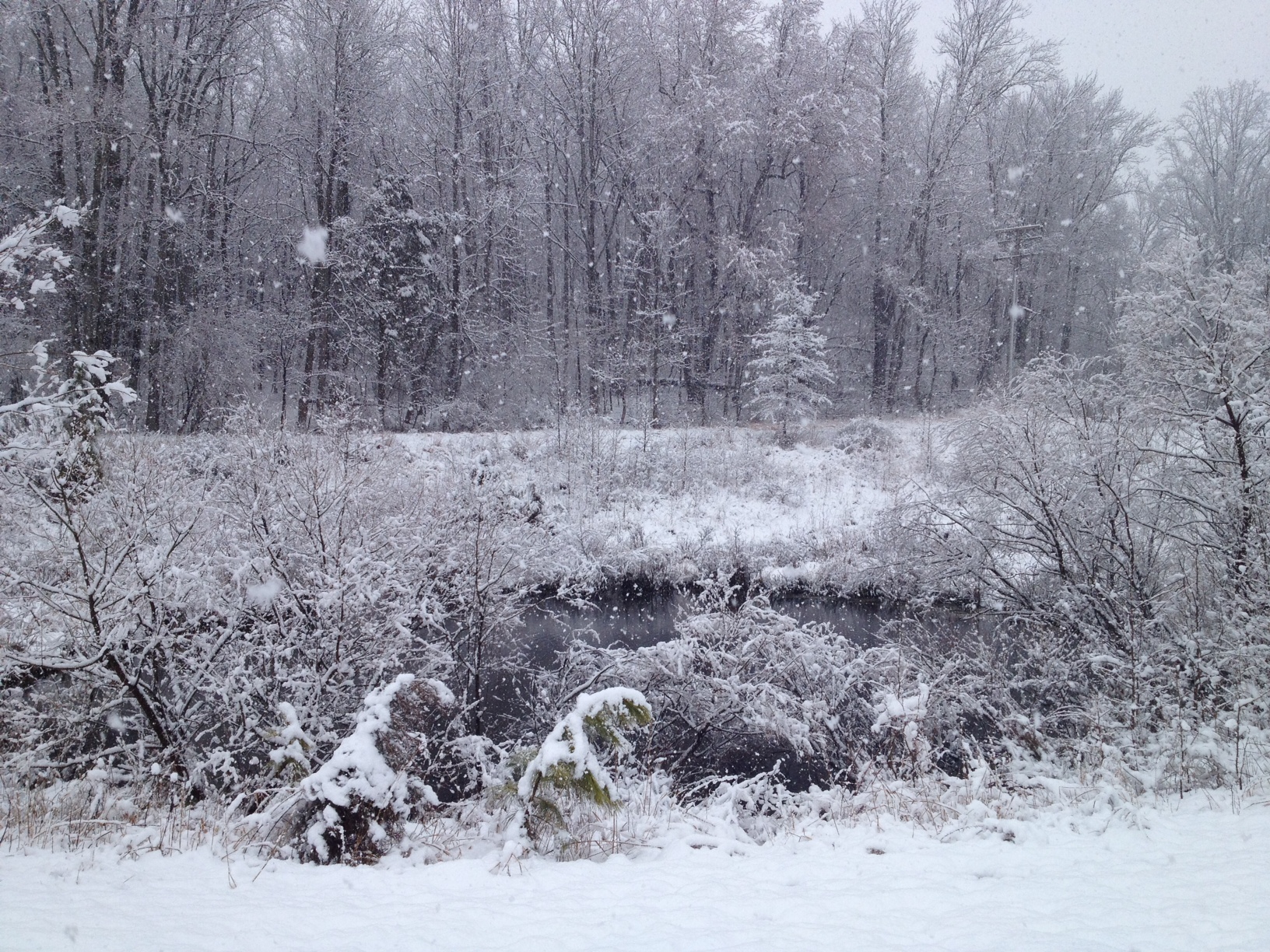
SERC pond on the morning of March 25. The short-lived spring snowstorm dumped up to 6 inches throughout Maryland, but most of it melted within 24 hours. (Kristen Minogue)
If the massive snowstorms that pummeled the northeast this winter—and at least one downpour in spring—seem out of place in a warming world, climate scientists have a message: Don’t fret, it’s just physics.
For several years, scientists have anticipated a future of “less snow, more blizzards” in the winters ahead. The message may sound like a paradox. But for the planet, it boils down to one simple truth: Warm air holds more moisture than cold air.
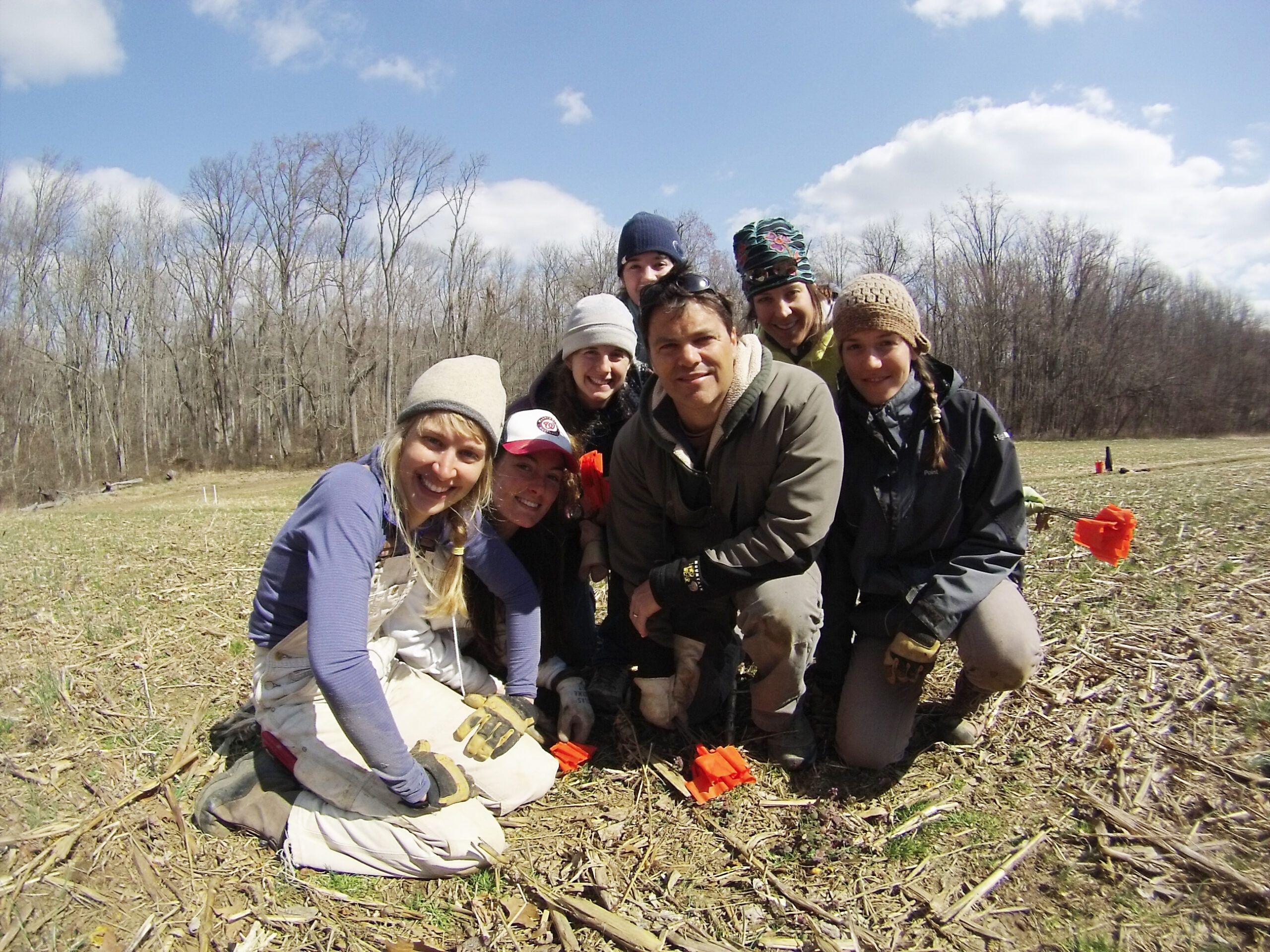
The scientists and interns who planted BiodiversiTREE in 2013, along with roughly 100 volunteers. From left: Susan Cook-Patton, Whitney Hoot, Caitlyn Cecil, Jess Shue, John Parker, Kim Holzer and Lada Klimesova. (Credit: Susan Cook-Patton)
An Irish-Canadian farmer once told his son that the true meaning of life was to plant trees under whose shade he did not expect to sit. It’s a proverb many altruists and humanitarians have taken to heart, though not all as literally as John Parker.
In March, Parker began planting an entire forest. If things go as planned, that forest will become the longest-running field experiment in SERC’s history—an experiment he will not live to see completed.
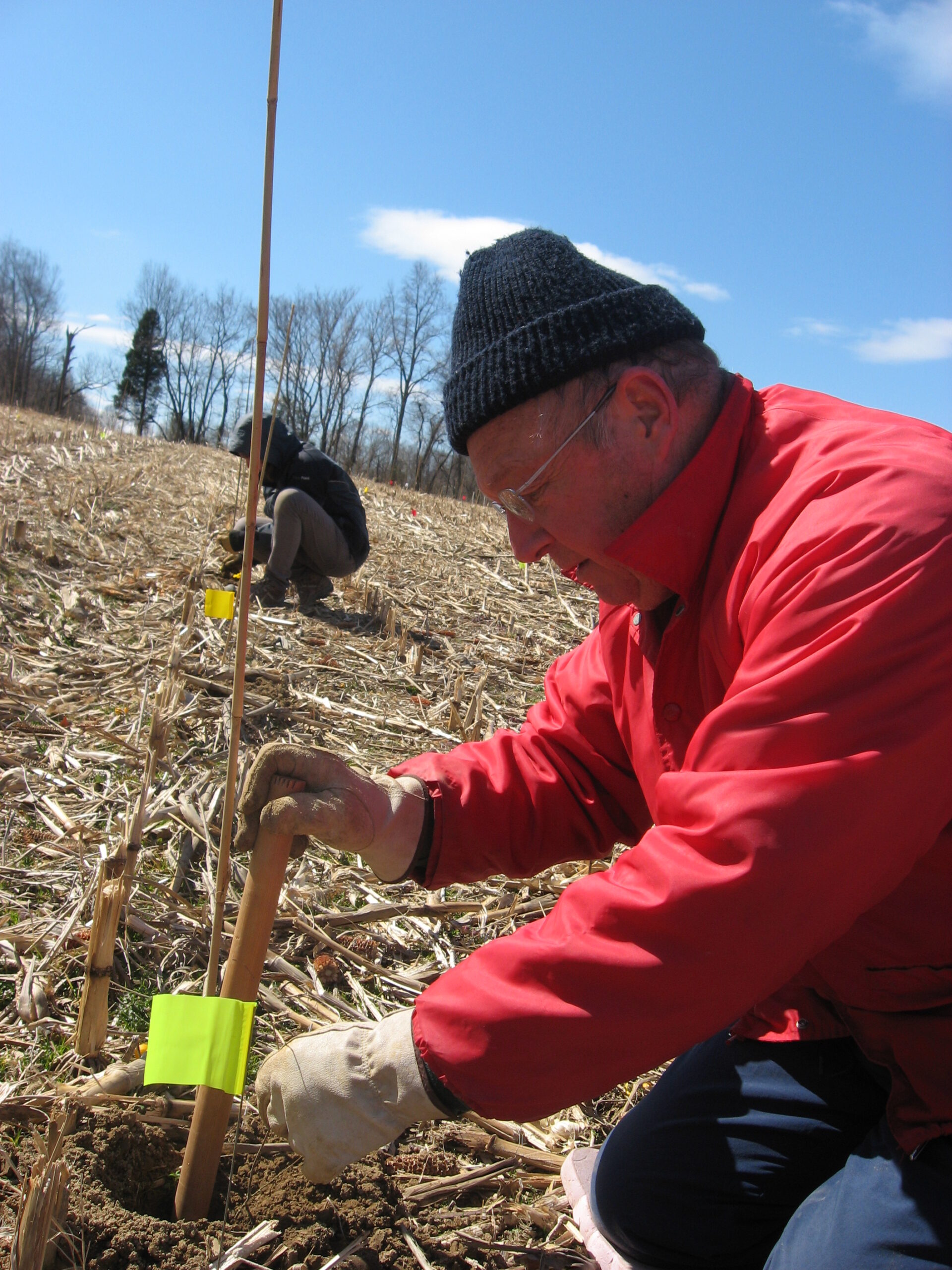
His lab works in Watershed 109, an expanse of brown field that grew nothing but corn for the last three decades. The core five-person team consists of Parker, postdoc Susan Cook-Patton, field aids Whitney Hoot and Lada Klimesova, and intern Caitlin Cecil. They’ve been outside overseeing volunteers seven days a week since March 4, with only two days off for harsh weather. One day it rained, sleeted and snowed with winds up to 40 miles per hour. That day wasn’t one of them.
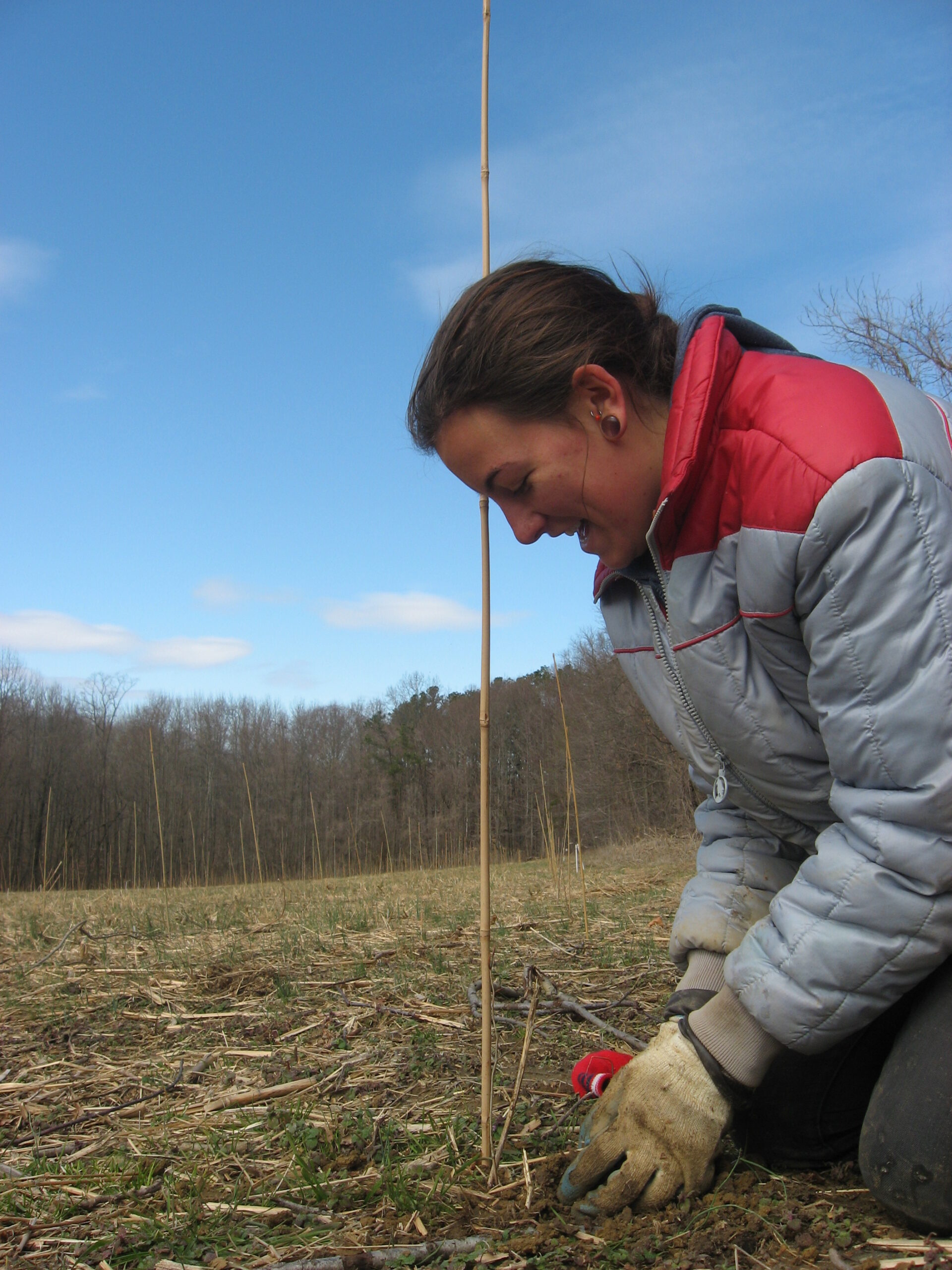
There’s an art to planting saplings, Hoot explains. The holes need to be completely filled with soil so infant trees don’t drown in a well of rainwater. Occasionally they have to trim what Hoot calls “suicidal” trees, whose roots curve upward into a J.
Whitney Hoot, project coordinator for BiodiversiTREE, plants a new sapling in a former cornfield. (Credit: Kristen Minogue/SERC)
“It will grow along the surface instead of growing down, and it just can’t get enough water,” Hoot says. “And so rather than killing the tree immediately, it will take a couple of years. And that’s really bad for our experiment.”
Then, once they’re in the ground, there’s the matter of watering all 18,000 saplings. “In a perfect world, it would rain every day for 45 minutes and get sunny again, but that ain’t gonna happen,” Parker says.
But the labor pains of birthing the new forest will pass. When they do, Parker and the ecologists after him will have something priceless: the chance to watch it evolve over a century or longer.
Project BiodiversiTREE
The name BiodiversiTREE comes from the key question Parker wants to answer: Is a diverse forest a better forest? Are trees more likely to survive surrounded by other species? Will it shelter more animals? And will it do more for people, filtering out our pollutants and absorbing our carbon?
There’s reason to think it will. Different tree species have different root systems. Grouping them together minimizes competition for water and nutrients—and increases the odds of them stopping harmful chemicals before they reach Chesapeake Bay. Tasty plants stand a greater chance of not getting eaten if they hide among less palatable ones. And a forest with more plants that survive, period, will do a much better job soaking up CO2.
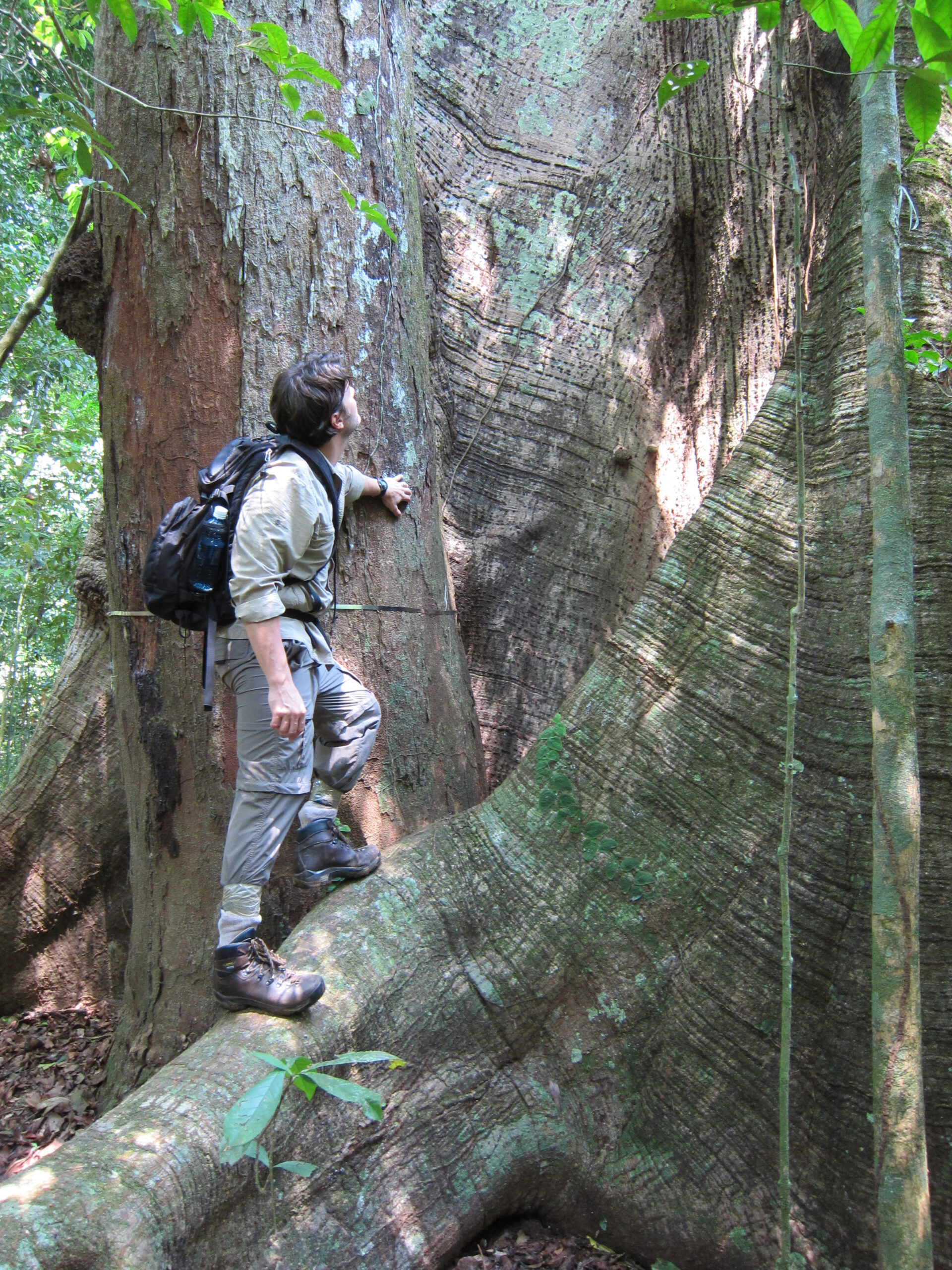
John Parker circles a kapok tree in Panama. Panama’s forests shelter over 400 tree species. Parker wants to find out if biodiversity is just as important in the temperate zone. (Credit: SERC)
The project is one of just a handful in the world like it, and the largest in North America. The Smithsonian has two experimental forests in Panama. By comparing them, ecologists can find out if diversity matters as much in the temperate zone as it does in the tropics, where researchers have roughly 400 tree species to work with. Perhaps it matters more.
“If you have four hundred, you’ve got a lot of extra rivets to hold that plane together,” Parker says. “Here, you’ve got 30, 35. But if you look at the distribution of species, it’s dominated by two or three.” If just one species falls by the wayside—like the tulip poplar—it could drastically alter the ecosystem.
But to test that, the team needs to design the forest carefully. They have divided the farmland into 35-by-35-meter plots. Each plot can hold 255 trees, and they have 16 species to choose from. Cook-Patton, Parker’s postdoc, is in charge of deciding which trees go where. Some will contain only oak or beech or red maple. Others will contain mixtures of four or 12 different species. And five plots will be left to regrow naturally. By the time it’s finished, a mosaic of 75 forest plots will cover the landscape.
Parker has done similar projects on a smaller scale, with 1 meter-squared plots. His findings back up the pros of diversity. Survival rates for saplings in mixed communities were only slightly higher than in segregated ones (3 percent), but those that lived grew 17 percent larger in a mix. A grasslands project at the University of Minnesota found the same thing: Plants grow better in mixed cultures than monocultures. The whole is greater than the sum of its parts.
Forests Past and Future
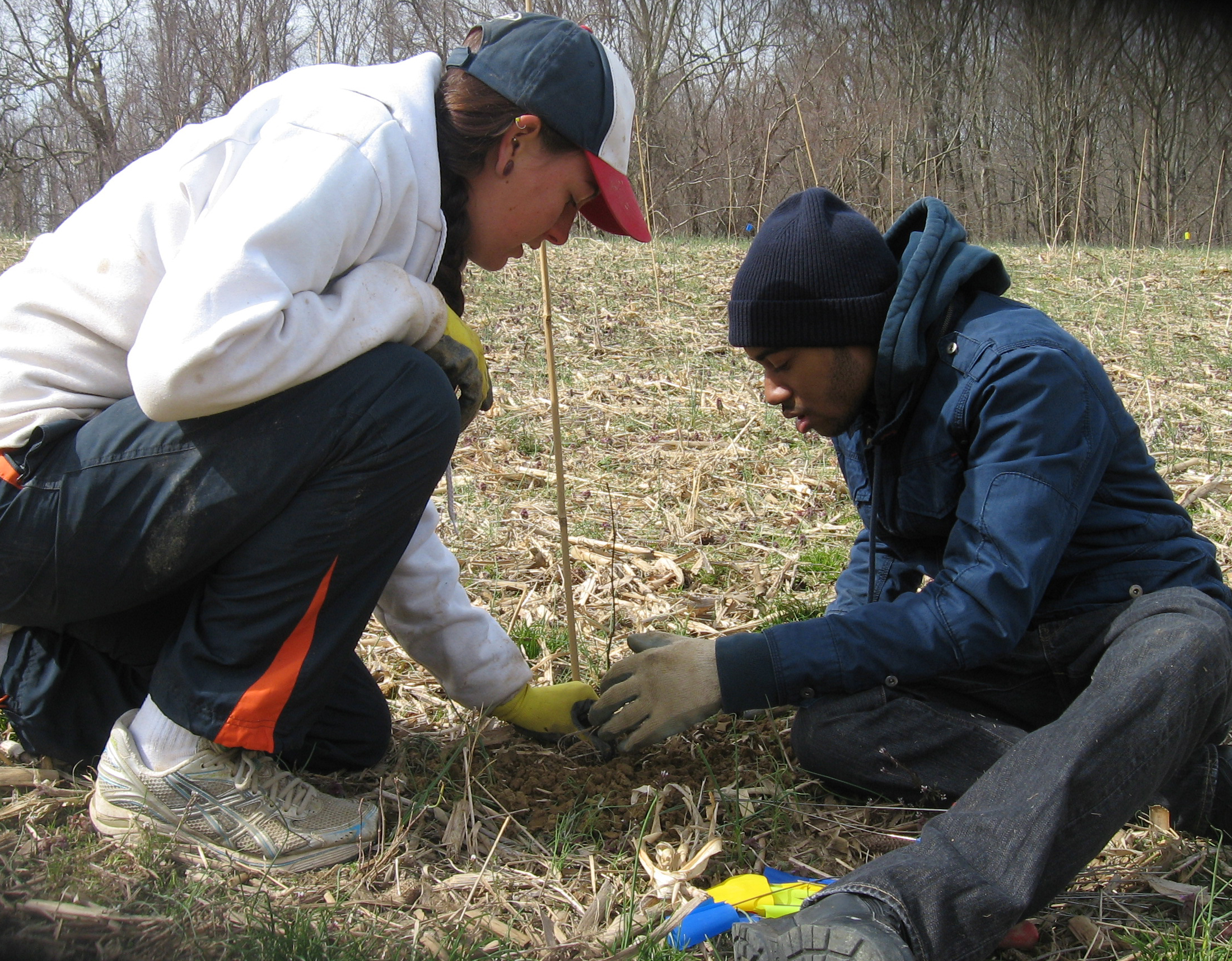
Project coordinator Whitney Hoot (left) helps Joseph Shirley plant a red maple. (Credit: Kristen Minogue/SERC)
When complete, the saplings will cover 60 acres of former cropland. There will be trees with special goo on their roots to help them absorb water. There will be trees with cages to protect them from deer. Some trees will even get a special “bloodmeal” spray of cow or pig blood, to see if the scent of a kill does a better job scaring off deer. All the while ecologists will track how the 75 mini-forests handle climate change, water pollution and animal communities.
Scientists aren’t the only ones with a stake in the forest. In Anne Arundel County, developers who cut down trees in critical area—land within 1,000 feet of shoreline—have to plant new trees inside the critical area or face a hefty fine. Their third option is to purchase forest mitigation credits. Since virtually all of BiodiversiTree falls within critical area, it can sell those credits in spades. It also can provide credits for animals, called forest interior dwelling species (FIDS) credits.
Phil Bishop, a SERC education volunteer who helped plant BiodiversiTREE. “I ran a computer center for years. Contracts. I said, when I quit, I’m going outside.” (Credit: Kristen Minogue/SERC)
But that is only the first half of the project. Nearby, another 70 acres of forest will remain untouched. As Parker and his successors watch the new forest grow beside it, they will face another question: What legacy does three decades of farming leave in its wake?
“It’s very stressful. I’ve never had a project this big,” Parker says. It isn’t just the immensity of this project on his mind. Parker still lives in the publish-or-perish world of all scholars. Having a century-long field experiment in place doesn’t change that. Still, most academics leave their legacies in journals. “When do you ever get a chance to leave something behind that’s not just words on paper?”
After they finish planting, Parker says he hopes to leave one more thing: A small open space on the edge of the woods with 16 trees, one of each species in the project. The trees will stand in two concentric rings, like Stongehenge. He wants to call it…”Treehenge.”
Posted in Publications | Comments Off on BiodiversiTREE: The Hundred-Year Forest Experiment
European green crabs are eating and marching their way up the west coast.
One of nine marine invertebrates to make the list of the world’s 100 worst invasive species, they’ve had major economic impacts on shellfisheries in New England, including blue mussels, the Virginia oyster (Crassostrea virginica) and Bay scallops. Impacts are mounting on the west coast too, where losses to bivalve fisheries (Pacific littleneck, Japanese littleneck, softshell clams and blue mussels) are projected to reach $20,000-60,000 per year. Ecologically, their impact has been no less severe, as they prey on and compete with other crabs, bivalves, gastropods like snails and slugs, and many other invertebrates.
European Green Crab Carcinus maenas. Green crabs have visited every continent but Antarctica. They’ve colonized parts of the Americas from Alaska to the southern tip of Argentina. (Arthro)
Green crabs are exceptional world travelers, making it from their native region along the European Coast to six major regions of the world, including the Northwest Atlantic (Maryland to Newfoundland), the Northeast Pacific (California to British Columbia), Patagonia, South Africa, Japan and Australia. Their mode of transport may vary, but evidence suggests they’ve been transported with the live-bait trade and in ships’ ballast water.
Green crabs have been on the East Coast of the US for about 200 years, according the NEMESIS database. They made their first appearance near New Jersey in 1817. From there they moved north, reaching the Bay of Fundy, Nova Scotia in 1953, the Gulf of St. Lawrence by 1994, and finally, Placentia Bay, Newfoundland in 2007. Their southward expansion stopped at the Chesapeake Bay; possibly they couldn’t compete with the blue crab (Callinectes sapidus).
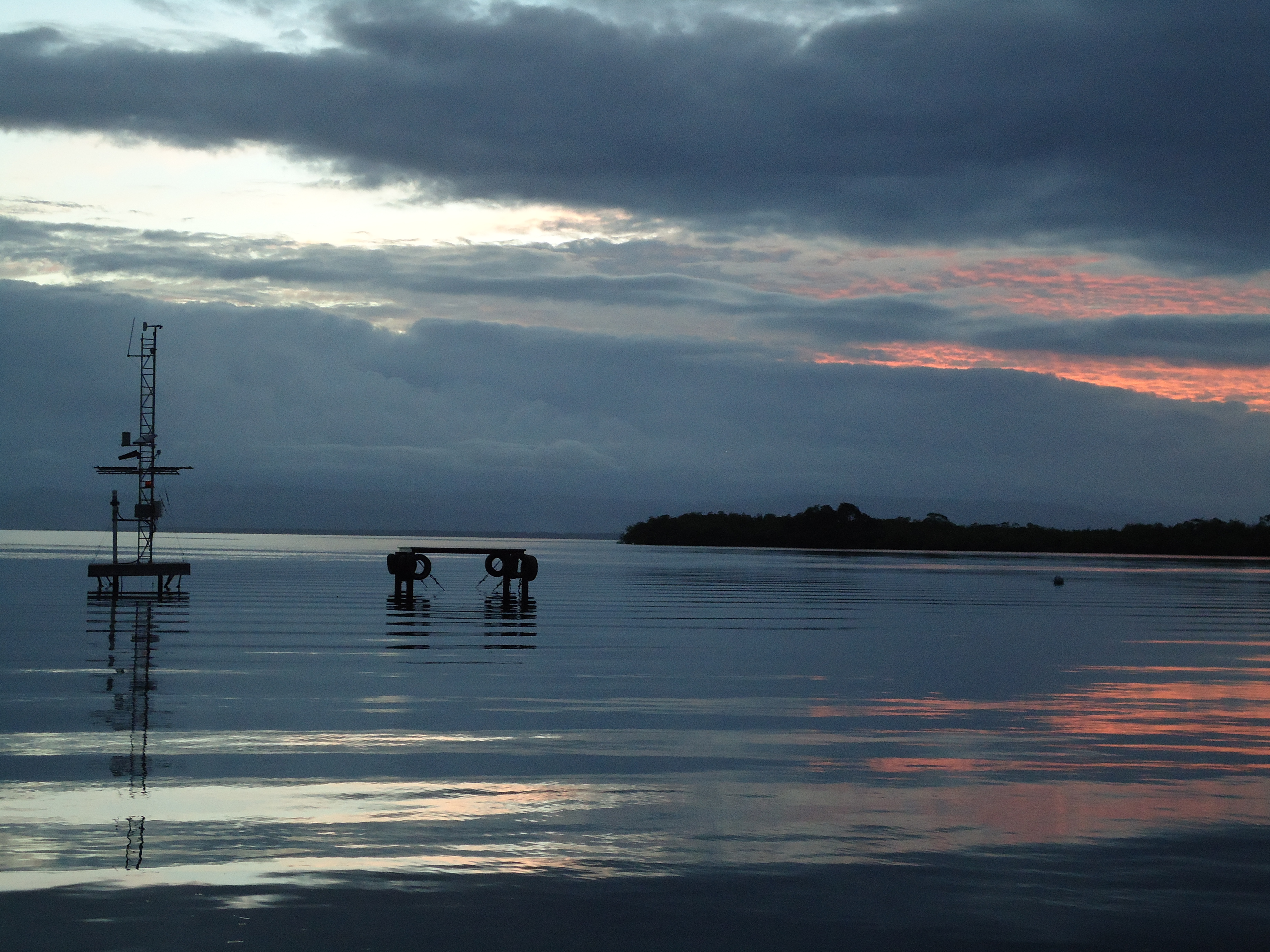
Sunset from the dock at the Bocas del Toro Marine Station, Smithsonian. (Katrina Lohan)
We had very little trouble finding two of the oyster species we needed at three different places. But with only three days left in our trip, we had yet to find Ostrea sp. at more than one location. With our hopes high, we headed toward Portobelo to see if we could find a saline river-like environment that had Ostrea sp. in high enough abundance for us to sample. The drive was gorgeous! We drove along the Atlantic Coast of Panama and stopped at five separate “rivers”, though most of them were pretty small and should probably be called streams instead. We also briefly drove into Portobelo so that we could drive past the old Spanish forts in the city.
We only found Ostrea sp. at one of the rivers, and we didn’t find enough to sample there. Our final stop on our way back to Naos was the French Canal. We had borrowed an inflatable canoe from Mark Torchin, which took us about 20 minutes to pump up. Once we did, we were able to get the canoe into the water and used it to more closely investigate what oysters were growing on the bridge pilings. We had our fingers crossed that it would be Ostrea sp. but, alas, it was Crassostrea sp. instead. Well, I can’t be too upset. While we didn’t get the ideal sampling we were hoping for, it was still a very successful trip!
Next month we head to Merida, Mexico to continue our sampling adventures. Stay tuned!
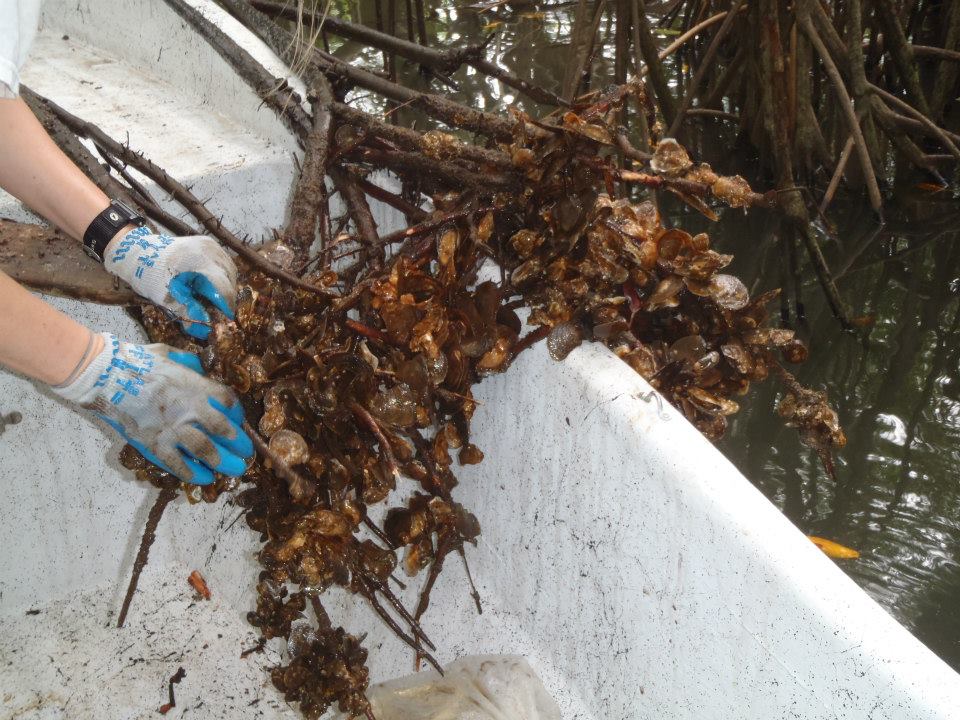
Kristina Hill investigates a mangrove root at Rio Alejandro, Panama, to determine what kinds of oysters are living on it. (Katrina Lohan)
The day after arriving in Panama City, we went out into the field to continue collecting. During our trip in December, we had sampled two locations on the Atlantic side of the Canal. Now we had to complete our sampling for the three genera we had been sampling in Bocas. So we headed out to an area near Colon, Panama, and rented a boat for a few hours to go find oysters in the mangroves. We were successful at finding all three species at one location and two of the three species at another location. Not bad for a single morning.
We were able to find a final location for Ostrea sp. in Bocas del Toro, which wrapped up our sampling there. So it was time to return to Panama City to complete our sampling on the Atlantic side of the Panama Canal.
Now I have been trying to learn and remember some Spanish phrases. There were times when my lack of fluency was awkward, and other times when it is more problematic. Our return trip to Panama City was one of the problematic occasions!
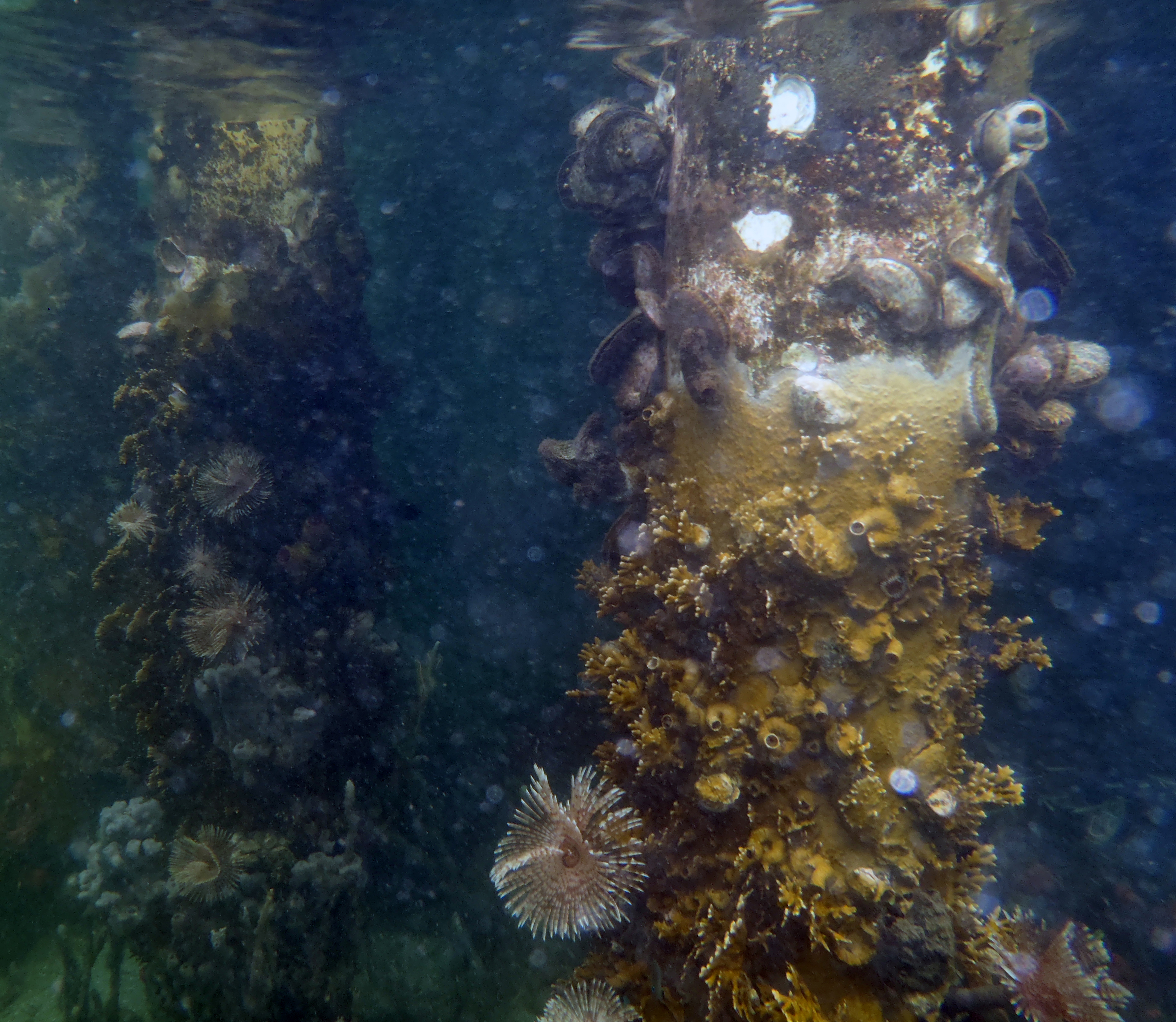
Life underwater. Fire coral, anemones, sponges and a diverse group of oysters cling to a dock at the Smithsonian's Bocas del Toro Marine Station. (Kristina Hill)
To satisfy our sampling scheme, we needed one more location with all three genera present. The dock at Bocas del Toro wasn’t the most glamorous location to sample, but it was an amazing place to snorkel around. There were many bivalve species and an abundance of individuals for each species located on the pilings. There were lots of different fish, coral, hydroids and sponges. It was beautiful! We decided to make this our third sampling location as it was easily accessible and had all three species–or so we thought.
We know oysters are tricky to morphologically identify, as they have such a wide range of growth patterns. It wasn’t until we were back in the lab and had shucked a few of the oysters open that we realized what we thought was Ostrea sp. in the field was actually a different species, Dendostrea frons. Oops…
Katrina Lohan attempts to scrape Striostrea oysters off rocks in a tidal pool at Bique, Panama. (Kristina Hill)
For the second oyster sampling excursion, we headed out to Bastimentos and Solarte to try to find another site where the same three oyster species co-occur. Unfortunately, Kristy was out of commission at the time due to illness (though I’m happy to report that she has made a full recovery).
Mark, Greg and I had scouted out a few potential locations the night before. While we had no trouble finding Isognomon sp. and Crassostrea sp. on the mangroves in multiple locations, we struggled to find a location where Ostrea sp. occurred with them. So, when we ventured out to collect in the morning, we decided to scout out a few more locations that might have all three species. At Solarte, we found just the right spot! Collecting all the oysters we needed didn’t take long at all, so I suggested that perhaps we do a little snorkeling while on our way back to the field station. Mark knew just where to go. We ended up snorkeling at a place called Hospital Point, where I saw a spiny lobster (Panulirus argus). Then we stopped at another snorkeling spot with huge sea stars, cute sandy gobies, sea cucumbers and beautiful coral!
The extra time spent in the water was just what I needed to motivate myself to get into the lab and process some oysters, as I knew that any data I helped generate would add to the ever-growing body of knowledge about the world beneath the waves!