by Jan Payne Wilson, SERC Volunteer

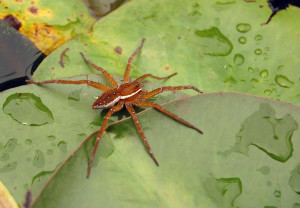
Six-spotted fishing spider, Dolomedes triton. Credit: Derek Ramsey
My dad was uncomfortable around spiders. Today we’d probably say he had a phobia. To deal with it, he found a spider-like creature, the Daddy Long Legs, and learned how benign and beneficial it was. From then on, he could focus on a “good spider” rather than his fear. As a child, I was indoctrinated with the knowledge that a Daddy Long Legs 1) could not bite you and 2) performed good deeds by eating “bad” spiders and other biting, child-frightening insects. Furthermore, they needed our help because they had delicate legs that easily broke off, so we moved them out of dangerous areas and avoided stepping on them. When I was older my father revealed that Daddy Long Legs weren’t actually spiders. Unlike true spiders, they can’t make silk and have neither fangs nor venom. From my father I learned that understanding a creature often changes fear into appreciation and, sometimes, amazement.
On the docks of the Smithsonian Environmental Research Center (SERC), I use my dad’s strategy to help students who either fear spiders or believe the only good spider is a dead spider. With Daddy Long Legs it’s easy. But we also have large spiders we don’t see as frequently: fishing spiders. When you see your first fishing spider, it’s a hard sell to believe she’s got redeeming characteristics. Click to continue »