by Kristen Minogue
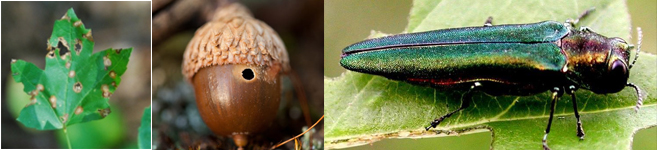
Signs of three temperate forest enemies, left to right: Anthracnose (SERC), insect hole in an acorn (Jonathan Myers), emerald ash borer (Leah Bauer, USDA Forest Service Northern Research Station, Bugwood.org)
Walk through a forest in Maryland or Missouri, and you’ll probably find yourself surrounded by dozens of different tree species. Walk through a tropical forest in Brazil or Malaysia, and you’ll be surrounded by hundreds—in some forests, over 1,000. What’s behind this colossal difference in diversity? Scientists with the Smithsonian-led ForestGEO network came up with one morbid possibility: It may come down to having the right kind of enemy.
Earlier this summer, in a study in Science, researchers from 24 plots in the forest network from five continents pooled their data and detected a strange pattern: There’s a force at work in the tropics helping rare species thrive, a force that is much weaker in the cooler temperate zone.
Call it a clustering effect. The scientific term is “conspecific negative density dependence,” but it boils down to this: If too many trees of the same species grow in the same spot, they become magnets for enemies that slash their populations. In tropical forests, enemies generally knock them down just enough for new species to fill the gaps, without completely wiping out the first species. The result is a kaleidoscope forest with hundreds of species, many quite rare.
It may seem like a counterintuitive idea, that a lethal enemy could help sustain biodiversity. It can work when this thinning process prevents any one species from dominating.
“Just when a population is ready to take over, it catches a cold,” explained Sean McMahon, a co-author and forest ecologist with the Smithsonian Environmental Research Center (SERC). “And so it gets knocked back.”