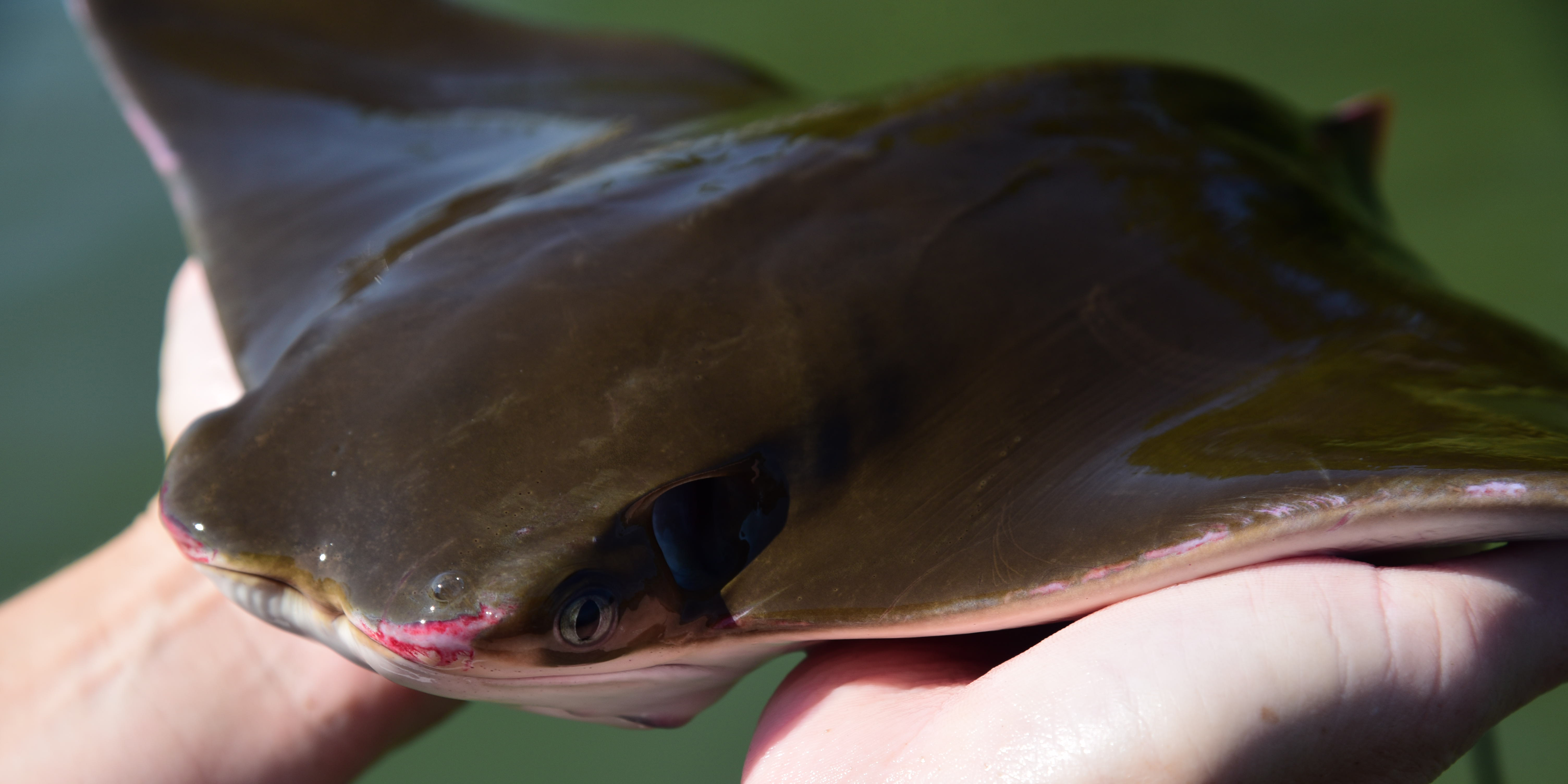
Cownose rays are migratory animals that come into the Chesapeake in summer and swim to Florida for the winter. (Credit: Jay Fleming/Smithsonian)
by Marissa Sandoval
While most students around the country are returning from summer break, some schools stay in session year-round—those under the sea, that is. Schools of marine organisms will migrate great lengths in search of food, breeding grounds, or safety from predation. So unless you want to be left behind, attendance is mandatory for migratory marine animals.
Luckily, some animals have migratory cues that prompt them to depart en masse. The charismatic cownose ray (Rhinoptera bonasus) is one of them.
In a new study published Sept. 9 in the journal Ecosphere, researchers led by Chuck Bangley and Matt Ogburn at the Smithsonian Environmental Research Center (SERC) and Robert Fisher at the Virginia Institute of Marine Science (VIMS) pinpointed which variables cue the rays to and from their summer and winter homes. What’s more, male and female rays may respond to different cues to leave their winter habitat in Florida. Meanwhile, at the end of the summer, both sexes travel together—though climate change may affect their future travel plans. Click to continue »
Posted in Publications | Comments Off on What Cues Cownose Rays to Migrate When They Do?
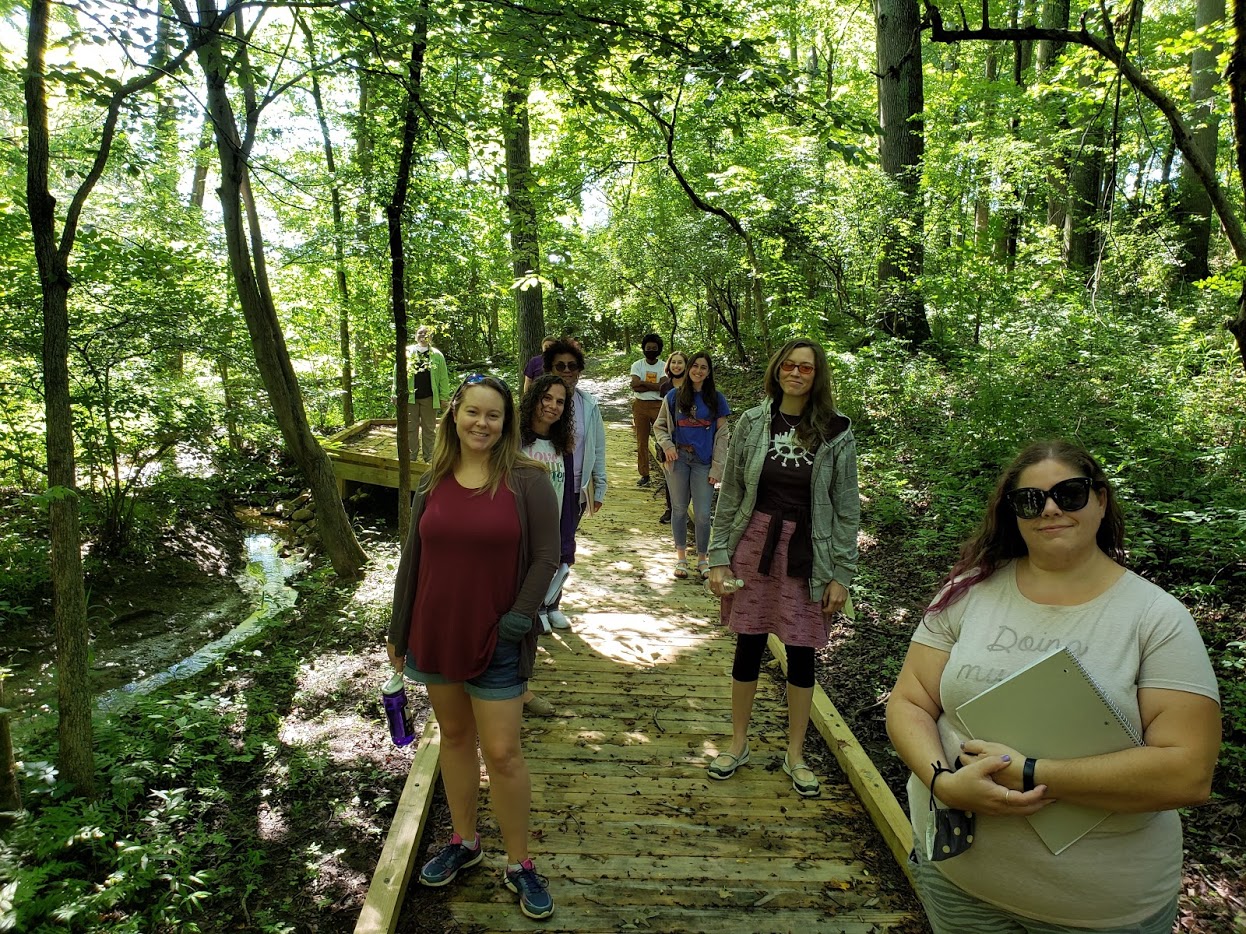
Maryland teachers participate in an outdoor excursion in the SERC forest. (Credit: Karen McDonald)
This summer, the Smithsonian Environmental Research Center (SERC) invited 21 Maryland educators to join a three-day “hybrid” workshop (virtual and in-person) on how to teach watershed science. The workshop was part of a collaboration with the Maryland Association for Environmental and Outdoor Education (MAEOE). It went swimmingly.
In normal years the SERC education team brings up to 6,000 visitors from around the Chesapeake, leading field trips for K-12 students and programs for adults. A growing component of SERC’s educational outreach is devoted to teacher professional development. These trainings help teachers learn the practices and techniques that SERC scientists use, and take them back to the classroom.
But as the pandemic raged on, SERC was forced to adjust its education model. Unable to bring students to the Edgewater campus, field trips and workshops went virtual. As with the rest of the world, in-person experiences switched to Zoom. While the quality of SERC’s education programs stayed the same, many longed for the days of bustling classrooms and hands-on science.
That’s when Karen McDonald, SERC’s director of education, had an idea. Collaborating with MAEOE, McDonald hoped to create a workshop for Maryland educators that focused on teaching children about watersheds.
“During COVID, teaching about watersheds to students who are remote and can’t necessarily go outside is super challenging,” said McDonald. “On top of that, many teachers don’t know how to take students outside to study their local watersheds. This is going to be something super desirable when we go back to school because we need to socially distance. And being outside is a perfect way to do it.” Click to continue »
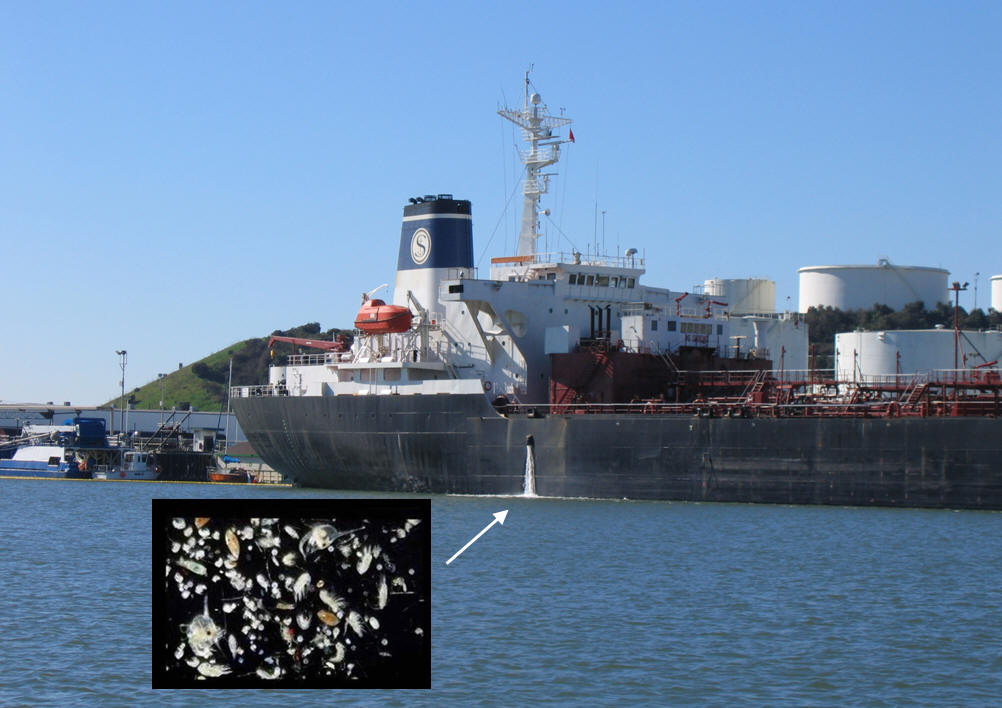
Many aquatic creatures live in the ballast water ships need for stability. But when ships discharge their ballast water, some of those creatures can become invasive. (Credit: Monaca Noble/SERC)
This is the first article in a three-part series which aims to explain the biosecurity concerns of ballast water and the work of the Smithsonian Environmental Research Center (SERC). Scientists in SERC’s Marine Invasions Lab have teamed up with a variety of organizations to research invasive species, on-board technology and shipping networks. The Marine Invasions Lab works from SERC’s main campus in Edgewater, Maryland, and its West Coast campus in Tiburon, California.
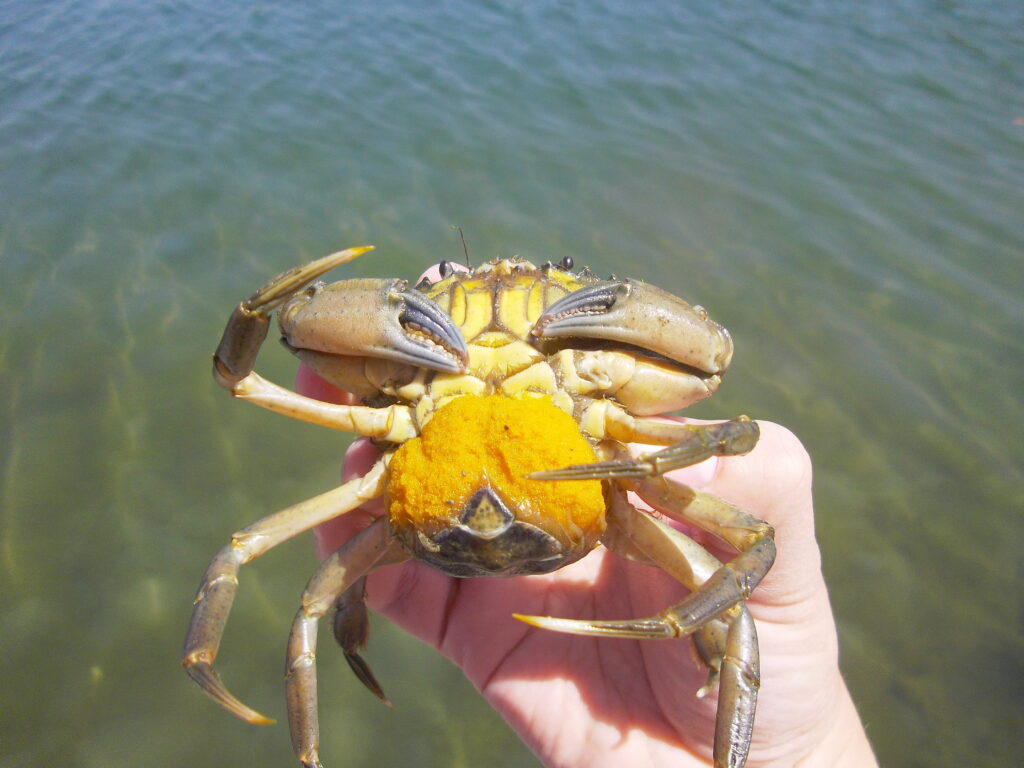
European green crab (Carcinus maenas), an invasive crustacean that’s caused economic and environmental problems on both U.S. coasts. (Credit: Brianna Tracy-Sawdey/SERC)
In the late 1980s, tiny crab larvae arrived in California through the water massive ships eject when they dock. The infamous European green crab had already been doing a number on the Eastern Seaboard, causing damages that would eventually reach over $22 million a year. Soon enough it was causing chaos on the West Coast as well, voraciously eating native crabs, oysters, and clams. The highly invasive crab serves as a cautionary tale of the never-ending struggles with hitchhiking marine invaders introduced via ballast water.
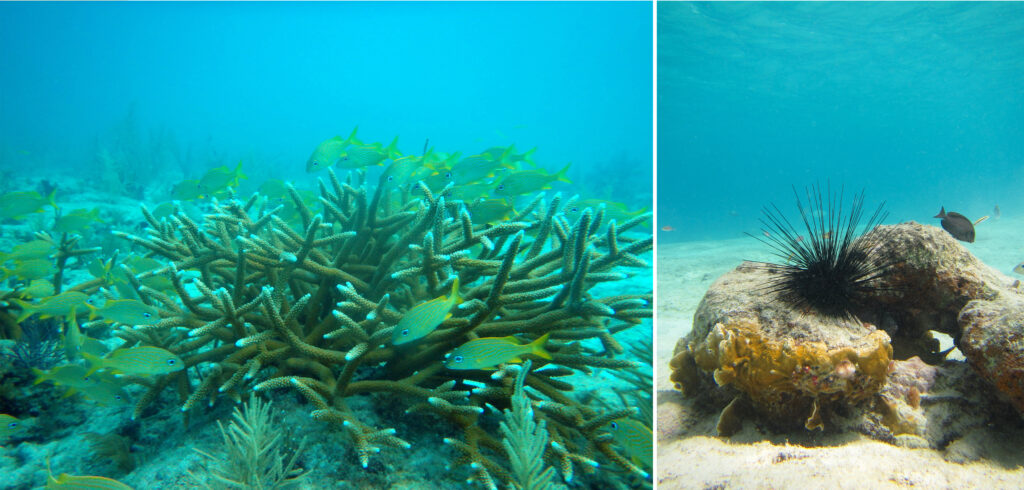
Left: Staghorn coral, Acropora cervicornis (Credit: Florida Fish and Wildlife / CC license). Right: Long-spined urchin, Diadema antillarum, perched on a rock (Credit: Via Tsuji / CC license).
As coral reefs around the world deteriorate at frightening rates, many scientists are searching for ways to rebuild these valuable ecosystems. According to a recent study published in the Journal of Experimental Marine Biology and Ecology, the key to successful coral restoration may be found amidst a bunch of hungry sea urchins.Click to continue »
Posted in Publications | Comments Off on Could Algae-Eating Sea Urchins Save Coral Reefs?
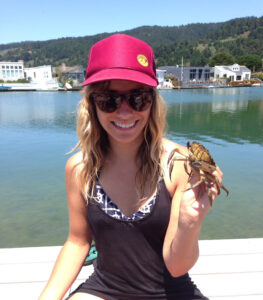
Julie Gonzalez, a graduate student at the University of California, Davis, holds up an invasive European green crab. (Credit: SERC)
In an artificially created estuary near San Francisco Bay, called Seadrift Lagoon, a very real problem arose when European green crabs (Carcinus maenas) arrived in the 1990s. After taking up residency, the invasive species population grew immensely as the crabs feasted on Dungeness crabs, clams, and oysters—a grim problem for the native animals and migratory shorebirds that rely on them.
But their efforts accidentally led to even more green crabs. Now, over a decade later, the teams who addressed the problem head-on have published a paper in the Proceedings of the National Academy of Sciences on what they learned from a conservation effort gone awry. Led by Ted Grosholz of the University of California, Davis, the new study advocates for major caution when working with invasive species whose life history is similar to European green crabs. Click to continue »
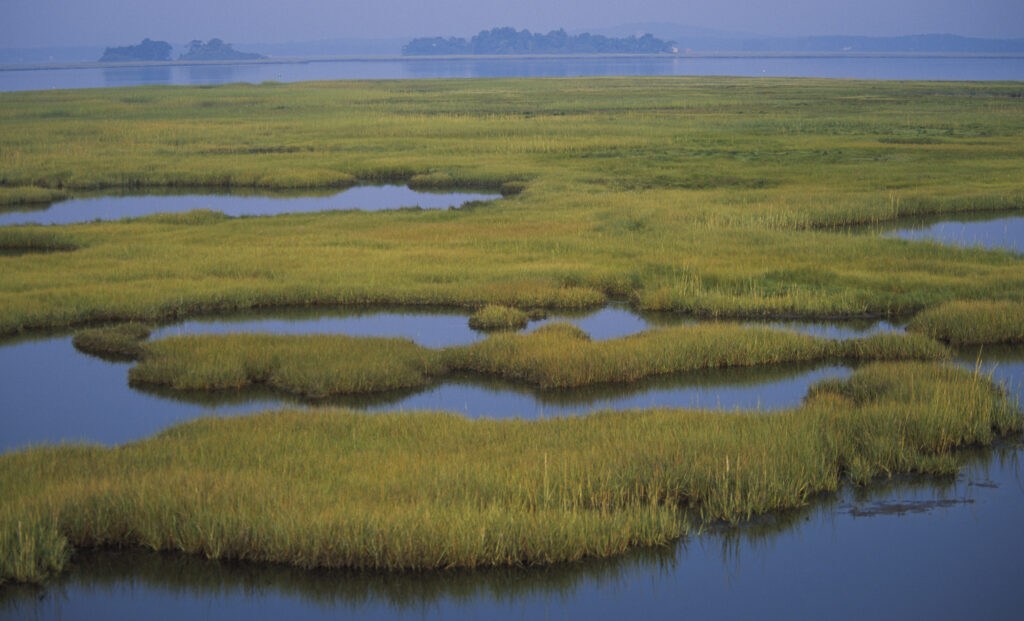
The study, published in the June issue of Earth’s Future, highlighted the capacity of coastal wetlands across the continental United States to resist sea level rise. While wetland plants are adapted to the stress of salty tides, sea level rise threatens to entirely submerge some sections of marsh—eventually causing these plants to die.
The survival of wetlands is essential to the continued prosperity of coastal communities. Wetlands protect shorelines from damage by severe storms. They provide vital habitats for fish and shellfish that humans rely on for food, and support numerous endangered and endemic species. To many locals, wetlands also tie into their cultures and identities, and provide tourism revenue.
“Our collective economic and cultural wealth is diminished if we don’t have tidal wetlands,” said SERC scientist James Holmquist, who spearheaded the study. Click to continue »
Actively restoring oyster reefs—beyond simply protecting them from harvest—can create big payoffs for habitat quality and the other species that flock to them. A new study from the Smithsonian Environmental Research Center (SERC), published June 10 in the journal Marine Ecology Progress Series, compared restored, protected and harvested areas using photos and video footage from roughly 200 sites.
Roughly a quarter of Maryland’s oyster habitat lies protected in oyster sanctuaries. But only a small fraction of those sanctuaries have undergone full-scale restorations, with reconstructed reefs and new live oyster plantings. The new paper offers an easier way to determine if those restorations are paying off.
“You’ve got to actively restore something,” said Keira Heggie, lead author of the study and a technician in SERC’s Fisheries Conservation Lab. “But if you actively restore something and then let it go by its wayside, then you’re not going to know exactly if it’s still doing well.” Click to continue »
Diseases don’t spread in a vacuum. But as ecologists try to create a more interconnected picture of planet Earth, parasites, viruses and other disease-spreading pathogens have been sidelined. In a new article published May 17 in Nature Ecology and Evolution, a team of scientists makes the case that today, we have the tech and the global connectivity to change that. In this Q&A, we talked with lead author Dr. James Hassell, a wildlife veterinarian, disease ecologist and Keller Family Skorton Scholar with the Smithsonian Conservation Biology Institute’s Global Health Program, and co-author Dr. Katrina Lohan, a parasite and disease ecologist at the Smithsonian Environmental Research Center. Edited for brevity and clarity.Click to continue »
Posted in Ecology, Interviews, Publications | Comments Off on Q&A: For Too Long, Big-Picture Ecologists Have Left Disease Out Of Their Models. It’s Time To Fix That.
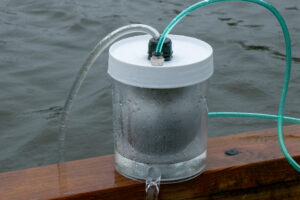
The silver EQSphere measures dissolved carbon dioxide and methane, potent greenhouse gases, in the Rhode River on a rainy afternoon. (Photo: Marisa Sloan/Northwestern University)
Don’t be fooled—the EQSphere™ isn’t a silver softball or a tree ornament gone rogue. It’s a spherical equilibrator invented to continuously yank carbon dioxide, methane and other gases from three feet underwater into the air to be measured in real time.
Whitman Miller, a research scientist with the Smithsonian Environmental Research Center, came up with the design with his head technician Amanda Reynolds while they were studying the effects of elevated carbon dioxide in marine ecosystems. He considers it an invention born of necessity, thanks to turbid and debris-ridden coastal waters, where it’s dangerous to deploy expensive instruments for very long.
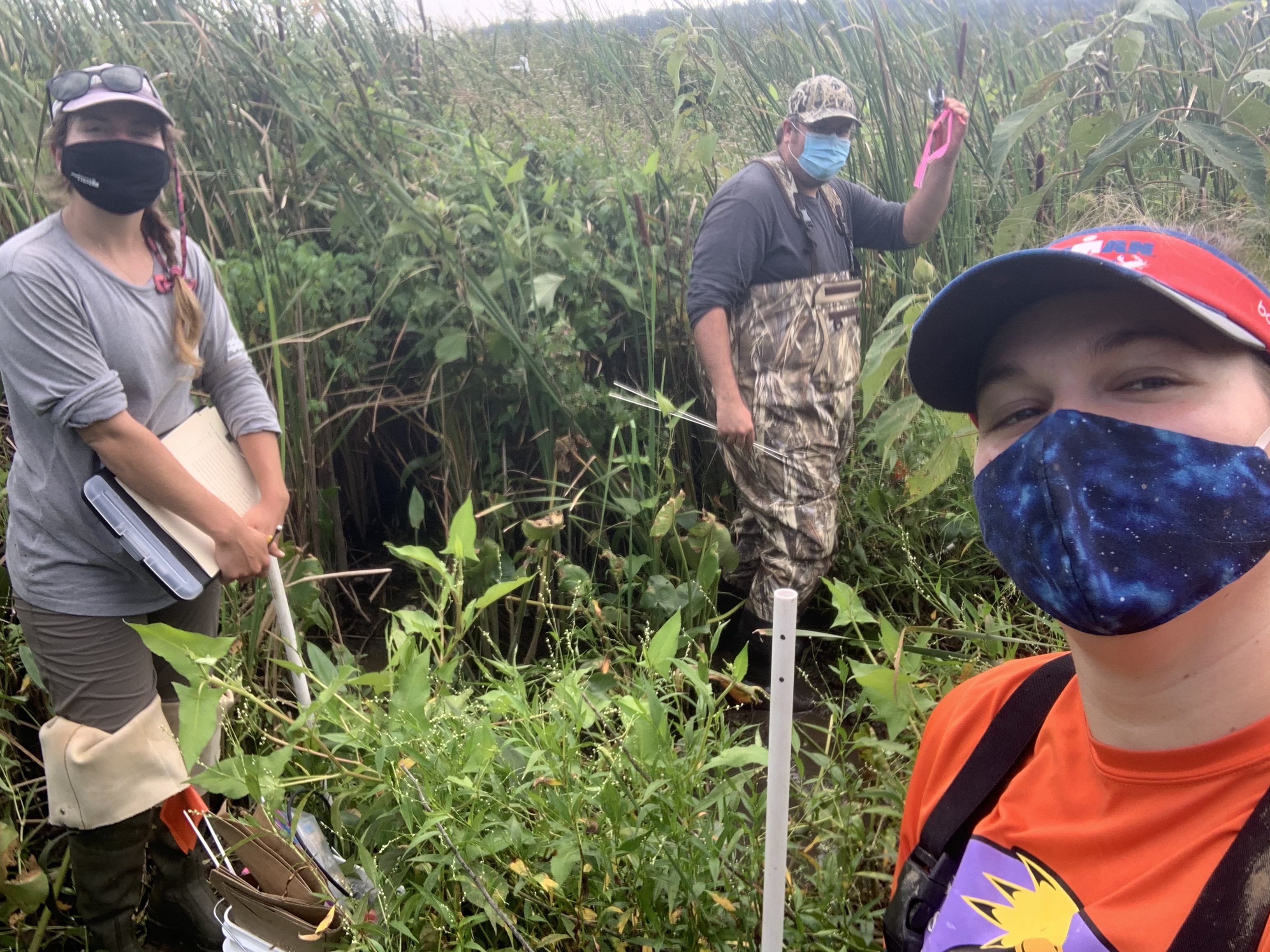
Erika Koontz (right) pauses for a selfie with Shelby Cross (left) and Kyle Derby (center) while doing methane sampling in Maryland’s Jug Bay, one of the few sites she could visit in-person during the pandemic. (Credit: Erika Koontz)
This article is part of a series of posts highlighting research the Smithsonian Environmental Research Center is continuing to do amid the COVID-19 pandemic, and adaptations its staff have been making in a more socially distant world.
Like many scientists, Erika Koontz was hired for a specific project. She had just begun a job as a technician with the Smithsonian Environmental Research Center’s Biogeochemistry Lab. Her new supervisor, James Holmquist, had an ambitious goal in mind: Uncover how wetlands across the U.S. store—or emit—the powerful greenhouse gas methane. They called it the Blue Methane project.
“It’s a dataset that’s really never been attempted before, to be housed under one single project,” Koontz said. During field season, Koontz would visit wetlands on the East, West and Gulf Coasts, sampling methane in their porewater and measuring the flux of methane into and out of their soils.
Koontz started her job in March 2020. Enough said on that subject.
The next six months were some of the busiest of her life.