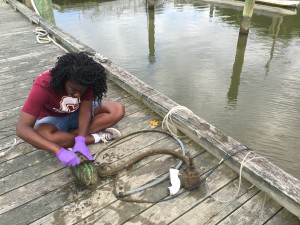
SERC intern Jasmin Graham cleans her equipment of marine organisms (Photo: Emily Li/SERC)
by Emily Li
Watching educational programs like Animal Planet or That’s My Baby—a series that documents pregnant animals—might evoke memories of flickering classroom projectors for most. But for Jasmin Graham, an intern with the Smithsonian Environmental Research Center (SERC), these shows were her childhood. Her love for marine science and wildlife followed her through high school science fairs and university research on shark genetics at the College of Charleston. Now, at an internship with SERC’s Ocean Acidification Lab, she studies acidification not in the open ocean, but in a far more dramatic arena, where the marine celebrities she grew up with may be at risk.
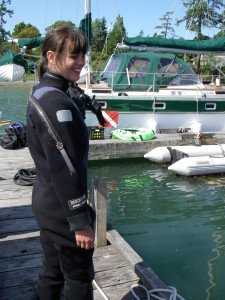
Christina Simkanin prepares to dive to survey ascidians. (Credit: Natalia Filip, University of Victoria, BC, Canada)
by Emily Li
Smithsonian biologists are on the trail of invasive ascidians. But with roughly 2300 species worldwide, describing these marine filter feeders (also known as “tunicates” or “sea squirts”) for a Most Wanted sign is tricky. Some ascidians are solitary; some are social. Some breed sexually, some asexually. Some, like Botrylloides magnicoecum, form large colonies of what look like octopus tentacles ringed in gold and highlighter blue. Others, like Rhopalaea crassa, resemble a cross between ghostly butterfly cocoons and pastel-colored pencil grips, while Polycarpa aurata is bulbous and mustard-yellow, with navy-blue veins that flare into trumpets.
When they invade new territory, ascidians can leave trails of damage in their wakes—but not always in ways scientists predict. In a new study published in the July issue of Marine Biology, a team of Smithsonian researchers, including marine ecologist Christina Simkanin of the Smithsonian Environmental Research Center (SERC), tracked their invasions across North America.
What they found seemed simple at first: North America’s 26 non-native ascidian species have spread so much they’re now established along nearly 3000 miles of its coastlines. But a few surprises were hiding in the details.
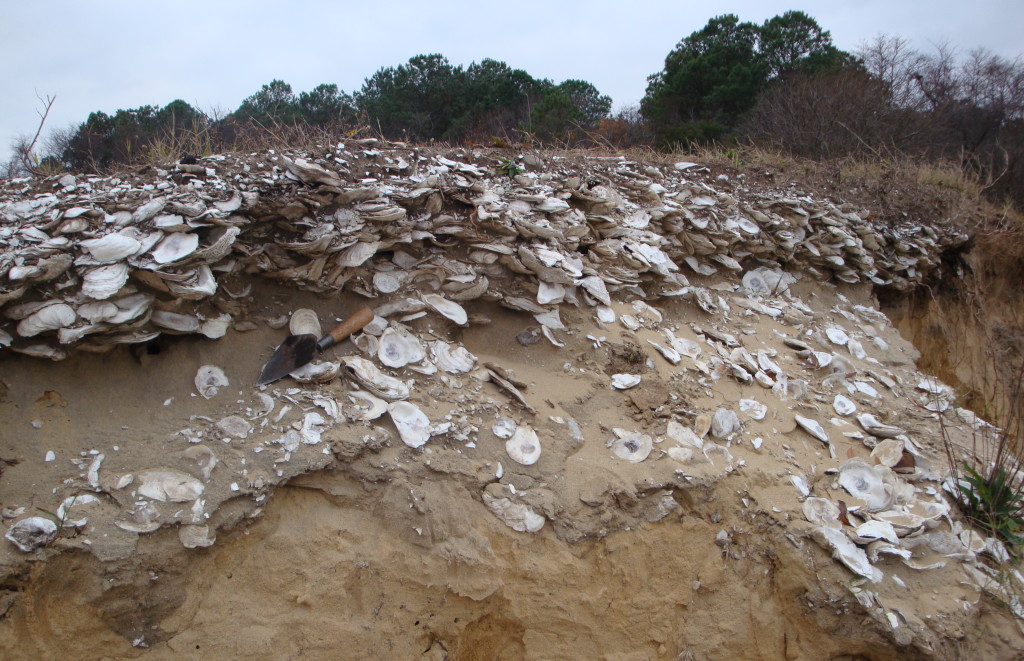
Typical American Indian oyster deposit, roughly 1,000 years old. (Torben Rick/Smithsonian)
by John Gibbons
Oysters have provided food for humans for millennia, and play an enormous role in sustaining estuaries around the world. Yet after more than a century of overfishing, pollution, disease and habitat degradation, oyster populations in the Chesapeake Bay and elsewhere have suffered dramatic declines. But for thousands of years,American Indians in the region harvested the shellfish from the Bay sustainably—a discovery published Monday that could offer clues for future oyster restoration.
Little is known about oyster populations prior to the late 1800s. On May 23 a team of Smithsonian scientists and other researchers published the first bay-wide, millennial-scale study of oyster harvesting in the Chesapeake in Proceedings of the National Academy of Sciences. Using fossil, archaeological, and modern biological data, the team was able to reconstruct changes in oyster size from four timeframes: the Pleistocene (780,000-13,000 years ago), prehistoric American Indian occupation (3,200 – 400 years ago), historic (400 – 50 years ago) and modern times (2000 to 2014).
Fish provide protein to billions of people and are an especially critical food source in the developing world. Today, marine biologists confirmed a key factor that could help them thrive through the coming decades: biodiversity. Communities with more fish species are more productive and more resilient to rising temperatures and temperature swings, according to a new study from the Smithsonian’s Tennenbaum Marine Observatories Network and other international institutions.
The accelerating loss and rearrangement of species all over the globe have troubled scientists and the public for decades. But the question of whether biodiversity offers practical value—for humans and ecosystems—remained controversial. The new study, published May 16 in the Proceedings of the National Academy of Sciences, offers the most thorough proof yet that preserving marine biodiversity can benefit people as much as it benefits the oceans.
“Biodiversity is more than a pretty face,” said lead author Emmett Duffy, director of the Tennenbaum Marine Observatories Network and senior scientist at the Smithsonian Environmental Research Center. “Preserving biodiversity is not just an aesthetic or spiritual issue—it’s critical to the healthy functioning of ecosystems and the important services they provide to humans, like seafood.”
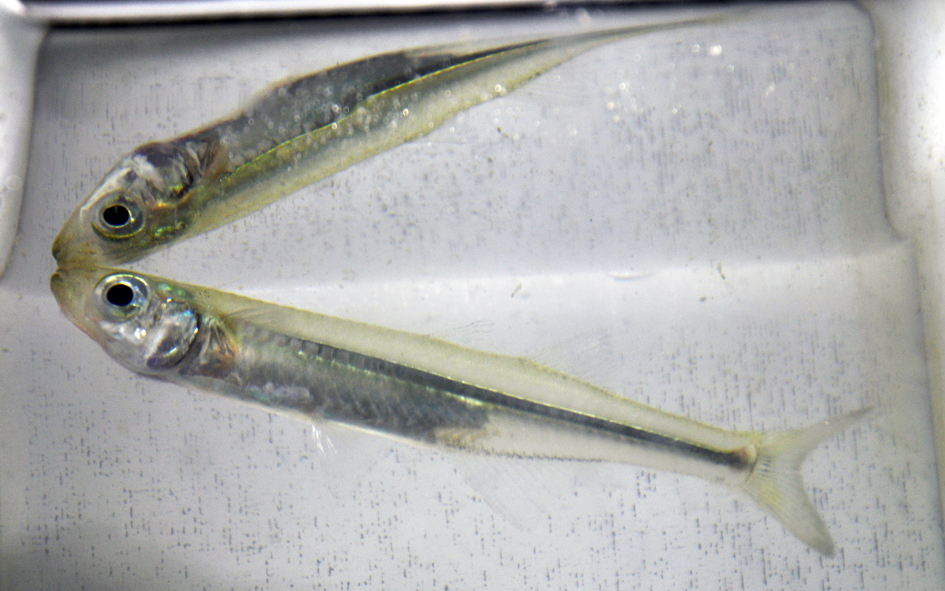
Inland silverside (Menidia beryllina) reflected in aquarium. When threatened with low oxygen, fish often swim to the surface, where oxygen is more abundant but predators can more easily spot them. (SERC)
Severe oxygen drops in the water can leave trails of fish kills in their wakes, but scientists thought adult fish would be more resilient to the second major threat in coastal waters: acidification. A new study published Tuesday from the Smithsonian Environmental Research Center (SERC) shows that is not entirely true—where fish are concerned, acidification can make low oxygen even more deadly.
Winter storm Jonas is knocking on our doorsteps here on the East Coast, threatening blizzard conditions in some areas. Many of us will be hunkering down waiting for the storm to pass. We thought we’d create some fun Chesapeake Bay inspired snowflake designs for you and your family to create during the storm. Simply download the pdfs, print them out and follow the instructions at the bottom.
There are four designs to choose from, the easiest being the cownose ray and the most difficult being the blue crab. We’ve provided a blank template for you to create your own Chesapeake Bay or nature inspired design. Since this requires the use of scissors, parents please assist small children.
We’d love to see your snowflakes – be sure to post pictures of your snowflakes on our Facebook page or on Twitter!
It’s been another wild year at the Smithsonian Environmental Research Center. We sent a sailboat to the Arctic, pitted our orchids in a showdown against the Hope Diamond and discovered a couple new species. And somewhere along the way we celebrated the center’s 50th anniversary. Scroll below for the 2015 #YearInReview, a collection of the top 12 stories, journeys and biggest surprises of 2015.
Cownose Rays (SERC/Laura Patrick)
Exploring the Ocean
Totes Adorbs! Cownose Rays Take Internet
These marine heartthrobs have earned a top billing. Besides making a 900-mile migration every year, which SERC marine ecologists are tracking with acoustic tags, the kite-shaped rays (whose mouths are stretched so that they seem to be wearing a perpetual smile) also won a Twitter #CuteOff in September.
What Does Life in the Ocean Sound Like?
Postdoc Erica Staaterman listens to the ocean for a living. Often seen as a silent landscape broken only by whale or dolphin songs, Staaterman is helping uncover a wealth of noise from the ocean’s hidden creatures. She shared some of the recordings with us in this edited Q&A.
Cruising the Arctic’s Forgotten Fjords
Ocean acidification researcher Whitman Miller sent one of his CO2-monitoring devices on a 100-day journey to the Arctic. Its mission: Venture to some of Greenland’s never-before-seen fjords and discover how melting glaciers are changing the water. And do it all in a small, 42-foot sailboat. Click to continue »
Last week Nature magazine published a news piece about how supplies of agar, a research staple in labs around the world, are dwindling. Agar is a gelatinous material from red seaweed of the genus Gelidium, and is referred to as ‘red gold’ by those within the industry. Insiders suggest that the tightening of seaweed supply is related to overharvesting, causing agar processing facilities to reduce production. Most of the world’s ‘red gold’ comes from Morocco. In the 2000s, the nation harvested 14,000 tons per year. Today, harvest limits are set at 6,000 tons per year, with only 1,200 tons available for foreign export outside the country. In typical supply and demand fashion, distributor prices are expected to skyrocket. As a result, things could get tough for scientists who use agar and agar-based materials in their research.
Agar is a scientist’s Jell-O. Just like grandma used to make Jell-O desserts with fruit artfully arranged on top or floating in suspended animation within a mold, scientists use agar the same way. Bacteria and fungi can be cultured on top of nutrient-enriched agar, tissues of organisms can be suspended within an agar-based medium and chunks of DNA can move through an agarose gel, a carbohydrate material that comes from agar. Agar and agar products are the Leathermans of the science world.
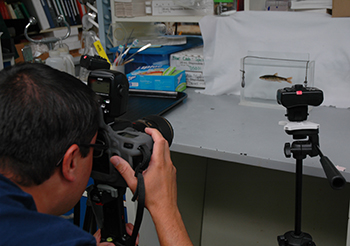
Rob Aguilar takes photos of all DNA barcoding reference specimens they collect in the Chesapeake Bay
Rob Aguilar of SERC’s Fish and Invertebrate Ecology Lab co-authored a DNA barcoding paper this past September in the journal Environmental Biology of Fishes. Rob spoke with us about his paper and the DNA barcoding work going on in the Fish and Invertebrate Lab. While the term DNA barcoding may seem difficult to understand, it’s easiest to think about it as a uniquely identifiable species level code.
Click the sound file below to listen to the interview.
Additional barcoding details are available in the full podcast transcript.
Erica Staaterman selfie with a baby larval snapper. (Erica Staaterman)
by Kristen Minogue
Dr. Erica Staaterman listens to the ocean for a living. Often seen as a silent landscape broken only by whale or dolphin songs, Staaterman is helping uncover a wealth of noise from the ocean’s hidden creatures, first in California and now in the Chesapeake as a postdoc for the Smithsonian Environmental Research Center. Learn more in the edited Q&A below, and click the sound files to hear some of the secret sounds of the sea.
How did you get into acoustic ecology?
My first research job out of my undergrad was working for Sheila Patek at UC Berkeley….She had a bunch of recordings of these [California spiny] lobsters making sound, and nobody really understood why they make sound. So we did an experiment where we tried to understand the function of the sounds made by these lobsters. So anyway, that was sort of my first foray into acoustics, and from there I just thought it was really fascinating.
In California, you described researching a chorus of mantis shrimp. What did that sound like?
We called them rumble groups. Sometimes they would have two rumbles per group, sometimes three rumbles per group, sometimes four or five….At dawn and dusk you would hear so many different rumble groups occurring at the same time that they would all be sort of overlapping, and it seems to indicate that there are many individuals making sound at the same time, just the way birds all sing out at once in air.



![Erica Staaterman in the [X] with baby [X].](https://sercblog.si.edu/wp-content/uploads/2015/11/withbabyfish_brightened.jpg)