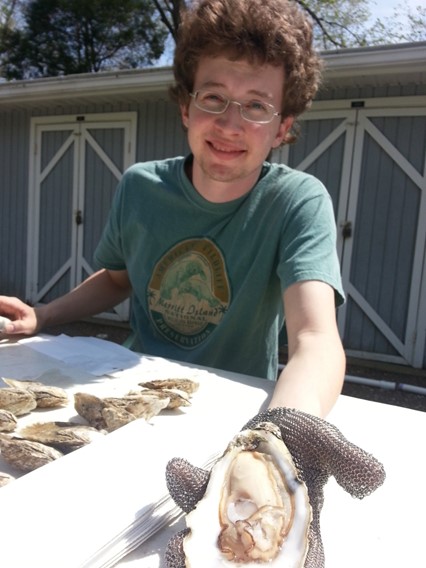
Slide of an oyster completely infected with Dermo.
Oysters in Chesapeake Bay face more dangers than overfishing and habitat loss. Over the last few decades they’ve also had to contend with crippling disease outbreaks. And according to marine ecologist Denise Breitburg, the wild day-night fluctuations in Bay waters aren’t helping.
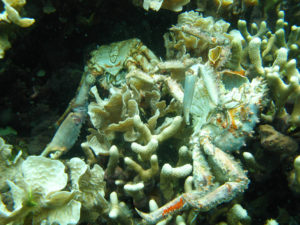
Infected crab. The sacs on its abdomen contain thousands of parasite larvae the crab will later release into the water.
The world is full of parasites that can force their hosts to do strange things. One such parasite lurks in Chesapeake Bay: an invasive barnacle that hijacks a mud crab’s reproductive system and impregnates it with parasite larvae—even if the crab is male.
The invasive parasite Loxothylacus panopaei (Loxo for short) is a type of barnacle, but looks and acts nothing like the typical barnacles growing on rocks along the shoreline. Loxo has a highly evolved life cycle, essentially custom-made for acting as a crab parasite. As a free-swimming larva, Loxo resembles a typical barnacle larva. A female larva infects a recently molted crab by burying into its shell. Once inside, she undergoes a series of changes and assumes control over the host crab, dictating major functions such as molting and reproduction.
The waters beneath mangroves are teeming with marine life, in part due to the refuge provided by the tangled complexity of their underwater roots. (Cora Johnston)
From salty branches to mucky roots, mangroves are teeming with life. Although many people recognize mangroves as spindly trees emerging right out of the water, it is under the water’s surface that mangroves really come alive for a marine ecologist like me. (That is also where you start to appreciate red mangroves’ apt name.)
Mangrove roots, both dangling from above (prop roots) and growing up from the sand (pneumatophores), not only mine for nutrients and allow for oxygen and carbon dioxide exchange for the plant; they also provide apparently crucial food and refuge for a stunning array of marine species. Fish, worms, crabs, shrimp, barnacles, and many other organisms take shelter among the roots – gluing right to the wood, hiding in crevices, and peering out through the maze. In such harsh intertidal conditions, where waves break, salt builds up, and the sun beats down, the shade and nooks formed by mangroves may be the key to survival for juvenile fish and crustaceans that will someday populate coral reefs and fishing hotspots farther offshore.
Over the coming months, I will be investigating how and why young fish and crustaceans use mangroves and marshes. By understanding the refuge provided by these very different coastal plants, I hope to better understand how the northward march of mangroves will influence the survival, abundance, and composition of marine species utilizing these now changing coastal nurseries.
Juvenile fish and crustaceans find safety in red mangrove roots during the early, vulnerable stages of their life. This young barracuda may be looking for a snack while hiding from larger predators. (Cora Johnston)
Even mangrove tree crabs that spend most of their time foraging in the canopy climb down to the safety of the mangrove roots to shed their old exoskeletons and harden their new ones. (Cora Johnston)
Few creatures in Chesapeake Bay have experienced the kind of whiplash felt by the blue crab. Having gone through a near-disastrous decline that lasted almost two decades, they made a dramatic comeback starting in 2009. But before managers could proclaim it a success, the numbers fell again. And this time, the reasons aren’t so clear.
Some species can survive just about anywhere. Take blue mussels, a group of shellfish whose habitat stretches from the Arctic to the Mediterranean. Over the last several decades, biologists have thrown all kinds of tests at them – heat, cold, saltwater, freshwater, low oxygen. They’ve even tried drying them out. Almost nothing fazes these animals. For invasion scientists trying to figure out how far they could spread, that’s a scary prospect. Click to continue »
Bat infected with deadly white-nose syndrome. (U.S. Fish and Wildlife Service)
The last Western Black Rhino appeared in Cameroon in 2000. Now they’re gone, according to the International Union for Conservation of Nature, which declared the rare subspecies officially extinct Nov. 10. As thousands more species go extinct across the world every year, the Chesapeake Bay watershed is fighting to save its own endangered flora and fauna. Maryland counts 362 plants and animals on its endangered list – and that’s not including the ones that have already been wiped out from the state. Whales, bats, turtles and orchids: here are six of Chesapeake’s most wanted. Click to continue »
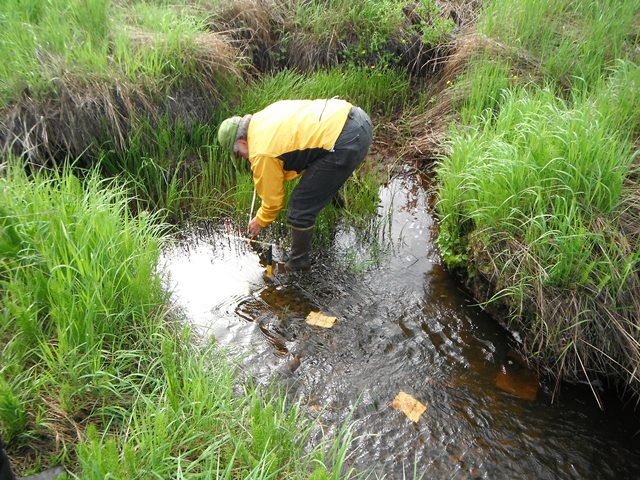
Intern Ginny Leviton (left) and Vienna Saccomanno sample groundwater from a drainage ditch, trying to pin down the exact spot where the nitrogen goes missing. (Credit: Tom Jordan)
The Choptank watershed has SERC researchers baffled. On the eastern shore of Chesapeake Bay, roughly a 75-minute drive from SERC, the groundwater flowing into the Choptank River passes through a cornfield – a likely source of nitrogen, a nutrient that can wreak havoc on the Bay’s ecosystem if it runs too high. But something is happening to the nitrogen here before it reaches the Bay. Nutrient ecologist Tom Jordan and his research team have spent the better part of a year trying to figure out what. Click to continue »
As summer wanes in the Chesapeake Bay, many female blue crabs are preparing for an epic journey. Come September they will walk and swim their way toward the mouth of the Chesapeake to release their eggs. Some will travel more than 150 miles. SERC scientists have studied the blue crab’s migratory patterns for more than a decade. Their findings have revealed new insight into the life history of this important species and have helped inform management policies. Tracking these invertebrates is not easy: it involves thousands of pink plastic tags, a unique collaboration with watermen and a blue crab hotline…
SERC senior scientist Denise Breitburg will lead the NOAA-funded study of hypoxia and acidification in the Chesapeake Bay.
Marine ecologist Denise Breitburg and her colleagues have thought up many novel ways to investigate the impacts of dead zones and acidification on Chesapeake Bay fish and invertebrates. Among their ideas: attaching tiny transmitters to fish and monitoring their movement in relation to oxygen and pH levels. A new $1.4 million grant from the National Oceanic and Atmospheric Administration will enable them to pursue this experiment and a host of others. Click to continue »
If you’re a fish or crab living in the Chesapeake Bay, it’s quite possible that at some point during your life, you’ll make your way into one of the creeks, rivers or subestuaries that feed the Chesapeake. These areas provide important nursery and spawning habitat for many of the Bay’s aquatic residents. For more than 25 years, researchers from the Smithsonian Environmental Research Center’s Fish and Invertebrate Ecology Lab have taken a weekly survey of the species that make their way into and out of one of these creeks. Its name is Muddy Creek and it feeds into the Rhode River, which flows into the Chesapeake Bay.
To survey the animals swimming up and down Muddy Creek, the researchers use a fish weir — an expanse of nets, gates and boardwalks — that temporarily blocks aquatic traffic. Once a week, the researchers close the weir, set out the nets and identify and count all the species that get trapped. Their data go back to 1983.
This type of fine-scale surveying, that’s done on a weekly basis, is rare. It’s even more unique to have such long-term data. Many ecological studies are funded for just a few years at a time. These short time frames can make it difficult for scientists to observe changes and patterns in species populations and composition.
Human activity and environmental conditions can affect which species are swimming in Muddy Creek. The water is brackish and salinity levels change seasonally and from year to year. During winter and early spring, when freshwater flow is usually the highest, researchers will generally catch more freshwater species like bluespotted and banded sunfish – two protected species in Maryland. During periods of high salinity, researchers can catch many species indicative of the higher saline lower Bay such as, red drum, spotted sea trout, and Spanish mackerel.
In honor of the 2010 U.S. Census, we thought we’d share photos from one of this month’s surveys. The salinity on this April day was fairly low (~ 5 ppt) and nearly a dozen golden shiners (a freshwater minnow) were caught along with several estuarine-resident and a few diadromous (fish that migrate between fresh and saltwater) species. Among the highlights: a sizeable snapping turtle, many white perch in spawning condition, juvenile American eels and a parasite.
You can read more about SERC’s Muddy Creek survey on our Web site.